




Is It Legal to Call Abandoned Carts? TCPA Rules for AI Calls
Yes, with prior express written consent. The FCC treats AI voices as artificial voices, so cart calls also need set hours, an opt-out and DNC checks.

Yes, with written consent and four other conditions
Update, Nov 17, 2026: On Feb 25, 2026, the Fifth Circuit ruled in Bradford v. Sovereign Pest Control that the TCPA itself does not require written consent, even for prerecorded sales calls, so oral or written consent both count. The ruling binds federal courts in Texas, Louisiana and Mississippi, and Florida, Oklahoma and Maryland still require written consent under state law. The written consent setup below is the strictest standard and still works everywhere. What the ruling means for cart calls, and the one line we now recommend: no written consent needed, court rules.
Yes, you can call shoppers who abandon checkout. Under the FCC's rules, an AI-voiced call that encourages them to finish the purchase needs their prior express written consent first. The FCC ruled in February 2024 that AI-generated voices are "artificial" voices under the Telephone Consumer Protection Act (TCPA), and the federal rules require written consent for artificial-voice sales calls to cell phones and home lines.
Consent is the first gate, not the only one. The call has to land inside the shopper's local calling hours, name your business at the start, offer an automated way to opt out, and stop for good once the shopper says stop. Several states add tighter hours and call limits on top.
This covers US rules as of Oct 16, 2026. It is general information, not legal advice; check your flows with counsel before you dial.
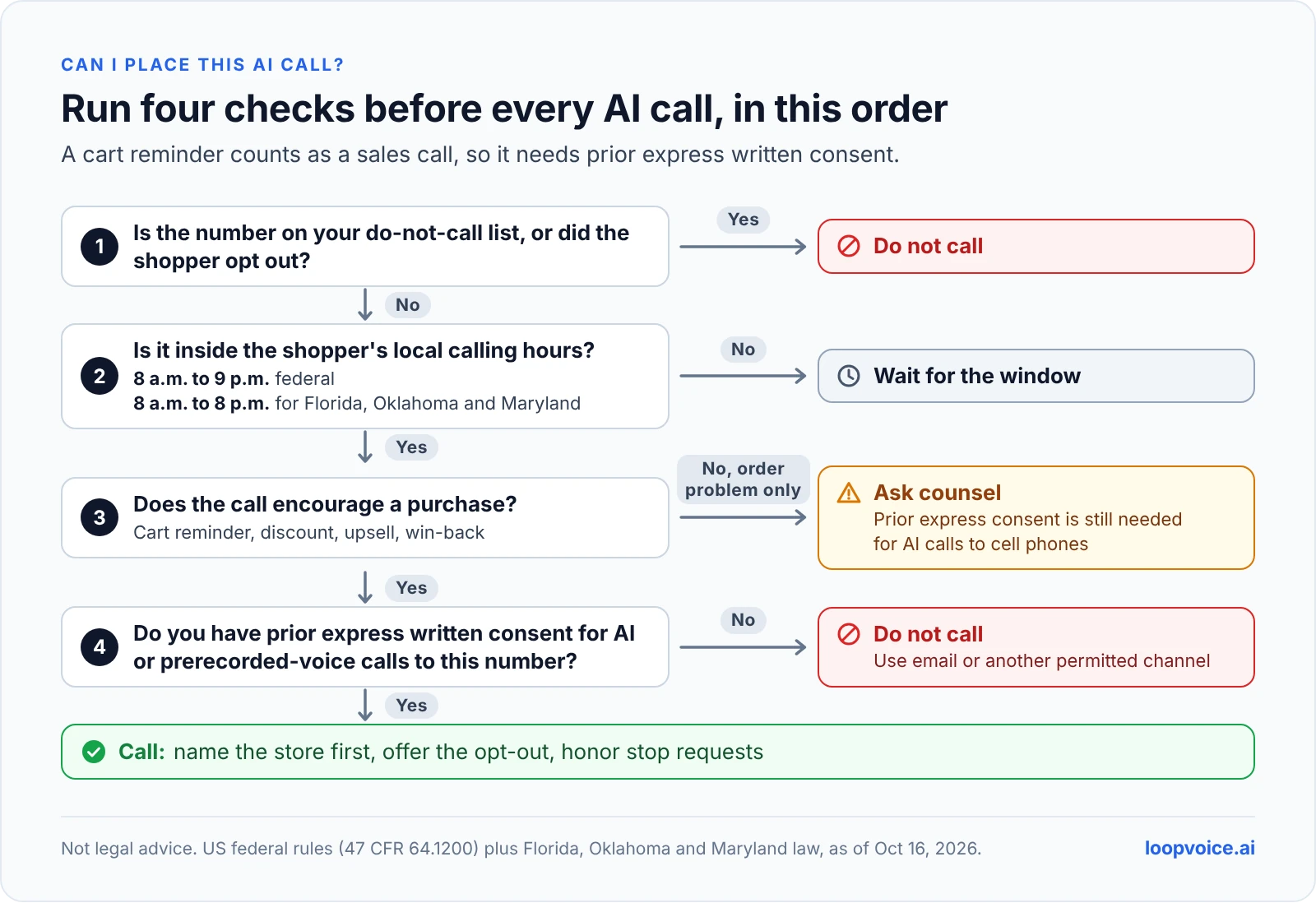
Which consent covers which call
Federal rules split calls by purpose and by the line you reach. The four rows that matter for a store, all from 47 CFR 64.1200:
| The call | Consent needed for an AI or prerecorded voice | Where the rule sits |
|---|---|---|
| Cart reminder, discount, upsell or win-back to a cell phone | Prior express written consent | 64.1200(a)(2) |
| The same sales call to a home landline | Prior express written consent | 64.1200(a)(3) |
| A problem with an order already placed (a delivery problem, an address question) to a cell phone | Prior express consent | 64.1200(a)(1)(iii) |
| The same informational call to a home landline | None, if you make no more than 3 such calls in 30 days and honor opt-outs | 64.1200(a)(3)(iii) |
A cart reminder counts as a sales call because the rule defines telemarketing as a call made "for the purpose of encouraging the purchase" of goods. Adding a discount code makes that clearer, not less clear. Shoppers rarely care about the label; regulators and plaintiffs' lawyers read the script.
Prior express written consent is a signed written agreement, where an electronic signature counts, that clearly lets your store deliver telemarketing calls using an autodialer or an artificial or prerecorded voice to one specific phone number. It must include a clear and conspicuous statement that the shopper does not have to agree as a condition of buying anything.
Prior express consent is a lower bar, but you still need to show the shopper agreed to be called at that number. Written consent does not come from an existing customer relationship: the federal artificial-voice rule for sales calls has no exception for past buyers, so a repeat customer needs the same written consent as a first-time shopper.
An AI agent is an artificial voice, even when it holds a conversation
The FCC's Declaratory Ruling FCC 24-17 settled the question for the agency: the TCPA's restrictions on "artificial or prerecorded voice" calls "encompass current AI technologies that generate human voices." The ruling also says the TCPA does not allow "any carve out of technologies that purport to provide the equivalent of a live agent."
That second line closes off the argument that a conversational agent that listens and answers is closer to a person than to a robocall. For consent purposes, treat every AI-voiced call as a robocall. The ruling's own footnote points to the written-consent rule whenever the call includes an advertisement or telemarketing.
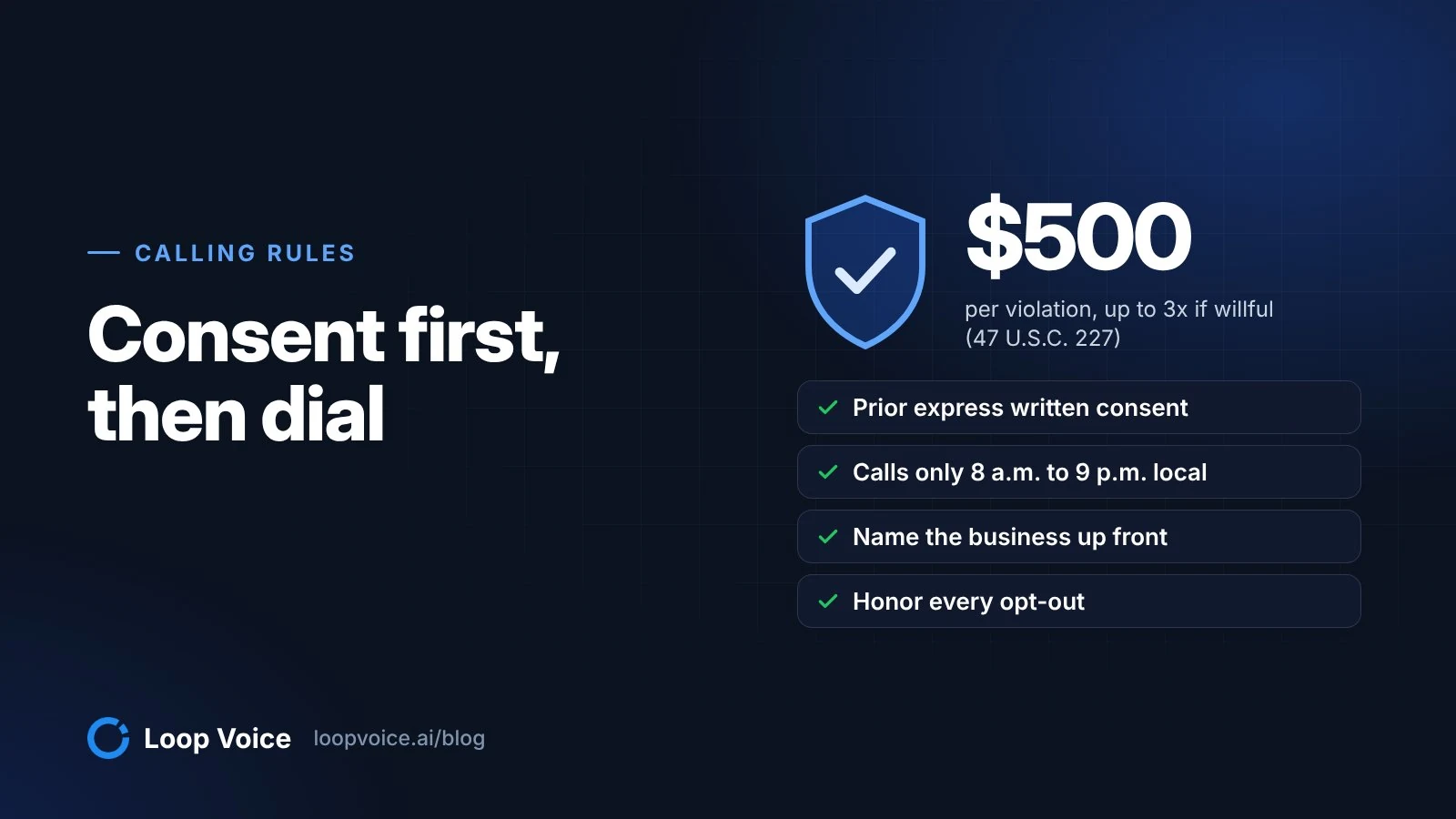
Penalties come from the statute itself. 47 U.S.C. 227 lets a person sue for actual losses or $500 for each violation, whichever is greater, and a court can triple that if the violation was willful or knowing. Each call can be a separate violation, which is why a flow that dials thousands of numbers without valid consent turns into a class action, not a fine.
What a consent checkbox can look like
The text below is an example to show the required elements, not legal advice. Have counsel adapt it to your store, your channels and your states.
| Example checkbox, unticked by default, placed directly under the phone field |
|---|
| [ ] Yes, call and text me about my cart, orders and offers. By checking this box, I agree that [Registered Store Name] may call and text me at the number above, including calls made with an AI-generated or prerecorded voice and automated technology. Consent is not a condition of purchase. Message and data rates may apply. Reply STOP to texts or say "stop calling" on any call to opt out. See our Terms and Privacy Policy. |
What each part does:
- Names the seller and the number. The written-consent definition requires an agreement that authorizes your business to call one specific number.
- Says AI or prerecorded voice out loud. The agreement must clearly cover calls made with an artificial or prerecorded voice or an autodialer, not just "updates".
- States that consent is not required to buy. This disclosure is mandatory under the federal definition, and Florida's and Oklahoma's definitions require it too.
- Uses a real action as the signature. Federal rules accept electronic signatures valid under federal or state law, and Florida's statute lists "checking a box indicating consent" as a signature.
- Stays separate. Keep it apart from your terms-of-service checkbox, and never pre-tick it.
The Shopify catch. Shopify's built-in marketing opt-in lives under Settings > Checkout > Marketing opt-in, and its help page says a shopper's SMS subscription choice is saved only when they submit the checkout. A shopper who ticks a box and then abandons may leave no saved consent at all, which is exactly the person you wanted to call. Collect call consent somewhere it is saved before they can leave, such as a sign-up form or account page that writes to the customer profile, and test it: tick the box, abandon a checkout, then open the customer record and confirm the consent and timestamp are there.
Keep a record for every number: the phone number, the exact wording and version shown, the page URL, the timestamp, and any later opt-out. If a shopper disputes consent, that record is your defense.
Calling hours, call limits and time zones
Federal law sets the outer limit, and three states with their own laws pull it in:
| Where the shopper is | Allowed calling hours, shopper's local time | Call limit | Source |
|---|---|---|---|
| Anywhere in the US | 8 a.m. to 9 p.m. | No federal per-day cap | 47 CFR 64.1200(c)(1) |
| Florida | 8 a.m. to 8 p.m. | 3 sales calls in 24 hours on the same subject | Fla. Stat. 501.616(6) |
| Oklahoma | 8 a.m. to 8 p.m. | 3 sales calls in 24 hours on the same subject | 15 O.S. 775C.4 |
| Maryland | No calls between 8 p.m. and 8 a.m. | 3 calls in 24 hours on the same subject | Md. Com. Law 14-4502(c) |
Florida and Oklahoma law both presume that a sales call to one of their area codes reaches a resident, so use the phone number's area code and the shipping address together when you decide which window applies. Florida's hour and call limits sit in its telemarketing act, and that act's exemption list expressly keeps those two limits in force even for callers it otherwise exempts.
The setting that satisfies every row above: call between 8 a.m. and 8 p.m. in the shopper's local time, and never more than three times in 24 hours. Most recovery flows need far fewer attempts than that anyway; the cart recovery call playbook covers which carts are worth a second call.
The first ten seconds of the call
The federal rules for artificial-voice calls are specific about the opening:
- Name the business at the beginning. The rule asks for the name the business is registered under with the state. If your store brand differs from your legal entity, make sure the name the agent says is a registered trade name.
- Give a phone number during or after the call that the shopper can use to reach you, and to ask not to be called again.
- Offer an automated opt-out within two seconds of the identification on any telemarketing call: a spoken or keypress option, with brief instructions. When the shopper uses it, the number must go on your do-not-call list and the call must end immediately.
- On voicemail, include a toll-free number that connects to the same automated opt-out.
Do not let the agent claim to be human. Utah's 2025 AI disclosure law requires a business using generative AI in a consumer transaction to say so when a person clearly asks, and gives a safe harbor to businesses that disclose it clearly at the outset and throughout the interaction. Opening with "the AI assistant for" your store costs one second and removes the question.
Example opening line, not legal advice: "Hi Maria, this is the AI assistant for [Registered Store Name]. If you'd rather not get calls from us, say 'stop calling' at any time. I'm calling about the checkout you started this afternoon, and this call is recorded. Do you have a minute?"
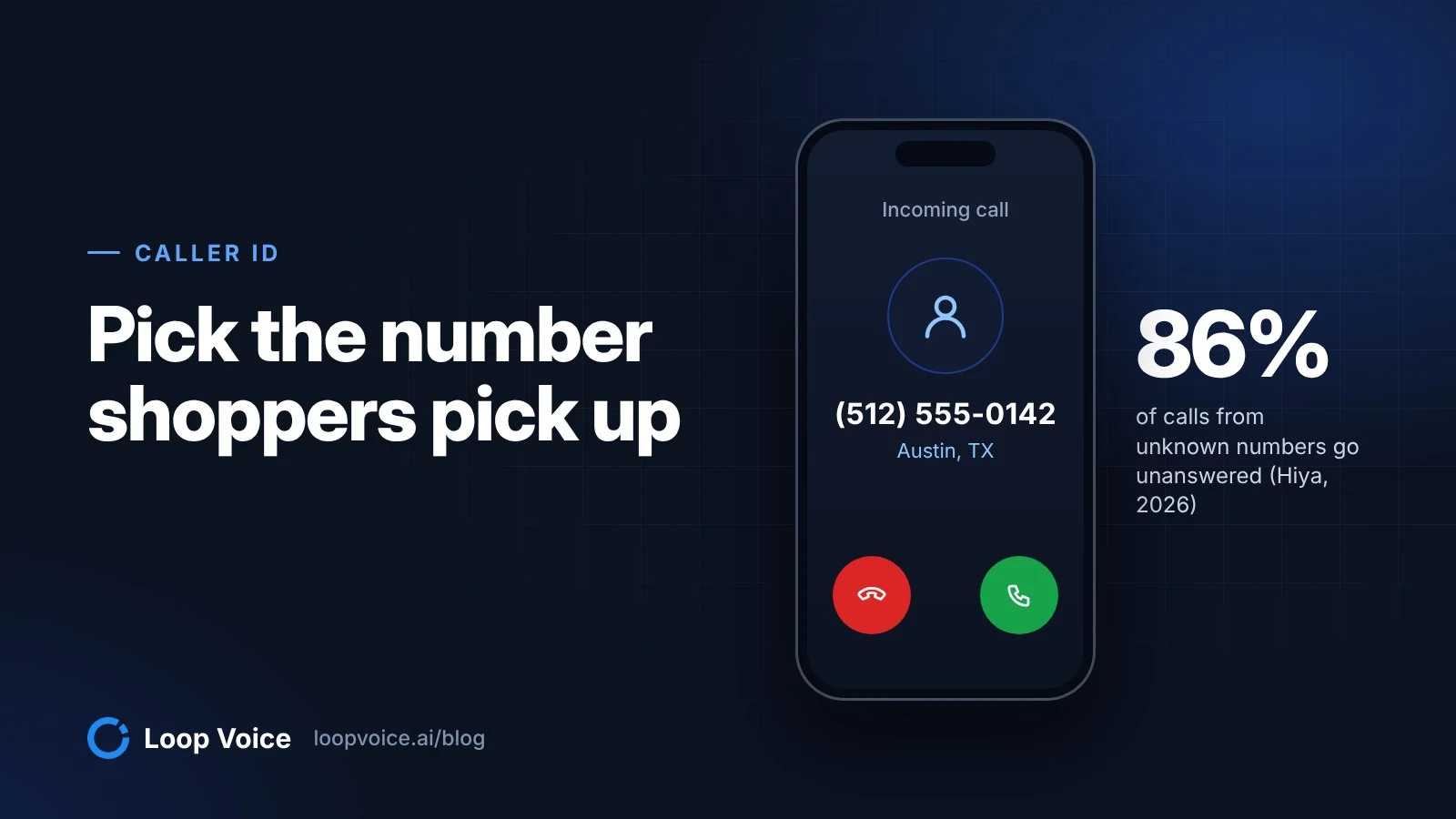
The rest of the call, from asking what stopped checkout to texting the link, is in our cart recovery script template. Caller ID matters too: Florida, Oklahoma and Maryland all require sales calls to show a caller ID number, Florida and Oklahoma require that number to accept calls back, and our caller ID guide covers local versus toll-free numbers.
When a shopper says stop, in any words
Under 64.1200(a)(10), a shopper can revoke consent by any reasonable method, and you must honor it within a reasonable time that cannot exceed 10 business days. Some methods count automatically: the automated opt-out on a call; replies of "stop," "quit," "end," "revoke," "opt out," "cancel" or "unsubscribe" to a text; or a website or phone number you designate for opt-outs. You may not make any one of them the only way to opt out.
Other channels count too. A voicemail or email to a number or address meant to reach you creates a rebuttable presumption that the shopper revoked consent. In practice, "take me off your list," "don't call again" and "I'm not interested, stop" all mean the same thing, and a support ticket that says it is an opt-out.
You also need an internal do-not-call list for telemarketing and for certain artificial-voice calls: a written policy available on request, staff trained on it, every request recorded when it is made, and each request honored for 5 years (64.1200(d)).
What is changing. In an order released Oct 1, 2026, the FCC lets callers designate an exclusive opt-out method, chosen from three approved types and disclosed clearly on every call or text, and lets them treat an opt-out from an informational message as covering only that category. An opt-out from marketing still ends all marketing calls and texts. Per Latham & Watkins' summary, the order takes effect 30 days after it is published in the Federal Register, and we found no publication there as of Oct 16, 2026. Until it takes effect, honor stop requests however they arrive.
The National Do Not Call Registry
The registry is run by the FTC, and its rules apply to sales calls whether a person or an AI places them. You can call a number on the registry only with an exception: the shopper's signed, written agreement to be called by your store at that number, or an established business relationship. The FTC's Q&A for sellers sets that relationship at 18 months after the shopper's last purchase, delivery or payment, or three months after an inquiry or application, and it ends the moment they ask you not to call.
For AI-voiced sales calls you need written consent anyway, so the relationship exception rarely helps. The registry still matters in three ways:
- Access is required. The FTC says a seller can be liable for any telemarketing call, even to numbers not on the registry, unless it has accessed the registry and paid any required fees.
- It has a price. Data for up to five area codes is free. From Oct 1, 2026 each additional area code costs $85 a year, up to $23,425 for the full list.
- It goes stale. If you are required to use the registry, you must sync your call lists with it at least every 31 days.
The FTC lists fines of up to $53,088 per violation, and each call can count separately.
States with rules stricter than federal law
Florida, Oklahoma and Maryland have their own versions of the TCPA, each with a private right of action:
| State | Consent rule for automated sales calls | Hours and limits | Damages |
|---|---|---|---|
| Florida (501.059) | Prior express written consent for unsolicited sales calls that use an automated system to select and dial numbers or play a recorded message | 8 a.m. to 8 p.m., 3 calls in 24 hours (501.616) | Actual damages or $500 per violation, up to 3x if willful |
| Oklahoma (Telephone Solicitation Act of 2022) | Prior express written consent for calls using an automated system to select or dial numbers or play a recorded message | 8 a.m. to 8 p.m., 3 calls in 24 hours | Actual damages or $500, up to 3x if willful |
| Maryland (Com. Law 14-4502) | Prior express written consent for solicitations using an automated system to select or dial numbers or play a recorded message | No calls 8 p.m. to 8 a.m., 3 calls in 24 hours | Up to $500, up to 3x if willful (14-4503) |
All three also require sales calls to transmit the originating number or the seller's customer service number to caller ID. Florida's definition of an "unsolicited" call leaves out calls to people you already do business with, but the federal artificial-voice rule has no such exception, so the written-consent standard still governs.
Other states have their own telemarketing registration rules and do-not-call lists. Before you call a new state at volume, have counsel check it.
Recording the call
Federal law allows recording with one party's consent, but the Reporters Committee's recording guide counts about 11 states that primarily require every party's consent: California, Delaware, Florida, Illinois, Maryland, Massachusetts, Michigan (at least for recordings by someone not in the conversation), Montana, New Hampshire, Pennsylvania and Washington. Connecticut and Nevada also require all-party consent for phone calls.
The practical rule for a store calling nationally: announce the recording near the start of every call. The guide notes that when parties are warned a call is recorded and keep talking, consent is generally presumed. If you would rather not announce it, turn recording off for those calls.
Texts that follow the call
Texting the checkout link during or after a call is a separate message, and the consent and opt-out rules above cover texts too. The consent you collect should name texts as well as calls, as the example checkbox does, and every marketing text should tell the shopper how to reply STOP. Since Sept 1, 2023, all unregistered US 10DLC text traffic has been blocked (Twilio), so register before you send; our A2P 10DLC registration guide walks through it. Registration is not consent, and consent is not registration.
Rule by rule: what Loop Voice handles and what stays with you
Software can enforce rules. It cannot decide whether you have consent. Here is how each requirement above maps to a Loop Voice setting, and what you still own:
| Requirement | Loop Voice control | What you still own |
|---|---|---|
| Written consent | Campaigns can target a Shopify or Klaviyo segment, such as shoppers who gave call consent | Collecting, storing and proving consent |
| Calling hours | Store hours, call windows and campaign windows applied in each customer's local time zone | Choosing the strictest window you need |
| 3 calls in 24 hours | Frequency caps per customer per week, month, quarter, six months or year | Choosing caps; a weekly cap of three or fewer stays under the 24-hour limit |
| Identification at the start | The agent introduces itself with the store's name and never claims to be human | Using your registered business name |
| Opt-out and revocation | "Don't call me" on a call, STOP by text or a carrier block goes to the do-not-contact list before the next step runs | Adding opt-outs that arrive by email or ticket |
| Internal do-not-call list | One list honored by every flow, campaign and text, with the reason and an audit trail for each entry | The written policy and staff training |
| National registry | Not part of the controls above | Your registry subscription and list scrubbing |
| Recording | Recording on or off per number; recordings are kept only for a limited time | Announcing the recording |
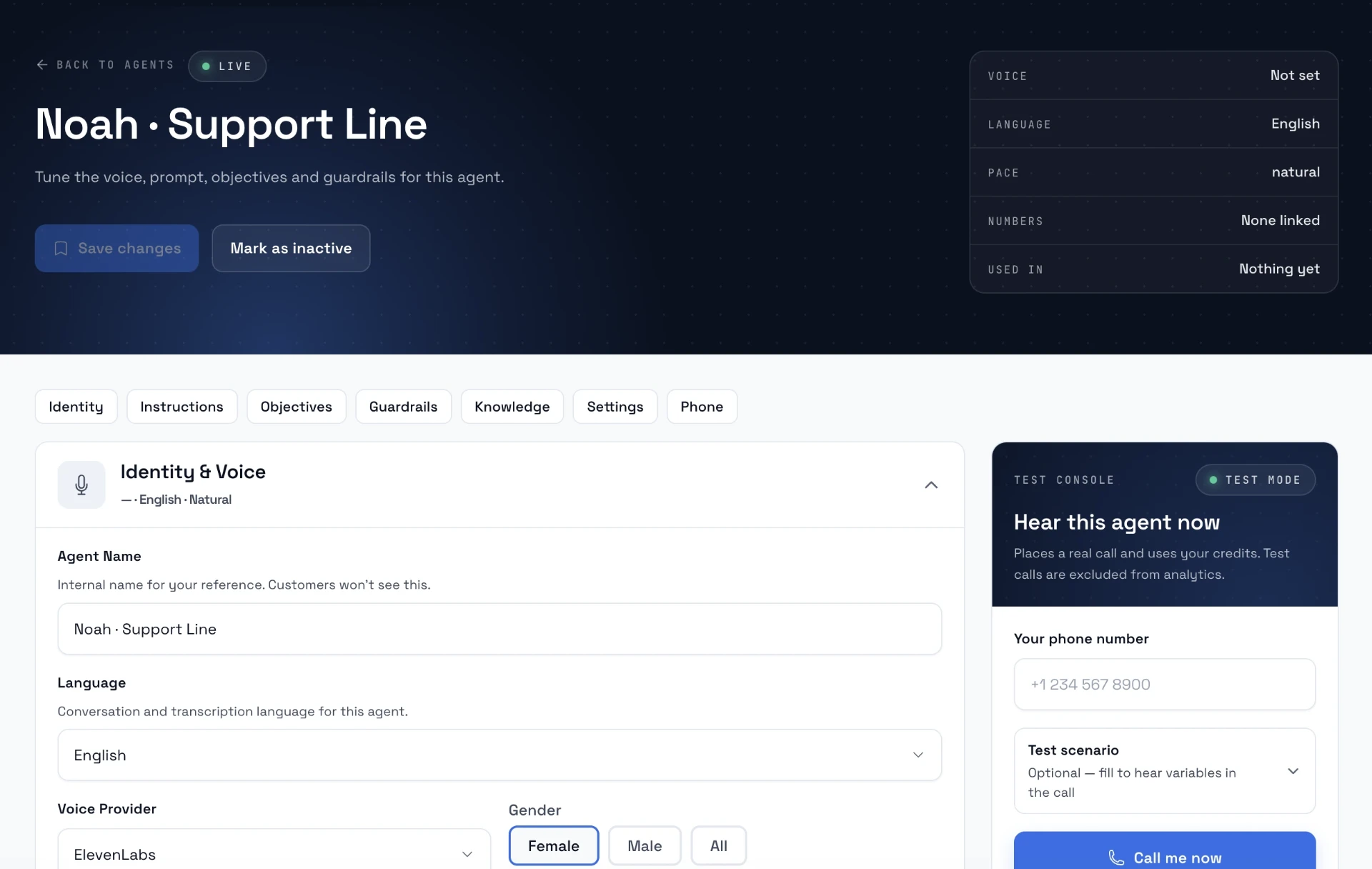
Flows also stop the moment the shopper orders, says stop or has a negative call. The full list of controls is on the Loop Voice features page, and the data handling details are on our security page.
Pre-launch checklist
- Write down the purpose of each flow and campaign, and which consent each one needs.
- Confirm the consent text, the unticked box and where the consent record is saved, then test it with an abandoned checkout.
- Set calling hours to 8 a.m. to 8 p.m. local time, and cap calls so no shopper gets more than three in 24 hours.
- Check the opening line: registered business name, AI disclosure, opt-out instruction, recording notice.
- Say "stop calling" on a test call and confirm that the call ends and the number lands on the do-not-contact list.
- Get registry access for the area codes you call and record the download date.
- Register your texting numbers and add STOP language to every text.
- Repeat the review whenever the audience, offer, channel or states change.
If you run calls next to a Klaviyo flow, keep one suppression list across both; our Klaviyo and phone call guide shows how.
Frequently asked questions
Can I buy a list of phone numbers and call them with an AI voice?
No. The FTC says a seller cannot place prerecorded sales calls to people whose information it got from third parties, because the written consent has to come directly from the shopper. A purchased list also gives you no record of the consent the federal artificial-voice rule requires. Build your call audience only from shoppers who agreed on your own site, form or checkout.
Do these rules apply to calls to Canada, the UK or the EU?
This page covers US rules only. Other countries have their own consent standards, do-not-call registries and calling-hour rules. If your flows can reach international numbers, exclude them until you have local advice, and use the shipping country as well as the phone number's country code to filter them.
Sources
- Declaratory Ruling FCC 24-17: Implications of Artificial Intelligence Technologies on Protecting Consumers from Unwanted Robocalls (Federal Communications Commission, 2024)
- 47 CFR 64.1200: Delivery restrictions (Cornell Law School, Legal Information Institute, 2026)
- 47 U.S.C. 227: Restrictions on use of telephone equipment (Cornell Law School, Legal Information Institute, 2026)
- Q&A for Telemarketers and Sellers About DNC Provisions in TSR (Federal Trade Commission, 2026)
- Florida Statutes 501.059: Telephone solicitation (Florida Legislature, 2026)
- Florida Statutes 501.616: Unlawful acts and practices (Florida Legislature, 2026)
- Florida Statutes 501.604: Exemptions (Florida Legislature, 2026)
- Enrolled House Bill 3168: Telephone Solicitation Act of 2022 (Oklahoma Legislature, 2022)
- Maryland Code, Commercial Law 14-4502 (Maryland General Assembly, 2026)
- Maryland Code, Commercial Law 14-4503 (Maryland General Assembly, 2026)
- Introduction to the Reporters Recording Guide (Reporters Committee for Freedom of the Press, 2026)
- S.B. 226 Artificial Intelligence Consumer Protection Amendments (enrolled) (Utah Legislature, 2025)
- Collecting customer contact information (Shopify Help Center, 2026)
- FCC Revamps Rules on Consent to Calls and Texts Under the TCPA (Latham & Watkins, 2026)
- U.S. A2P 10DLC: full blocking of traffic sent from unregistered numbers (Twilio, 2023)
Hear it before you decide
Listen to real recovery calls, or see Loop Voice call a test checkout on your own store.