




Local vs Toll-Free Numbers for Store Calls and Texts
Call shoppers from a local or local-presence number and keep toll-free for support lines and bulk texts. 86% of unknown calls go unanswered, so caller ID trust matters most.

The short answer
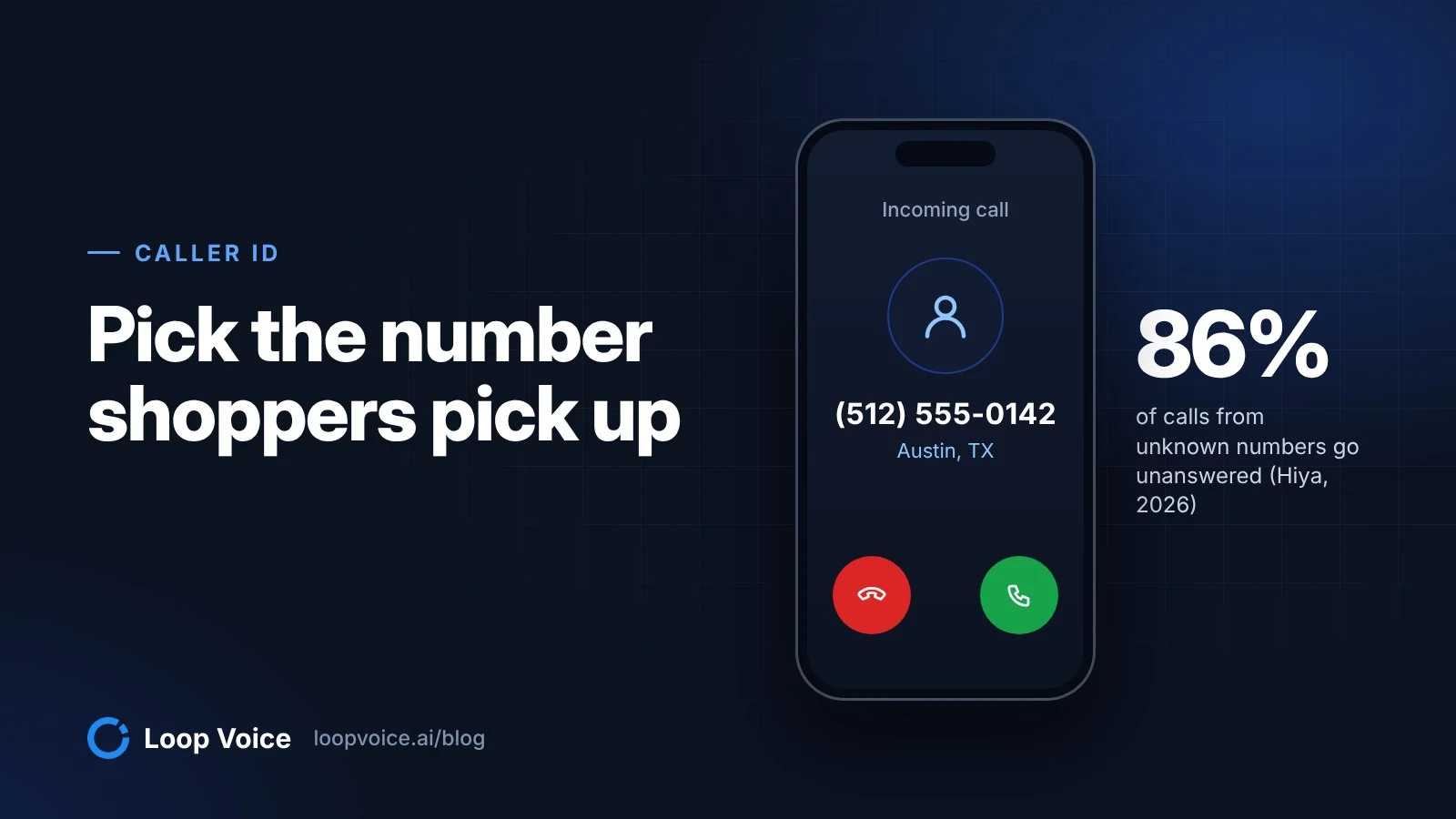
Call shoppers from a local number, or from a local-presence pool such as Loop Voice's Super Number, and keep toll-free numbers for the support line customers already have and for high-volume texting. Hiya's State of the Call 2026 found 86% of calls from unknown numbers go unanswered, so pickup depends less on the number type than on whether your call looks familiar, carries an authenticated caller ID and stays free of a spam label.
Use this table to decide by job, then read the reasons below:
| Job | Number to use | Why |
|---|---|---|
| Recovery, upsell and win-back calls to US shoppers | Local number, or the Super Number if you call across many area codes | Shows a local area code (matched to each shopper's own with the Super Number) and costs less to run on Twilio |
| The support number on your site and packaging | Keep the one customers already have, local or toll-free | Changing it breaks saved contacts, receipts and printed inserts |
| Checkout-link texts after a call | The same local number, registered for A2P 10DLC | One number for the call and the text the shopper expects |
| Promotional texts at volume | A verified toll-free number, or a short code | 3 segments per second by default on toll-free, approved in about 3 to 5 business days |
| Shoppers outside the US | A number local to the shopper's country | Loop Voice sells numbers in 90+ countries, and calling rules differ by country |
Why most calls from unknown numbers go unanswered
Hiya's State of the Call 2026, which draws on 12,000+ consumers across 6 countries, puts the share of unknown calls that go unanswered at 86%. A shopper who abandoned a checkout ten minutes ago almost certainly does not have your number saved, so your recovery call starts as an unknown call no matter how warm the lead is.
What the phone shows is the part you can influence. It is one of three things: a bare number with a city and state, a name, or a warning such as "Spam Risk". The rest of this post is about controlling which one appears.
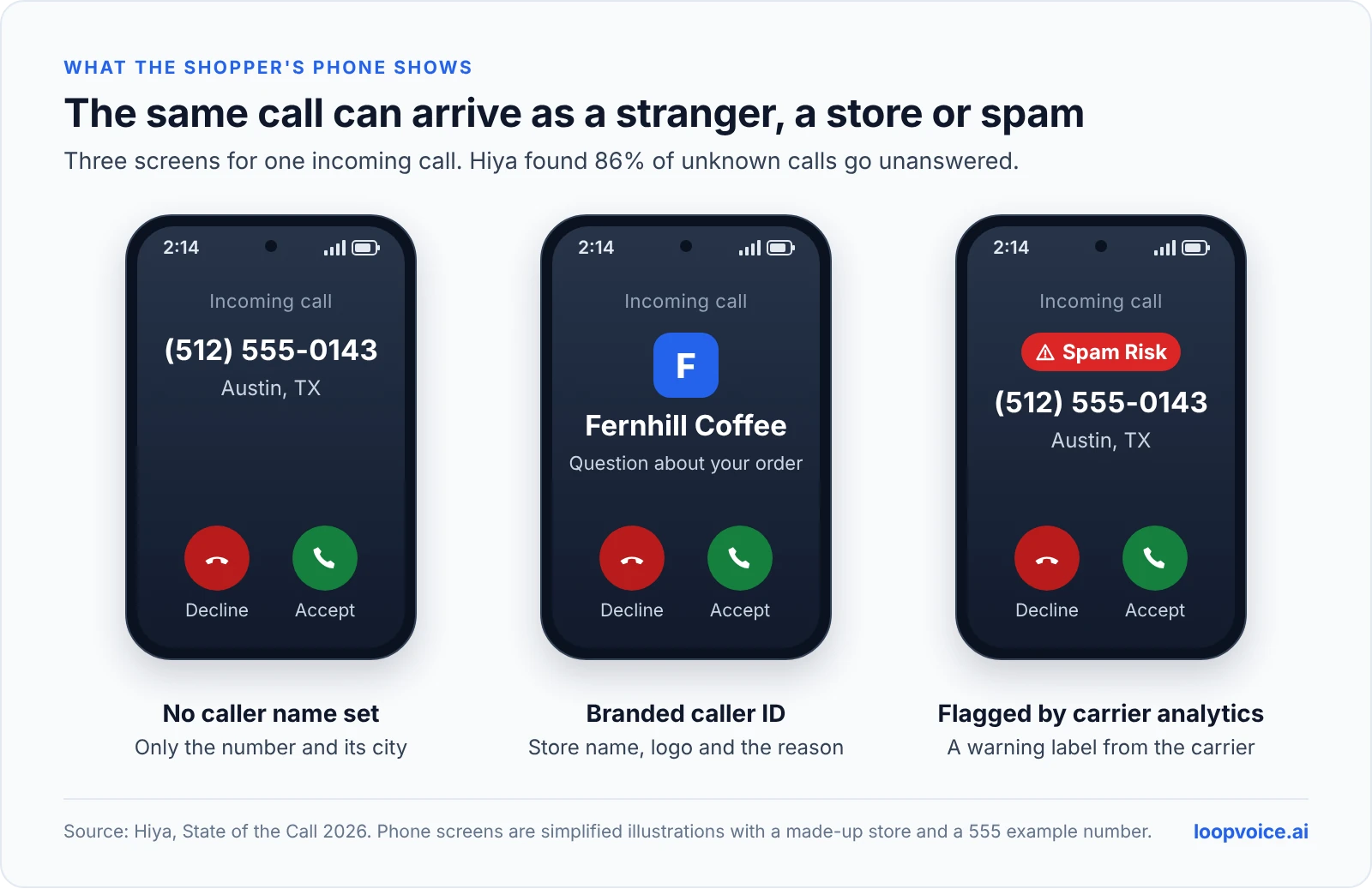
Carriers' spam analytics decide the warning. Hiya lists the inputs in its explainer on spam risk labels: high volumes of calls to unrelated numbers, recipients who hang up quickly or report the call, a history of complaints, and numbers that were never registered with the carriers. A store calling people who just started a checkout, with a useful reason to call, is on the right side of most of those.
STIR/SHAKEN: what attestation does for your calls
STIR/SHAKEN is the system US carriers use to sign calls so the receiving network can check the caller ID was not faked. Each call gets an attestation level, and the FCC's October 2025 proposal on caller ID, FCC 25-76, spells out what they mean:
- A (full): the provider knows the customer and has verified the customer may use that number.
- B (partial): the provider knows the customer but has not verified the number.
- C (gateway): the call entered the network from elsewhere, for example from abroad, and the provider has no relationship with the caller.
The same FCC document notes that providers may use attestation in their call analytics when deciding whether to block or label a call. It also states the limit plainly: call authentication "often does not let them know who is calling." Full attestation is the entry ticket, not the whole answer.
If your calls run through Twilio, it signs A-level only when you have an approved Business Profile, an approved SHAKEN/STIR Trust Product, and the phone numbers assigned to both, according to its SHAKEN/STIR onboarding page. Numbers that are not Twilio numbers top out at B, because Twilio cannot attest that you have the right to use them.
Keep your numbers off spam lists
Register every outbound number before it makes its first call. The Free Caller Registry is a single free form that sends your numbers and business details to First Orion, Hiya and Transaction Network Services, the call-protection providers behind the major US carriers. It does not guarantee your calls will never be labeled, and the registry says so, but it establishes the numbers as belonging to a real business.
Then behave like a business shoppers want to hear from:
- Call people who started a checkout with you, not purchased or scraped lists.
- Keep the first seconds useful: name the store and the reason for the call, so people do not hang up in confusion.
- Honor every "don't call me" at once and keep a frequency cap, so complaints stay rare.
- Watch pickup by caller ID weekly. A number whose answer rate drops suddenly may have picked up a label; check it before you place more calls from it.
None of this replaces consent. Who you may call with an AI voice, and when, is covered in the rules on consent and calling hours.
Branded caller ID: putting your store name on the screen
A name on the screen turns an unknown number into a known business. You have three ways to get one today, and one proposal that may change the picture:
| Option | What the shopper sees | Where it works | Cost and status (Oct 2026) |
|---|---|---|---|
| CNAM (caller name) | Up to 15 characters, such as your store name | Landlines by default; most US mobile carriers make it opt-in | Twilio public beta; needs an EIN or DUNS number; local numbers only in the Console |
| Branded calling, Basic | Your business name | Mobile phones on T-Mobile and Verizon | Twilio public beta |
| Branded calling, Enhanced | Name, logo and the reason for the call | Mobile phones on T-Mobile and Verizon | Generally available on Twilio |
| FCC proposal | A verified caller name on the phone | Proposed in October 2025 | A rulemaking, not something you can buy |
Details come from Twilio's CNAM guide, its Branded Calling overview and its US voice pricing page. Twilio lists branded calling at $0.12 per call. CNAM's catch is the mobile opt-in: Twilio notes that if the recipient has not enabled caller name display on their mobile phone, the name will not appear even when it is set correctly.
Example: a store placing 1,500 recovery calls a month with Enhanced branded calling on Twilio pays 1,500 x $0.12 = $180 a month for the branding. Whether that pays back depends on how many extra pickups it buys you, which is exactly what the test at the end of this post measures.
Where toll-free numbers fit
Toll-free numbers are a good home for inbound support: the caller pays nothing, and an 8XX number on a packing slip reads as a business line. The business pays for that convenience. On Twilio's US price list, receiving a call costs $0.0220 a minute on a toll-free number against $0.0085 on a local number, and the number itself is $2.15 a month against $1.15.
Example: 2,000 minutes of inbound support calls a month cost about $44 on a Twilio toll-free number and about $17 on a local one, before any other charges.
For texting, toll-free numbers need toll-free verification, which Twilio says takes about 3 to 5 business days. Unverified toll-free numbers have been blocked from texting US and Canadian phones since January 31, 2024, and verified ones send 3 segments per second by default. Local numbers go through A2P 10DLC instead; the steps and fees are in our A2P 10DLC registration guide.
Two smaller differences: CNAM on a Twilio toll-free number can only be changed through support, and a toll-free caller ID tells the shopper nothing about where the call comes from. For outbound recovery calls, that second point is the main reason to default to local.
Local presence and the Super Number
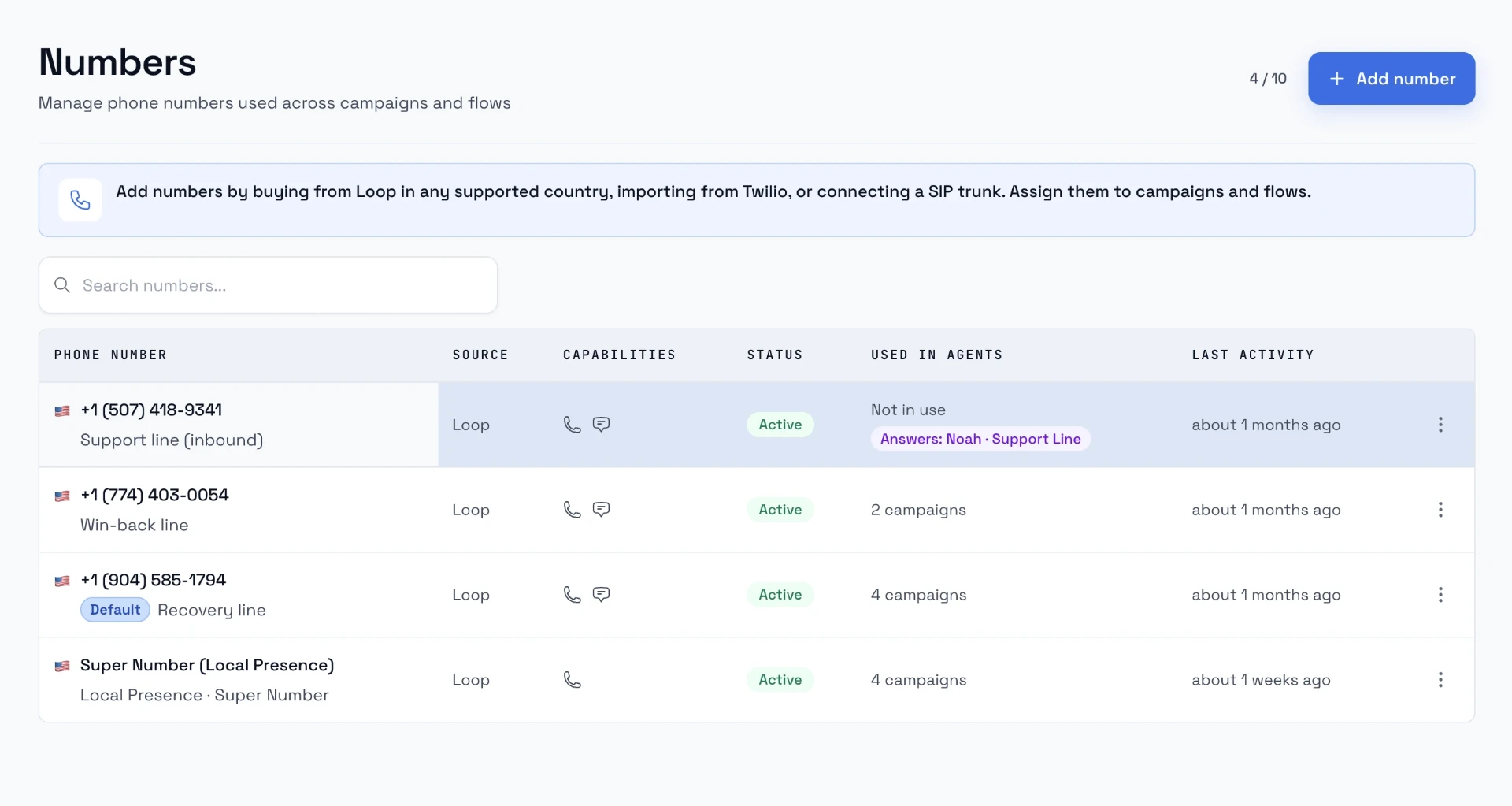
Local presence means each outbound call shows a number in the shopper's own area code. Loop Voice's Super Number does this automatically for US calls: every outbound call goes out from a number matching the customer's area code, drawn from a rotating pool, and calling windows and quiet hours apply in each customer's own time zone.
Two rules keep local presence honest. The FCC requires telemarketing calls to transmit a caller ID number that lets anyone make a do-not-call request during regular business hours (47 CFR 64.1601(e)), and it prohibits misleading caller ID used with intent to defraud, cause harm or wrongfully obtain anything of value (47 CFR 64.1604). In practice: only display numbers you control, and make sure every one of them can be called back.
The Super Number handles the callback side by pointing the whole pool at one designated agent for inbound calls, and a customer who was called recently gets the same agent back when they call in. It is included on the Scale plan; see pricing for the plans and the features page for the other number options (local numbers in 90+ countries, numbers imported from Twilio, or your own SIP trunk).
What each option costs per month
Twilio list prices for the US, from its voice pricing page and its SMS pricing page, checked October 16, 2026:
| Local number | Toll-free number | |
|---|---|---|
| Number rental | $1.15 a month | $2.15 a month |
| Making calls | $0.0140 a minute | $0.0140 a minute |
| Receiving calls | $0.0085 a minute | $0.0220 a minute |
| Sending a text (Twilio fee, before carrier fees) | $0.0083 per segment | $0.0083 per segment |
| Texting approval | A2P 10DLC brand and campaign | Toll-free verification |
| Store name on caller ID | CNAM in the Console | CNAM through support only |
If you would rather not run numbers yourself, Loop Voice sells local numbers inside the app and includes the Super Number on its Scale plan, and answered conversations are billed in credits rather than per minute. The full setup, including bringing your own Twilio number, is in the AI voice agent setup walkthrough.
Run a two-week caller ID test before you commit
We have not found a neutral public study that isolates how much a matching area code lifts pickup for a store's recovery calls, so measure it on your own shoppers. Keep everything else fixed and change only the number:
- Split abandoned checkouts at random between two caller IDs, for example a single local number and the Super Number.
- Use the same agent, offer, delay and calling window for both.
- Track pickup by caller ID, the share answered by a human rather than voicemail, orders attributed to the calls, and opt-outs. Loop Voice reports pickup by attempt and by caller ID.
- Run it for at least two full weeks so weekdays and weekends both count.
Example: with 400 dials per number, 120 pickups (30%) against 96 (24%) is a 6-point gap, which sits right at the edge of what random chance can produce at that size. If your gap is smaller than that, keep testing before you pay for a change.
A caller ID test tells you which calls get answered; a holdout tells you whether answered calls add orders. Do both, using our holdout test method, and see the recovery call playbook for which carts deserve a call at all. If the number will also take inbound calls, set up the answering side with the AI phone agent support setup.
Frequently asked questions
What number should I use for shoppers outside the US?
Use a number local to the shopper's country. Loop Voice sells numbers in 90+ countries and places calls from a number local to the person being called, with US, EU and Australian coverage. Twilio supports STIR/SHAKEN only in the United States and France, so attestation will not help in most other markets, and consent rules and calling hours differ by country.
Sources
- State of the Call 2026 (Hiya, 2026)
- Spam risk warnings: Are your outbound calls being flagged? (Hiya, 2025)
- FCC 25-76, Further Notice of Proposed Rulemaking on caller identification (Federal Communications Commission, 2025)
- SHAKEN/STIR Onboarding (Twilio, 2026)
- Free Caller Registry (First Orion, Hiya and TNS, 2026)
- Brand your calls using CNAM (Twilio, 2026)
- Branded Calling overview (Twilio, 2026)
- Voice pricing: United States (Twilio, 2026)
- SMS Pricing: United States (Twilio, 2026)
- Toll-Free Message Verification for US/Canada (Twilio Help Center, 2026)
- 47 CFR 64.1601, Delivery requirements and privacy restrictions (Cornell Law School LII, 2026)
- 47 CFR 64.1604, Prohibition on misleading caller identification (Cornell Law School LII, 2026)
Hear it before you decide
Listen to real recovery calls, or see Loop Voice call a test checkout on your own store.