




Email vs SMS vs Calls for Abandoned Carts: How to Run All Three
Run all three: email reaches the most shoppers, SMS gets the most clicks, and a call fixes what stopped checkout. Add calls where margin pays for each answered conversation.

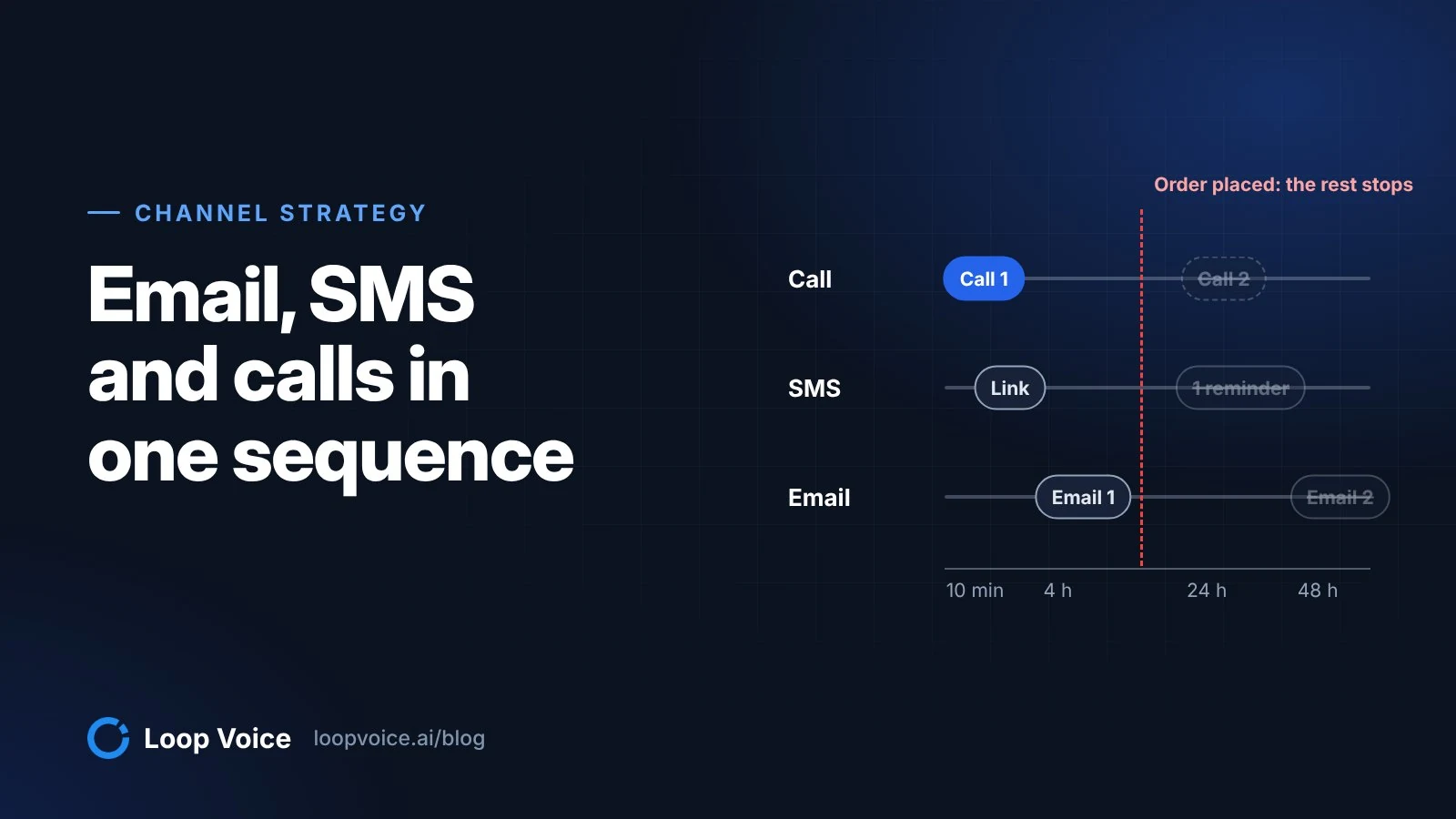
Email, SMS and calls side by side
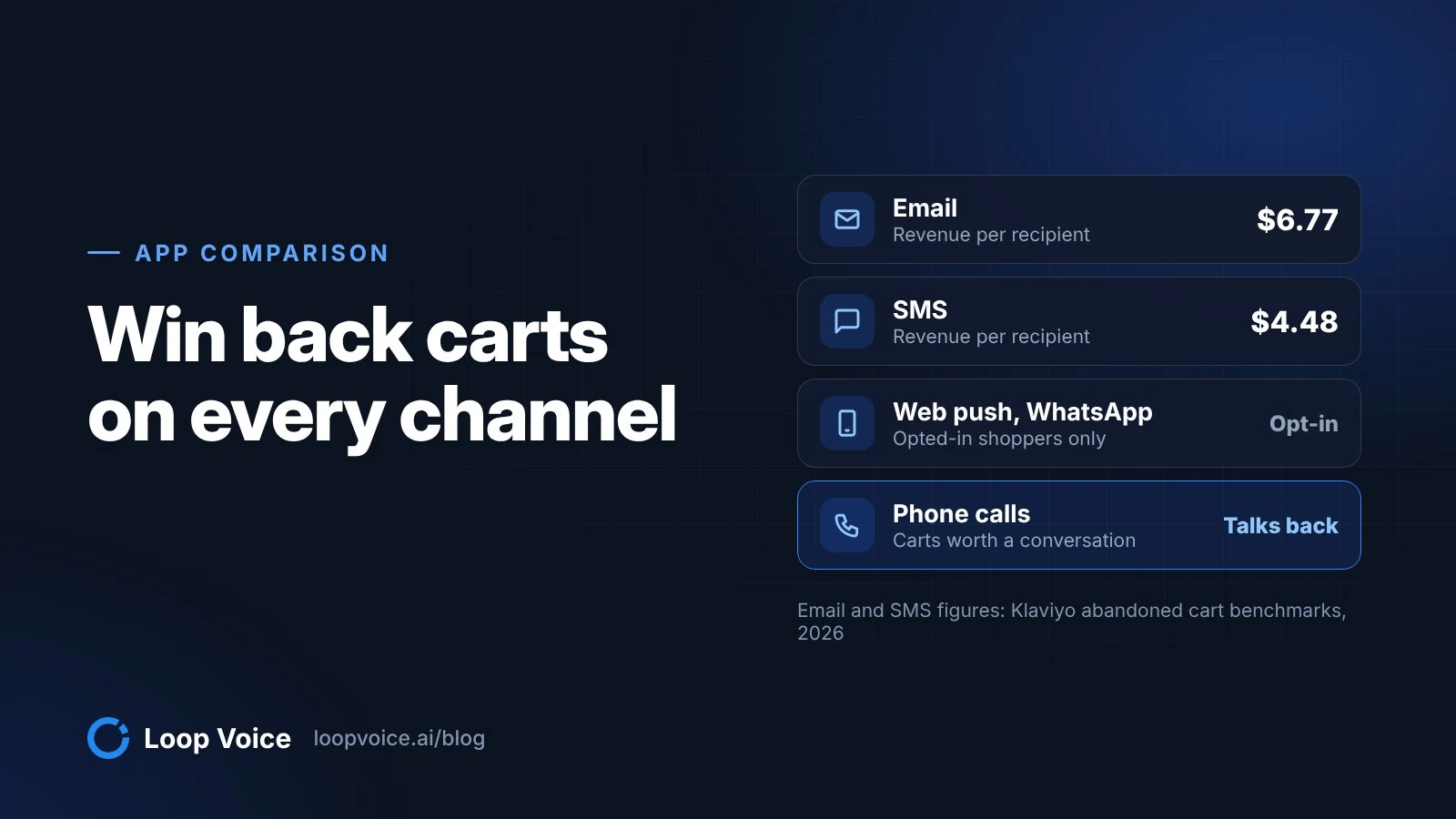
Run all three, each for what it does best: email reaches the most shoppers, SMS earns the most clicks (10.3% against 6.0% for email in Klaviyo's 2026 benchmarks), and a phone call is the only channel that can fix whatever stopped the order. Calls cost about $0.95 to $1.49 per answered conversation at Loop Voice's monthly list prices, so add them where an order's margin pays for the conversations it takes.
| SMS | AI phone call | ||
|---|---|---|---|
| Who you can reach | Anyone who entered an email at checkout and hasn't unsubscribed | Only shoppers who opted in to texts | Only shoppers who agreed to calls, and only when they pick up |
| US consent model | Opt-out: honor unsubscribes within 10 business days | Opt-in; Klaviyo lists double opt-in as required for US abandoned cart texts | Prior express written consent for artificial-voice telemarketing |
| Cost per contact | Covered by your email plan | $0.0083 per outbound US segment at Twilio's list price, plus carrier fees | $0.95 to $1.49 per answered conversation; unanswered calls cost nothing |
| 2026 benchmark | 6.0% click rate, $6.77 revenue per recipient | 10.3% click rate, $4.48 revenue per recipient | 5% to 11% of calls became a sale |
| Best at | Showing the whole cart, your policies and a link to come back to later | One short nudge with the checkout link | Finding and fixing the blocker while the shopper is still at checkout |
| Weak at | It can't answer a question | One abandoned cart text per shopper in the US, per Klaviyo's guidance | 86% of unknown calls go unanswered |
Read the benchmark row with care, because the three numbers measure different things. Klaviyo's figures are averages per recipient across more than 110,000 Klaviyo customers; its top 10% of brands reach 11.3% clicks and $13.70 per recipient on email, and 18.5% and $8.69 on SMS. The call figures are per call, from the four Loop Voice customers who publish results (Modern Hearing 11%, CastleFlexx 8%, Warrior Will Power 7.1%, CityMan USA 5%). Use each number to set expectations for its own channel, not to rank the channels against each other.
In plain terms, the consent row says: CAN-SPAM requires email opt-outs to be honored within 10 business days (15 U.S.C. 7704); Klaviyo's guide lists double opt-in as a requirement for US abandoned cart texts (Klaviyo Help Center); and federal rules require prior express written consent for artificial-voice telemarketing calls (47 CFR 64.1200), with the FCC counting AI-generated voices as artificial (FCC 24-17). Our TCPA and consent guide explains what that means for a store. The 86% figure comes from Hiya's State of the Call 2026 report.
What each channel does best
Each channel has one job it does better than the other two. Set them up for that job and stop asking them to do the others.
Email: the baseline that reaches everyone
Every eligible abandoned checkout should get email. Klaviyo's pre-built abandoned cart flows wait four hours before the first message, and Klaviyo recommends sending the first 2 to 4 hours after checkout starts and a second 20 to 48 hours later (Klaviyo Help Center). Add the flow filter "Placed Order zero times since starting this flow" so nobody gets a reminder after buying; Klaviyo checks it before each message.
Email's limit is that it can't answer back. A shopper stuck on a declined card or a confusing add-on screen gets the same reminder as someone who changed their mind. Our abandoned cart email guide covers timing, copy and when a discount is worth it.
SMS: one well-timed nudge
Texts get clicked, but you get very few of them. For US recipients, Klaviyo's guide lists three requirements for abandoned cart texts: double opt-in for SMS consent, only one SMS per recipient, and sending within 48 hours of the abandonment. Quiet hours are on by default for texts in Klaviyo, and it recommends leaving them on.
Texts are billed per segment, and Twilio's list price is $0.0083 per outbound US segment plus carrier fees (Twilio SMS pricing), so a reminder that runs to two segments costs twice as much. Sending from a US 10-digit number also requires A2P 10DLC registration: unregistered messages have been blocked since September 1, 2023, and Twilio still charges for blocked messages (Twilio changelog). Our A2P 10DLC registration guide walks through it.
Calls: the channel that talks back
A call is the only one of the three where the shopper can say what went wrong and get an answer. In our public recordings, most recovery calls fixed checkout mechanics, such as a declined card, an add-on screen or a site that would not load, rather than talking anyone into anything; the recovery calls playbook has the excerpts. Channels also hand off to each other inside the call. In this one from a gardening store, the agent answers a planting question, then offers to text Michael his cart so he can finish online.
Okay, sandy soil drains fast, so the fix is usually slower, deeper watering, and a mulch layer to hold moisture. If you do those two things right after planting, it makes a huge difference. Want to go ahead and place the order for the four plants with the loop 10 code?
I'll do that online.
Perfect. Use the code loop10 at checkout for 10% off. Do you want me to text you a direct link back to your cart so you can finish faster?
Sure.
One sec, texting that over to you. Cool, you should have that cart link now. Want me to stay on the line while you check out or are you all set?
I'm all set.
Loop Voice texts sent during or after a call carry the right link, usually the checkout, plus the required STOP footer. In this call the agent asks before it sends, and that's the habit to copy.
The break-even math for adding calls
An answered call costs more than 100 times as much as a text segment, so do this sum before you switch calls on:
Most answered conversations one recovered order can pay for = contribution per order ÷ cost per answered conversation
Contribution is what's left after product cost, shipping, payment fees and any discount. At Loop Voice's list prices an answered conversation costs about $1.49 on Starter, $1.20 on Growth, $0.98 on Scale and $0.95 on Enterprise with monthly billing, or about $1.19, $0.96, $0.78 and $0.76 billed yearly. An answered conversation uses about 1.5 credits, and calls nobody answers use none (Loop Voice pricing).
Example: a $120 average order at a 55% gross margin leaves $66. Take off $14 of shipping and payment fees and you have $52, or $40 if the agent's 10% code gets used. On Growth, $40 ÷ $1.20 = 33 answered conversations. Calls break even on contact cost if at least 1 in 33 answered conversations (3%) produces an order that wouldn't have happened anyway.
Example: a $35 average order at a 50% gross margin leaves $17.50, and $8.50 after $9 of shipping and fees. $8.50 ÷ $1.20 = 7 conversations, so 1 in 7 answered conversations (about 14%) would have to produce an extra order. The best published Loop Voice result is 11% of calls becoming a sale, and that's attributed, not incremental. Leave these carts to email and SMS.
Two adjustments keep the math honest. The per-conversation price assumes you use your plan: Starter is $119 a month for about 80 answered conversations, so if your eligible carts only produce 40, each one really costs about $3 ($119 ÷ 40). And attributed orders overstate what calls add, because some of those shoppers would have bought after your email anyway; the section on counting orders below covers how to get the incremental number.
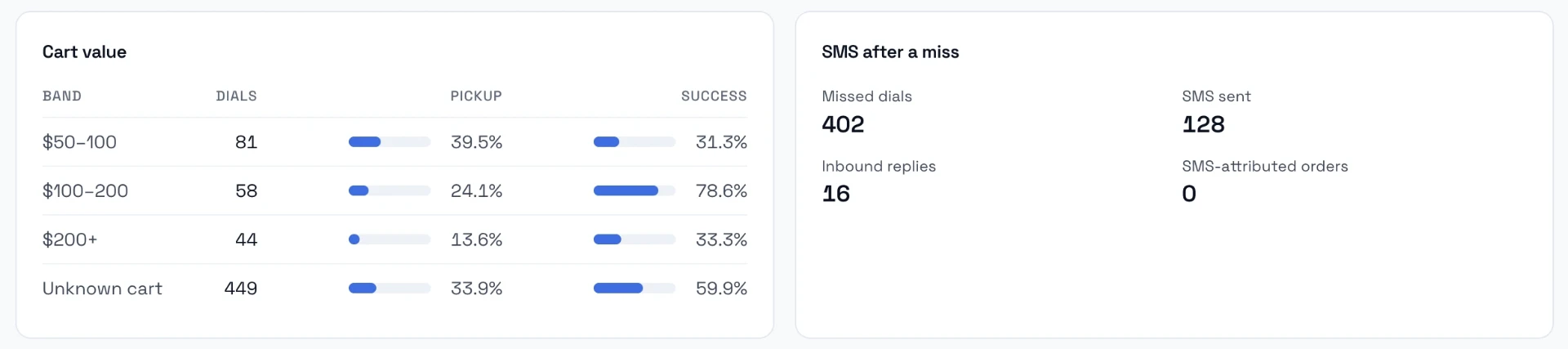
Once calls are live, check the math by cart value band and move the bands where it fails back to email and SMS.
When calls aren't worth adding
Sometimes the right stack is email and SMS only. Skip calls, or wait, when:
- Margins are thin. If one conversation eats most of an order's profit, as in the $35 example, calls can't pay.
- Volume is low. Loop Voice's own pricing page says calls work best with at least 100 abandoned carts a month and suggests stores below 50 work on traffic first. Our cart recovery vs traffic guide helps with that decision.
- The checkout itself is broken. Calls will find the problem, but fixing it on the site helps every shopper, called or not; start with our guide to reducing abandoned carts.
- Most customers are outside North America. The same pricing page says voice calls are most effective there.
How to sequence the three channels
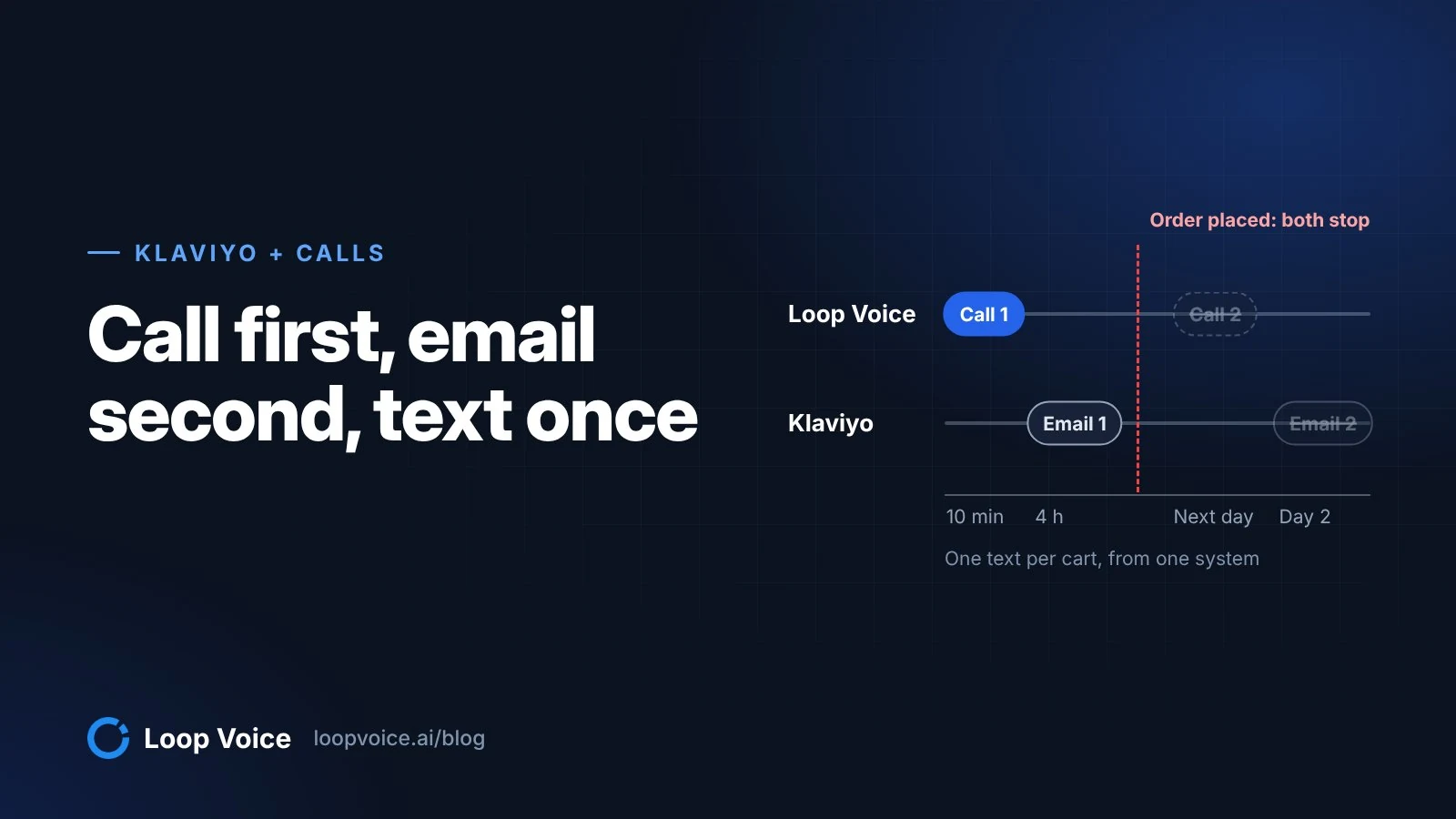
Each tool will follow its own settings perfectly while the shopper gets an email asking them to finish an order they completed on the phone an hour earlier. Give one person, usually whoever owns retention, the timing, offers, stop rules, caps and weekly review for all three channels, and route every change through them.
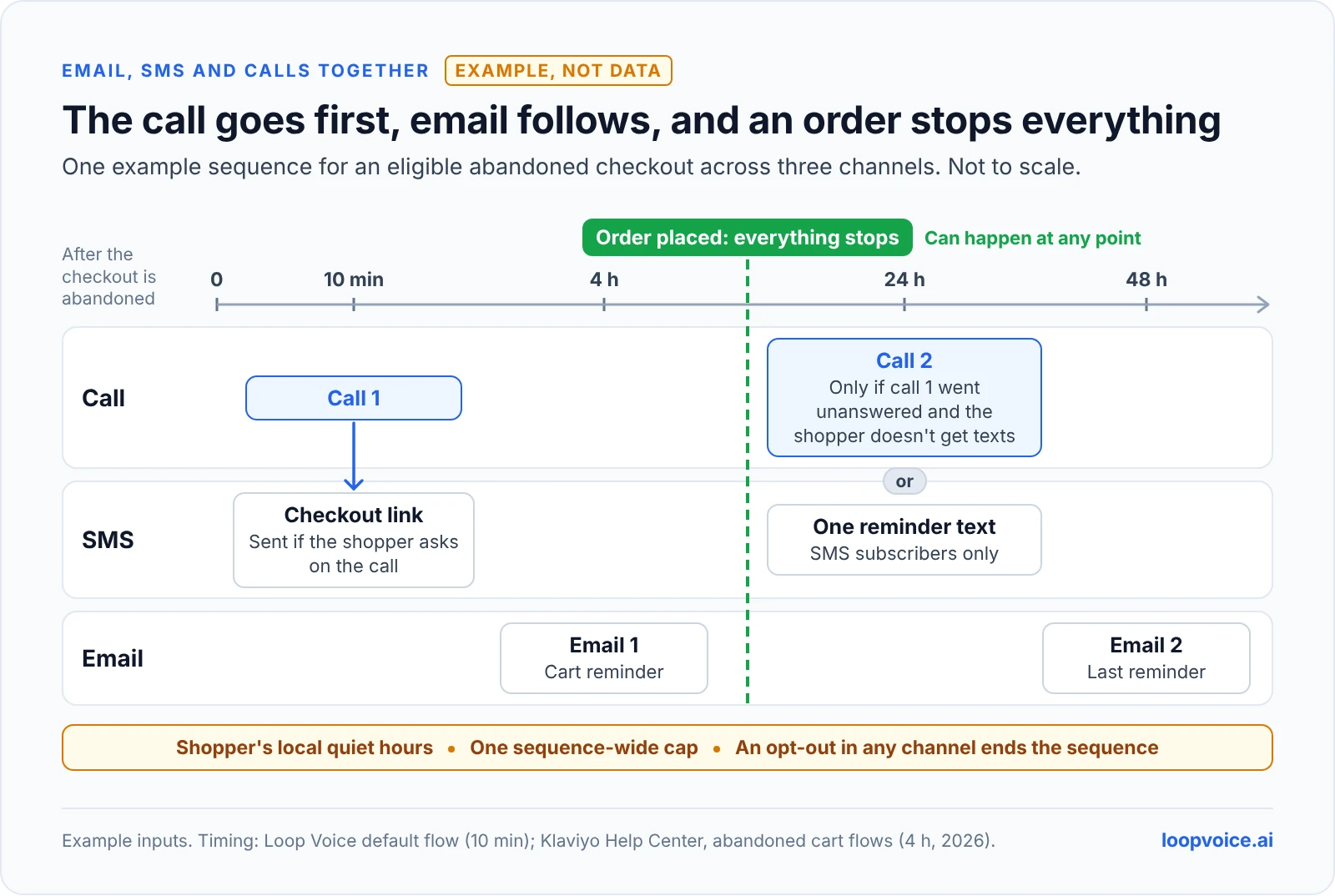
Example sequence for an eligible checkout with enough margin:
- 10 minutes: call. The call goes first because it's the only channel that gains from the shopper still being at checkout. If the shopper answers, the agent solves the problem and texts the link on request.
- 4 hours: first email. Klaviyo's default delay. It reaches everyone the call missed and gives people who talked to the agent the cart in writing. Loop Voice syncs each call's outcome back to Shopify and Klaviyo, so the sequence owner can decide what this email says to someone who already spoke to the agent.
- 24 hours: one text or a second call. SMS subscribers get their one abandoned cart text; Klaviyo's benchmark report describes a common sequence with a follow-up text and a discount at 24 hours. Shoppers who don't take texts and missed the first call get one more call, inside their calling hours.
- 48 hours: last email. That's 44 hours after the first, inside Klaviyo's recommended gap of 20 to 48 hours. After that, the shopper belongs to your browse and win-back flows, not recovery.
- Any time: an order ends everything. Every pending call, text and email stops.
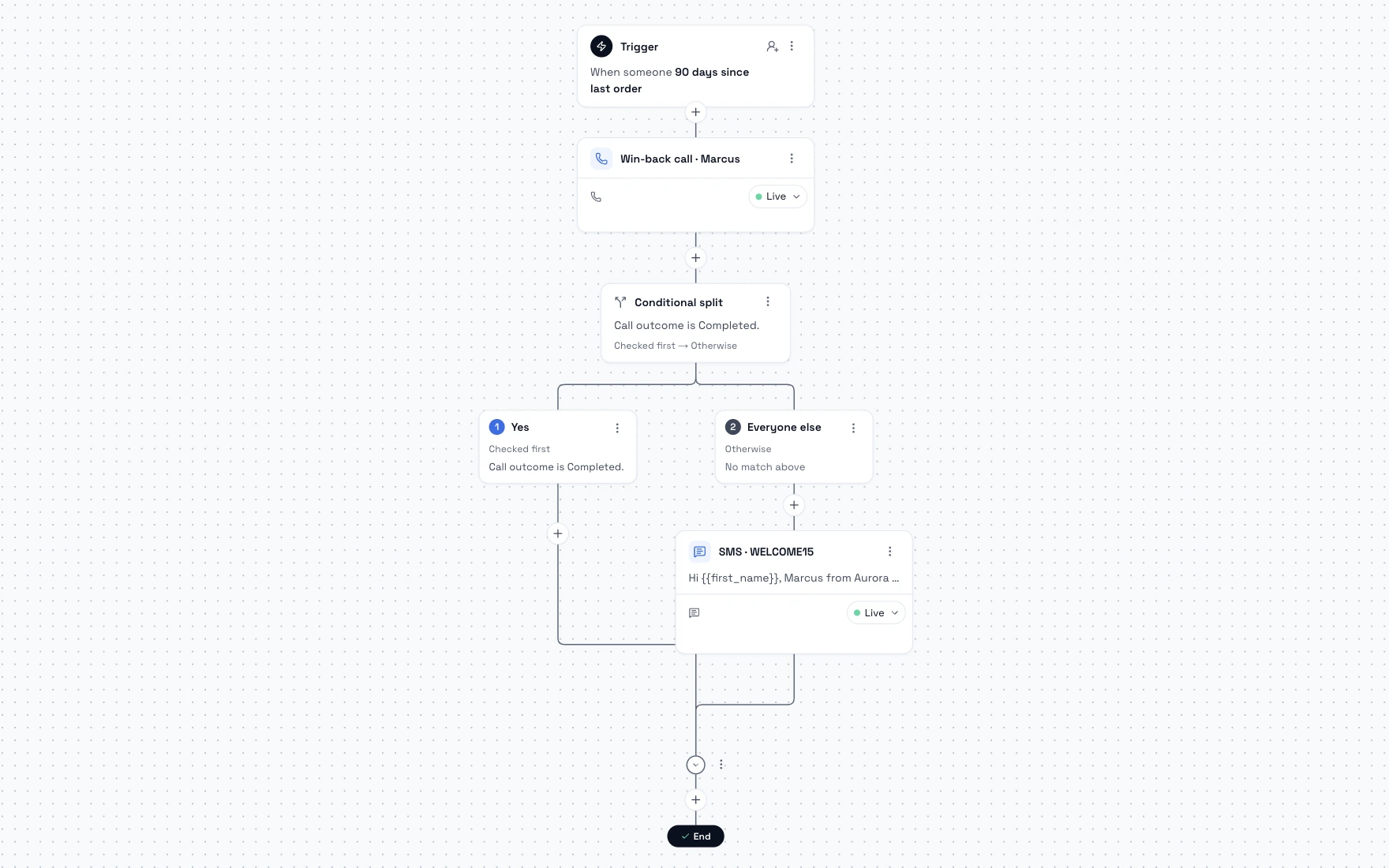
For the Klaviyo side of this setup, see running phone calls alongside a Klaviyo abandoned cart flow. On the calling side, the sequence is a Loop Voice flow built from wait, call, SMS and branch steps, and each step can be set to Draft, Manual or Live, so you can stage a change inside a running flow.
One offer, everywhere
Pick one discount rule and use it in every channel. If the agent offers 10% after a price objection, the 24-hour text shouldn't offer the same shopper a bigger discount, and no email should promise a code the agent was told not to give. Shoppers compare.
Count each order once
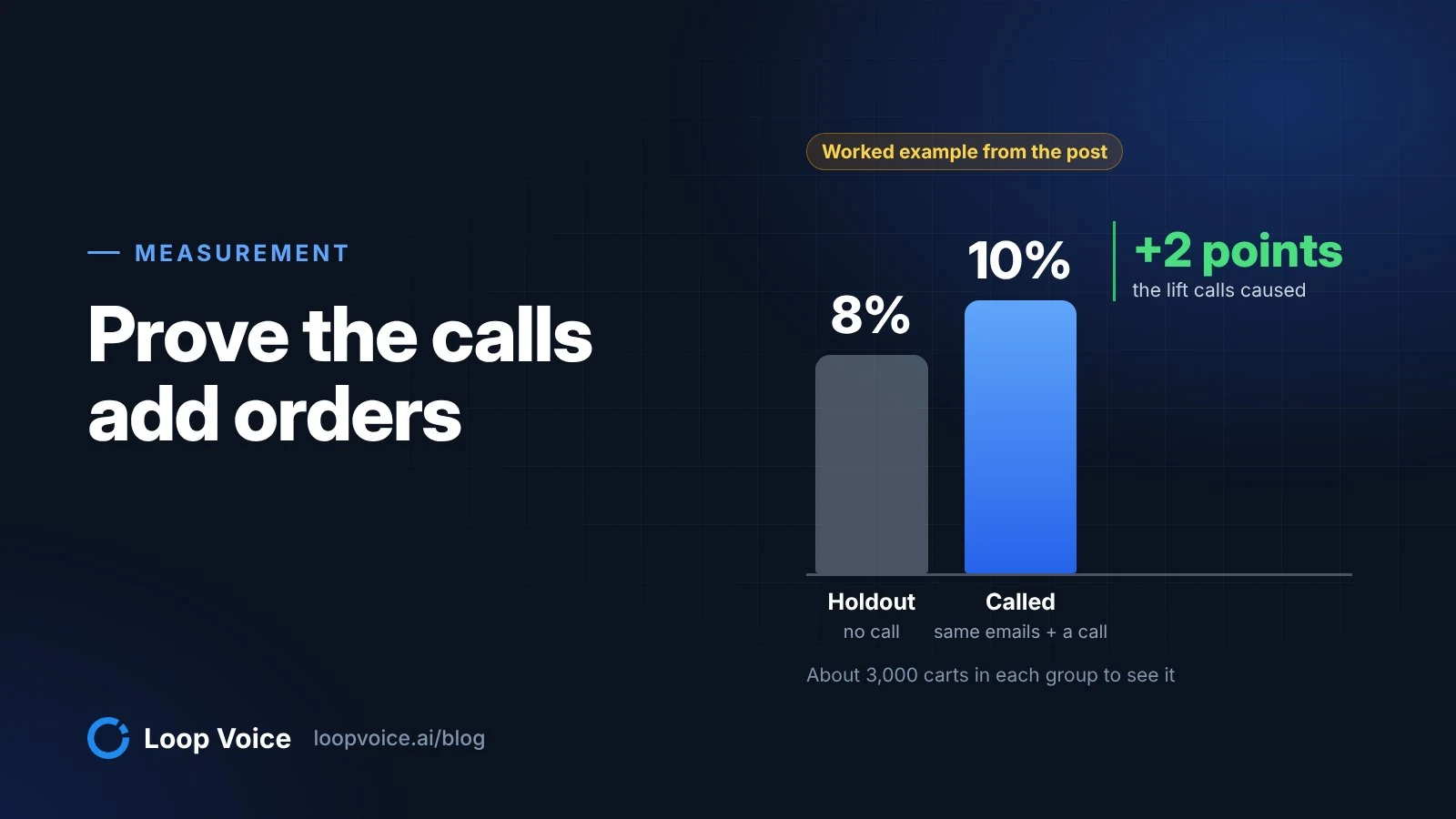
Every tool will claim the same order. Klaviyo's default is last-touch attribution with a five-day window for email opens, email clicks and SMS clicks (Klaviyo Help Center), and Loop Voice ties revenue to the call inside the attribution window you set. A shopper who talks to the agent, opens the four-hour email and then buys shows up in both dashboards. Judge the sequence on recovered orders per eligible cart, and use a holdout to see what calls add; our holdout test guide shows how.
Shared stop rules, quiet hours and frequency caps
Write these rules once, then set them in every tool. Here's where each one lives:
| Rule | Calls in Loop Voice | Texts and email (Klaviyo) |
|---|---|---|
| Stop on order | The flow stops when the customer orders | The "Placed Order zero times since starting this flow" filter, checked before each message |
| Opt-out | "Don't call me" on a call, or STOP by text, goes on the do-not-contact list before the next step | Replies such as STOP, QUIT, END, REVOKE, OPT OUT, CANCEL or UNSUBSCRIBE must count as opt-outs; email needs a working unsubscribe link |
| Quiet hours | Applied in each customer's time zone; federal rules bar solicitation calls before 8 a.m. or after 9 p.m. | Text quiet hours on by default; no texts before 8 a.m. or after 9 p.m., later starts and earlier stops in some states |
| Frequency | Calls per customer capped by week, month, quarter, six months or year | Smart Sending skips a text within 24 hours of the last one, and an email within 16 hours, by default |
The gap is the cap across channels. Klaviyo manages Smart Sending separately for each channel, so a shopper can get an email and a text on the same day with Smart Sending on (Klaviyo Help Center), and Loop Voice's caps cover its own calls. Nobody limits the total unless the sequence owner does. Example rule: no more than two recovery touches in any 24 hours, no more than five per abandoned checkout, and an opt-out in any channel ends the whole sequence.
Quiet hours need the same care. Klaviyo advises against texts before 8 a.m. or after 9 p.m. in the recipient's local time and notes that some states prohibit texts before 9 a.m. or after 8 p.m., which its optional state-level setting handles (Klaviyo Help Center). Revocations run on a clock too: the federal rule lists those reply words as valid ways to revoke consent and requires revocations to be honored within ten business days at most. Treat that as a ceiling, not a target, and see our calling-rules guide for the phone side.
Run it as an always-on system
Recovery is a system you maintain, not a campaign you launch. A 30-minute weekly review catches problems before shoppers do:
- Audit the stop rule. Pull ten orders from the week and check that none got a reminder after buying.
- Listen to ten calls, including ones that didn't convert. Recordings are kept seven days, so this can't wait for the monthly meeting.
- Check answer rate by hour and by caller ID, and move calling windows toward the hours your customers pick up.
- Read opt-outs and complaints by channel. A jump after a change means roll the change back.
- Check SMS delivery. Twilio error 30034 means a message from an unregistered 10DLC number was blocked and never reached the shopper.
- Watch the discount. How often the code goes out, and after which objection.
- Review LoopIQ's weekly suggestion. It names one change worth making, with its reasoning, and nothing changes until you approve it.
Once a month, look at revenue per eligible cart for the whole sequence and cost per recovered order by channel, and move cart value bands that miss break-even back to email and SMS. Once a quarter, rerun the holdout, and recheck consent capture and quiet-hour settings after any checkout or app change.
Frequently asked questions
What should happen when a shopper replies to the reminder text with a question?
Treat the reply as the start of a support conversation, not as a click. Pause the remaining reminders for that checkout, route the reply to a person or your support inbox, and answer the question first. A sequence that keeps sending reminders around an unanswered question is the quickest way to turn a buyer into an opt-out.
Do we need Klaviyo to add calls?
No. Loop Voice flows start from store events in Shopify, WooCommerce or Checkout Champ, such as an abandoned checkout, and send their own texts during or after a call. Klaviyo is optional: Loop Voice can point campaigns at Klaviyo segments and syncs call outcomes back to Klaviyo, which helps if your emails already run there.
Sources
- The abandoned cart benchmarks report: 2026 data (Klaviyo, 2026)
- 15 U.S.C. 7704, Other protections for users of commercial electronic mail (Cornell Law School Legal Information Institute, 2026)
- How to add SMS to your abandoned cart flow (Klaviyo Help Center, 2025)
- 47 CFR 64.1200, Delivery restrictions (Cornell Law School Legal Information Institute, 2026)
- Declaratory Ruling FCC 24-17 on AI-generated voices and the TCPA (Federal Communications Commission, 2024)
- State of the Call 2026 (Hiya, 2026)
- How to create an abandoned cart flow (Klaviyo Help Center, 2026)
- SMS pricing in the United States (Twilio, 2026)
- U.S. A2P 10DLC: full blocking of traffic sent from unregistered numbers (Twilio, 2023)
- Understanding Klaviyo message attribution (Klaviyo Help Center, 2026)
- Understanding Smart Sending in Klaviyo (Klaviyo Help Center, 2025)
- Understanding text message quiet hours in flows (Klaviyo Help Center, 2026)
- Customer results (Loop Voice, 2026)
- Pricing (Loop Voice, 2026)
Hear it before you decide
Listen to real recovery calls, or see Loop Voice call a test checkout on your own store.