




Cart Recovery vs Buying Traffic: Where the Next Dollar Goes
Fund whichever buys an incremental order for less than the order contributes. Recovery often wins per order but runs out of carts; paid traffic scales at a rising cost.

Key takeaways
- Compare cost per incremental order after contribution margin, not attributed revenue or ROAS.
- Recovery is capped by contactable abandoned checkouts; paid traffic keeps scaling at a rising cost.
- Shopify's conversion rate counts converting sessions, so recovery often adds to both sides of the ratio.
- Below about 50 abandoned carts a month, Loop Voice's own advice is to focus on traffic.
The rule for the next dollar
Put the next dollar where it buys an incremental order for less than that order contributes, and keep shifting dollars until the two costs meet. Recovery often wins per order because the shopper has already chosen a product, but it can only work on the abandoned checkouts you have, while paid traffic keeps scaling at a rising cost per order.
That turns the decision into a sequence. Run the free recovery steps first, add costlier ones such as calls only while their cost per incremental order stays below your margin, and send what's left of the budget to traffic.
Two formulas, one yardstick
Measure both options in cost per incremental order, meaning orders that wouldn't have happened without the spend, and judge each against the contribution an order leaves after product, shipping, payment fees and returns.
Cost per incremental recovered order = (tool fees + message and call costs + discounts given + staff time) ÷ recovered orders that wouldn't have happened anyway
Cost per new paid order = (ad spend + creative and agency costs) ÷ new orders the ads caused
Net contribution per order = contribution per order minus the cost per order above
Two habits make recovery look better than it is: counting every attributed order instead of incremental ones, and leaving out discounts, since a 10% code on a recovered order is a real cost. Two habits flatter ads: comparing bare media spend with a fully loaded recovery cost, and counting retargeting orders from your own cart abandoners as new customers, when that is recovery bought through an ad platform.
Then add the constraint most comparisons skip:
Recovery volume ≤ abandoned checkouts you can contact × share you reach × incremental conversion rate
Ads have no hard ceiling, but extra spend tends to reach colder audiences at a higher cost per order. If you also track your abandonment rate, keep its definition fixed while you test; our guide to the cart abandonment rate formula shows which counts to use.
Example: one store, two ways to spend
Example: a store with a $140 average order and a 45% contribution margin keeps $63 per order before marketing costs. Its abandoned checkout email already runs, and it's choosing between adding recovery calls and spending more on ads. Every input in this table is made up for illustration; swap in your own.
| Recovery calls | Paid traffic | |
|---|---|---|
| Audience | 250 abandoned checkouts a month with a phone number and call consent | New visitors |
| Spend | $119 plan (about 80 answered conversations) + $42 of discounts = $161 | $1,000 |
| What it buys | 80 answered conversations at a 32% answer rate | 667 clicks at $1.50 |
| Orders | 8 attributed; a holdout shows 3 would have bought anyway, so 5 incremental | 12 at a 1.8% conversion rate |
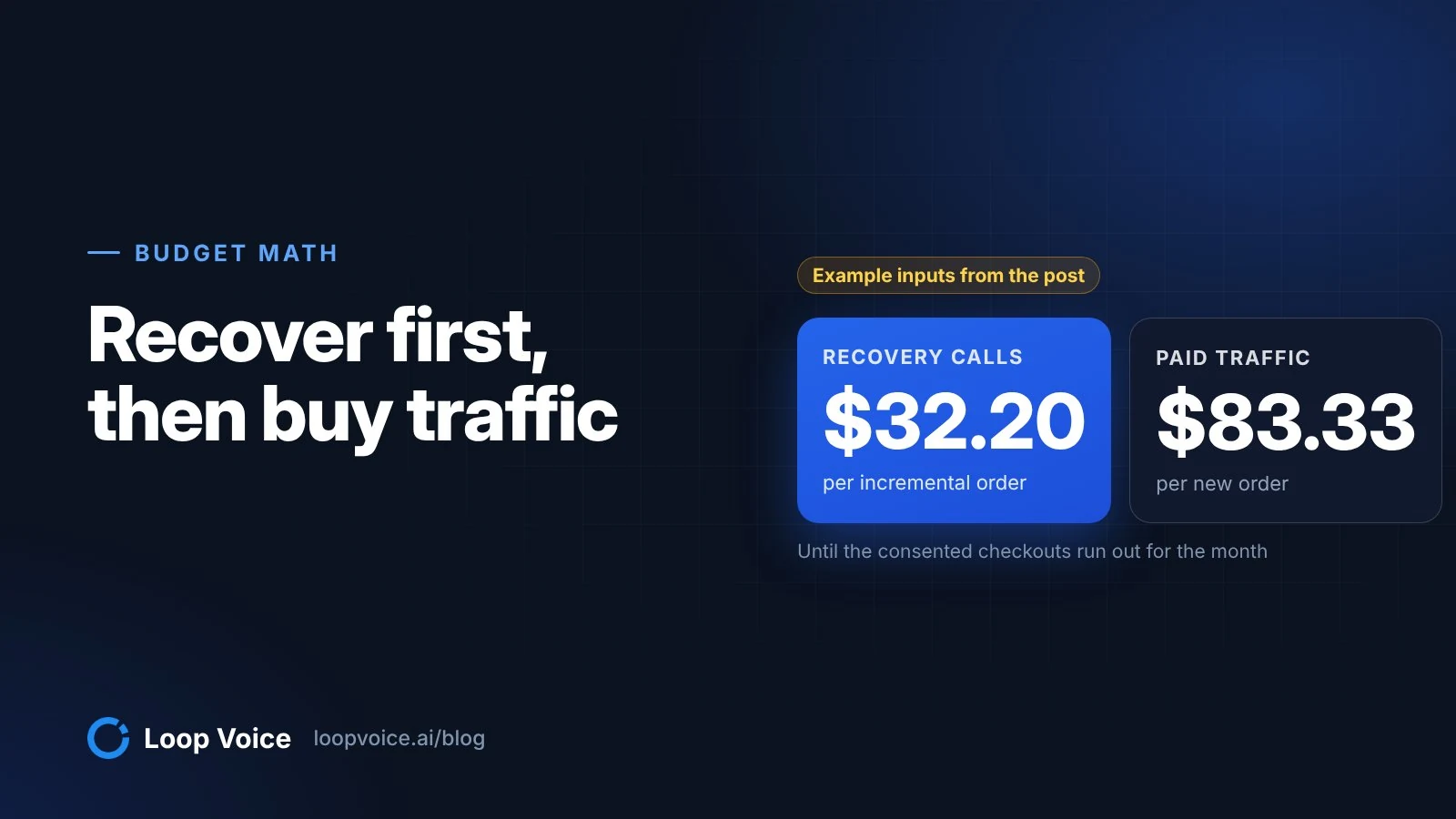
| Cost per incremental order | $32.20 | $83.33 |
| Net contribution per order | +$30.80 | -$20.33 on the first order |
| Can it absorb another $1,000? | No: no consented checkouts are left this month | Yes, at a rising cost per order |
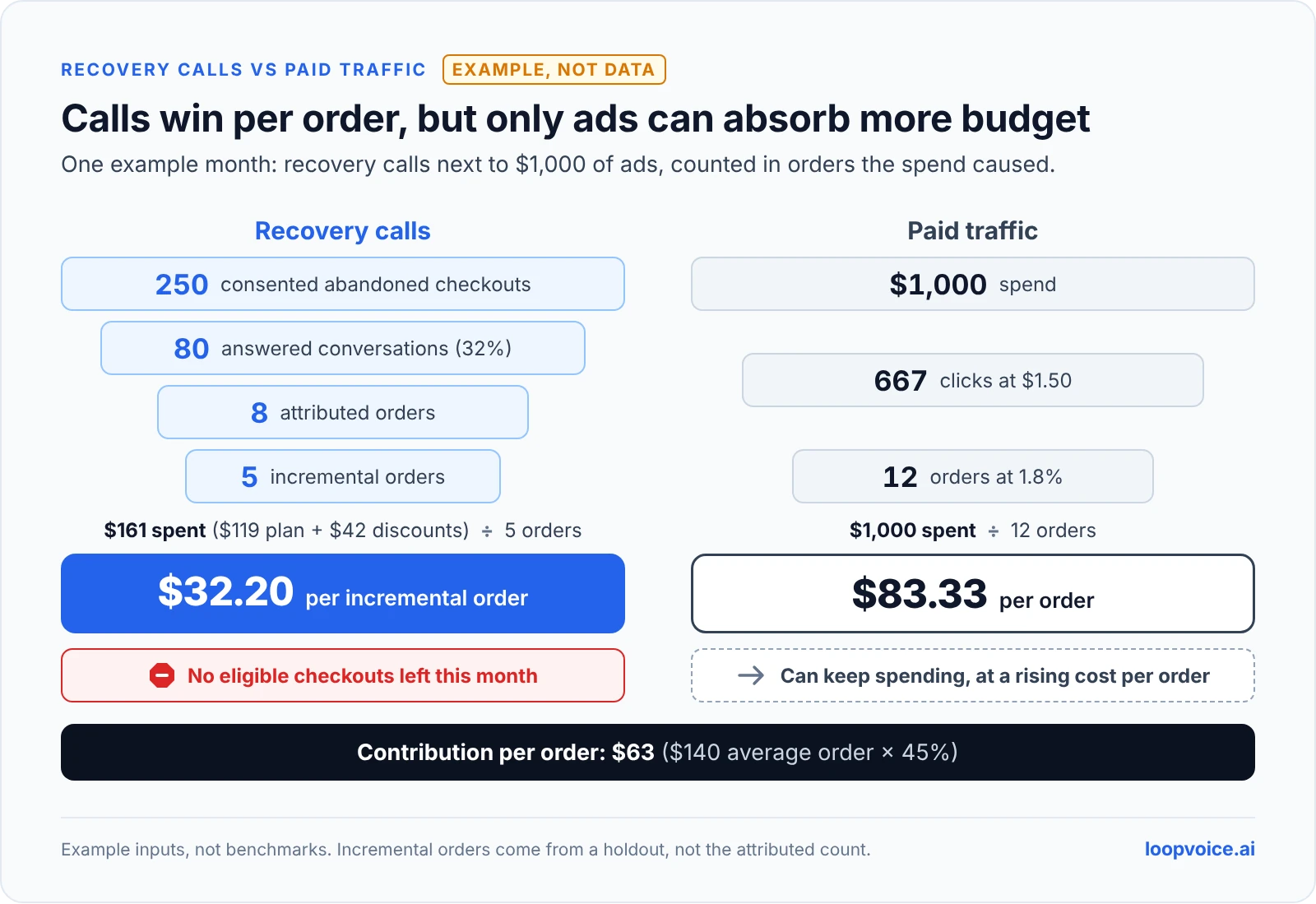
Per order, recovery wins easily here. But it tops out at five extra orders a month, and more money buys nothing more, while the ads lose money on the first order and only pay back if new customers buy again.
Example: if 35% of these new customers place a second order within a year at the same margin, first-year contribution is $63 × 1.35 = $85.05 per customer, just above the $83.33 it cost to win each one.
So this store should add the calls, keep its email, and then judge ads on measured repeat purchases rather than first-order profit. Run the same table at a $60 average order (contribution $27, discounts $18) and calls cost $27.40 per incremental order, roughly break-even. That lines up with Loop Voice's own pricing guidance that calling works best for stores with a $50+ average order value and 100+ abandoned carts a month.
Fill in your own numbers
To run the table for your own store, you need six inputs. Most stores have all of them already; the one people skip is the holdout.
| Input | Where to get it |
|---|---|
| Abandoned checkouts a month, with an email and with a phone number | Orders > Abandoned checkouts in Shopify; export monthly, because Shopify deletes abandoned checkouts older than three months |
| Contribution per order | Average order value minus product cost, shipping, payment fees and expected returns |
| Recovery spend | Tool invoices, per-message charges and the discounts redeemed on recovered orders |
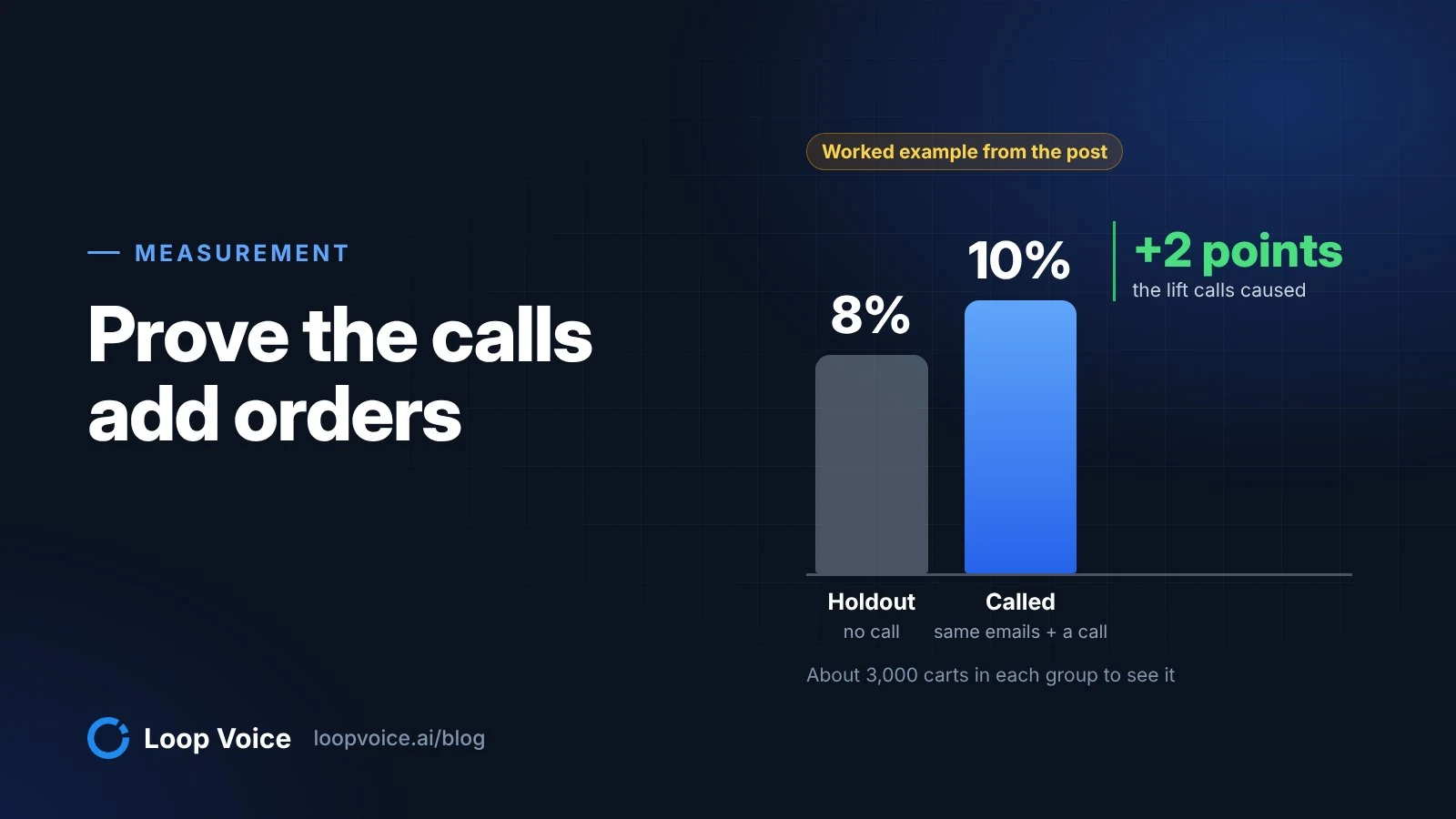
| Incremental recovered orders | A holdout test, not the tool's attributed count |
| Cost per new paid order | Ad spend divided by new-customer orders, ideally from a lift test rather than platform attribution |
| Repeat rate of new customers | The share of first-time buyers who order again within a window you choose, from your own order history |
Move budget in small steps and rerun the numbers each time. The next dollar never buys the same orders as the average one: recovery reaches lower-intent carts as you widen who gets contacted, and ads reach colder audiences as spend rises.
What each recovery channel costs
Unit costs differ by orders of magnitude across channels, which is why the order you add them in matters more than which one is best.
| Channel | What you pay | Published benchmark | Needs |
|---|---|---|---|
| Shopify's abandoned checkout email | Free, and it doesn't count toward Shopify Messaging's 10,000 free monthly emails (Shopify email pricing) | $6.77 revenue per recipient for abandoned cart email (Klaviyo, 2026) | An email on the checkout |
| SMS | $0.012 per US message on Shopify Messaging, plus $2.15 a month per toll-free number (Shopify SMS pricing) | $4.48 revenue per recipient and a 10.3% click rate for abandoned cart SMS (Klaviyo, 2026) | SMS consent |
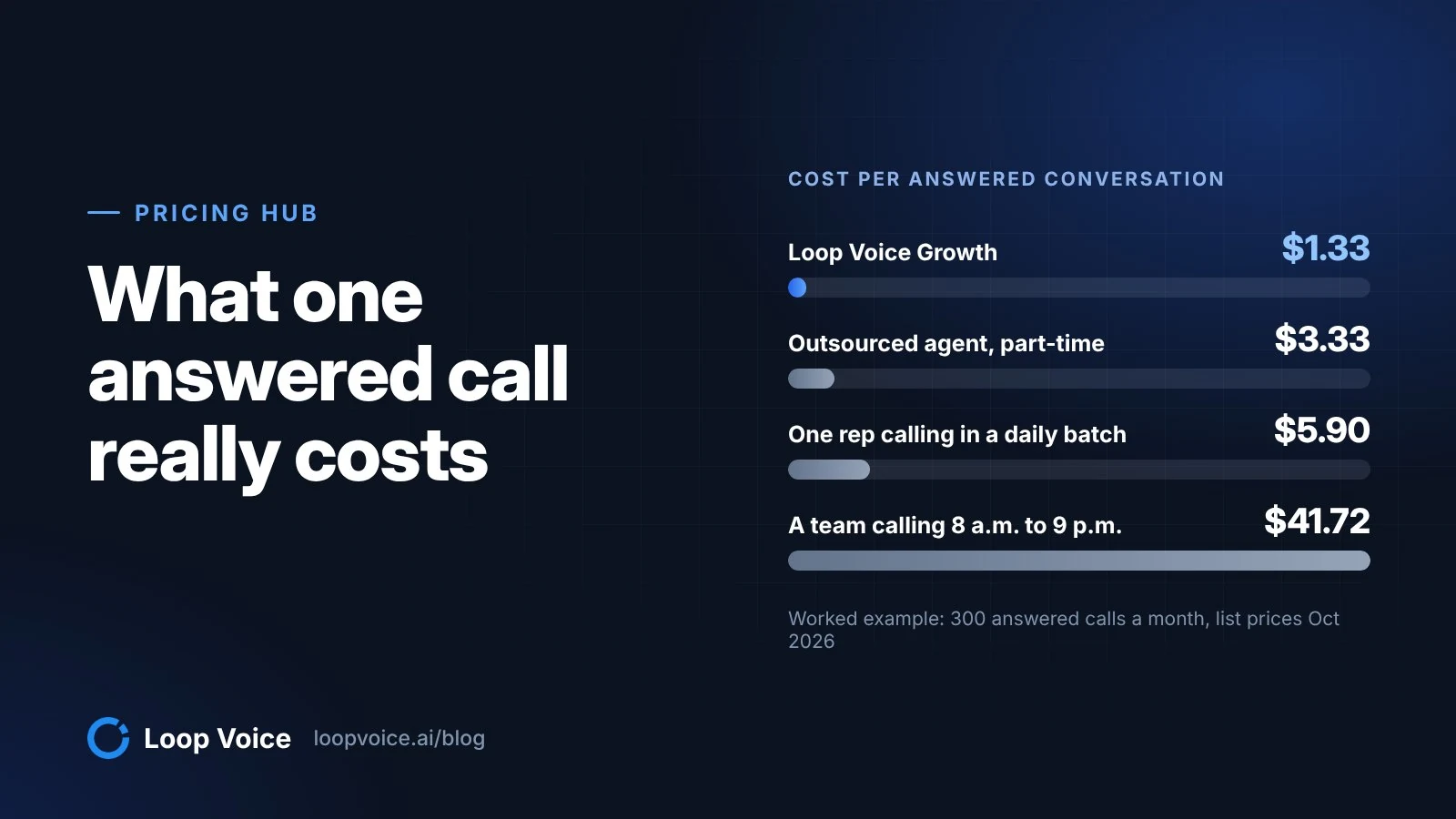
| AI phone call with Loop Voice | About $0.95 to $1.49 per answered conversation at list prices; unanswered calls use no credits | 5% (CityMan USA) to 11% (Modern Hearing) of calls became a sale | A phone number and call consent |
The Klaviyo figures come from its 2026 abandoned cart benchmarks across 110,000+ customers. They, and the published Loop Voice results, are attributed numbers rather than holdout-tested lifts, so treat them as ceilings for planning. SMS and calls both need the shopper's consent; our guide to calling and texting rules covers what counts.
Calls carry one more catch. Plans are a monthly fee for a block of credits, so the per-conversation price only holds if you use the capacity. Example: if only 40 of a Starter plan's roughly 80 answered conversations happen in a month, each one effectively cost $119 ÷ 40 = $2.98. Reach matters for the same reason: Hiya's State of the Call finds 86% of calls from unknown numbers go unanswered.
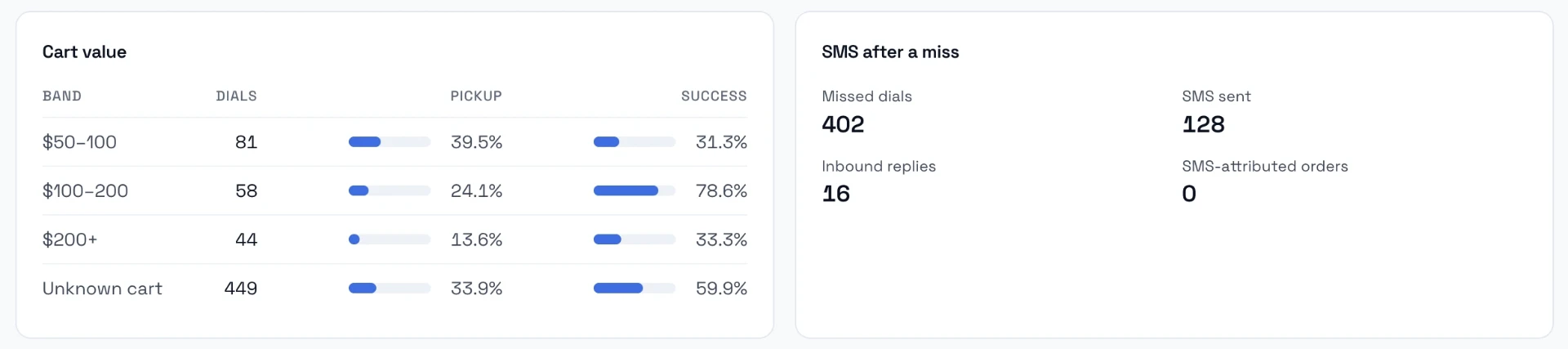
Splitting results by cart value shows where calls stop paying:
For how email, SMS and calls hand off to each other without double-contacting anyone, see our guide to running the channels together.
What recovery does to your Shopify conversion rate
Recovery lifts your reported conversion rate by less than the extra orders suggest, because Shopify's conversion rate is a ratio of sessions, not orders. The ShopifyQL sessions reference defines it as sessions that completed checkout divided by sessions, and a session ends after 30 minutes of inactivity, per Shopify's note on session measurement.
So the effect depends on how the shopper comes back:
| How the shopper comes back | Sessions | Sessions that completed checkout | Conversion rate |
|---|---|---|---|
| Finishes on the same device within 30 minutes of their last activity, for example during a call placed minutes after they left | No change | +1 | Up |
| Clicks an email or text hours later and buys | +1 | +1 | Up, slightly less |
| Opens the link on another device and buys | +1 | +1 | Up, slightly less |
| Clicks a reminder and doesn't buy | +1 | No change | Down |
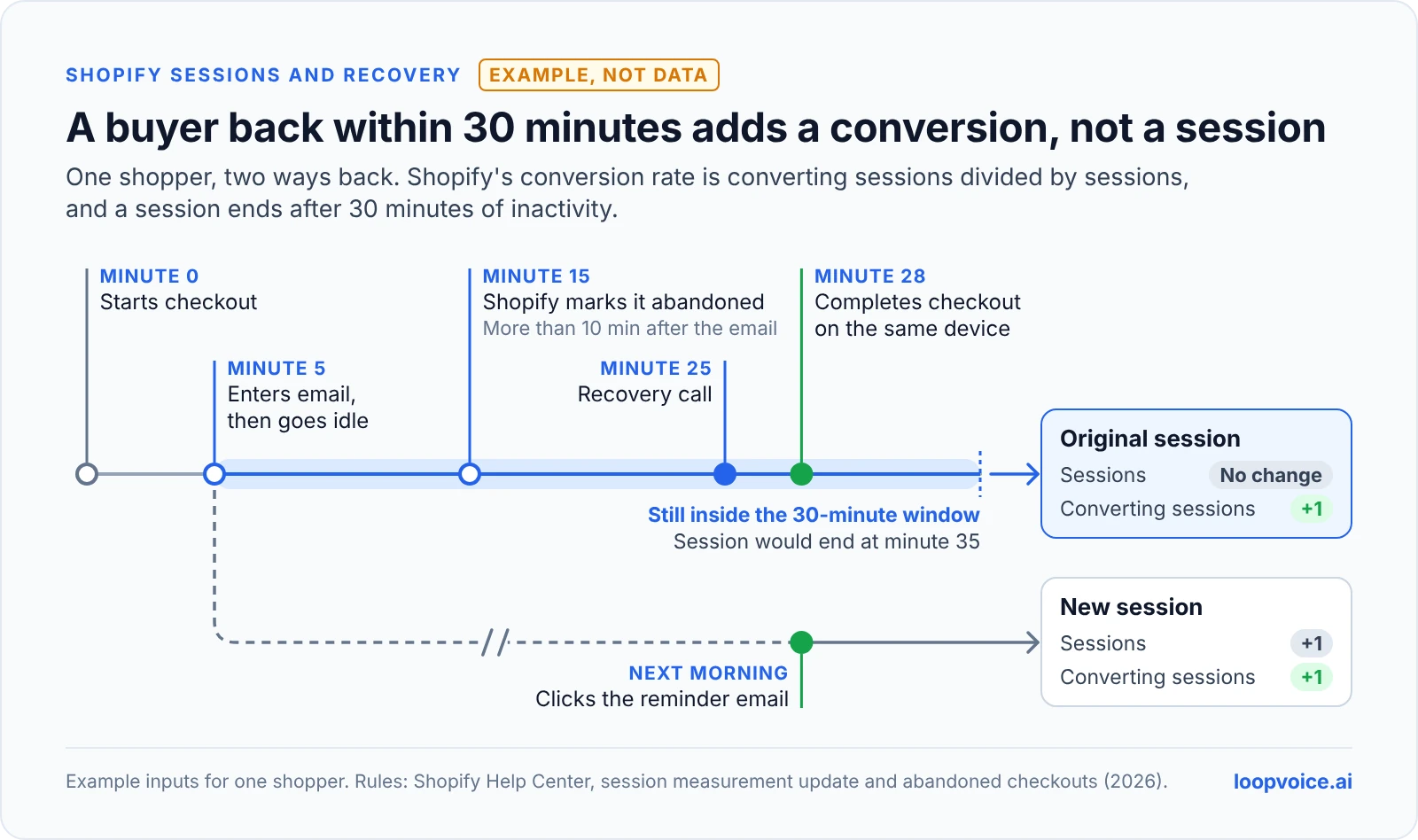
Shopify's September 2026 measurement update adds a twist. Some sessions without a pageview now count, such as a customer going directly to checkout from a cart link, which is exactly how recovery links work. Shopify warns that conversion rate can change even when orders and sales haven't, so don't read a before-and-after comparison spanning the September 21 to 23, 2026 rollout as a recovery result.
Example: a month with 20,000 sessions and 400 converting sessions shows a 2.00% conversion rate. A recovery program brings back 40 buyers, 25 through later clicks (new sessions) and 15 inside their original session, plus 160 clicks from shoppers who don't buy. The new rate is 440 ÷ 20,185 = 2.18%, not the 2.20% you'd get by adding orders and ignoring sessions.
Visitor-based numbers show recovery more fully, because a returning shopper adds sessions but not visitors; Shopify's definition notes that a visitor might have multiple sessions. Example: if those 20,000 sessions came from 15,000 visitors and every recovered buyer was already one of them, orders per visitor rise from 2.67% to 2.93%.
Don't strip recovery sessions out of the storewide rate to flatter it. Report recovered orders and contribution next to the storewide number, and tag recovery links with UTM parameters, since Shopify's sessions data can be split by UTM campaign.
When buying traffic is the better next dollar
Traffic is the better next dollar when any of these hold:
- You have fewer than about 50 abandoned carts a month. Loop Voice's own pricing page tells stores below that level to focus on traffic first, because there isn't enough recovery volume to matter.
- Your recovery is already saturated. Email and SMS run, calls cover the carts worth calling, and a holdout shows the next step adds little.
- Your margin can't carry a recovery cost. Cheap, thin-margin carts leave nothing after a call, so email alone is the right level of effort.
- Ads still win customers below their value. If your cost per new order sits under first-order contribution, or under contribution over a repeat window you have actually measured, every extra dollar earns money.
- You need new customers more than finished checkouts. Recovery only works on people already in your funnel; a launch, a new market or list growth needs traffic.
Recovery is the better next dollar when the opposite holds: 100+ abandoned carts a month, an average order well above $50, considered purchases where shoppers have questions, and payment or checkout errors turning up in your abandoned checkouts. Our abandoned cart call playbook covers which of those carts deserve a call.
A checkout fix lowers both costs
Both budgets pour shoppers into the same checkout, so a checkout fix lowers the cost per order of every channel at once. The Baymard Institute estimates the average large ecommerce site can gain a 35.26% increase in conversion rate through better checkout design, counting only issues it has documented as solvable.
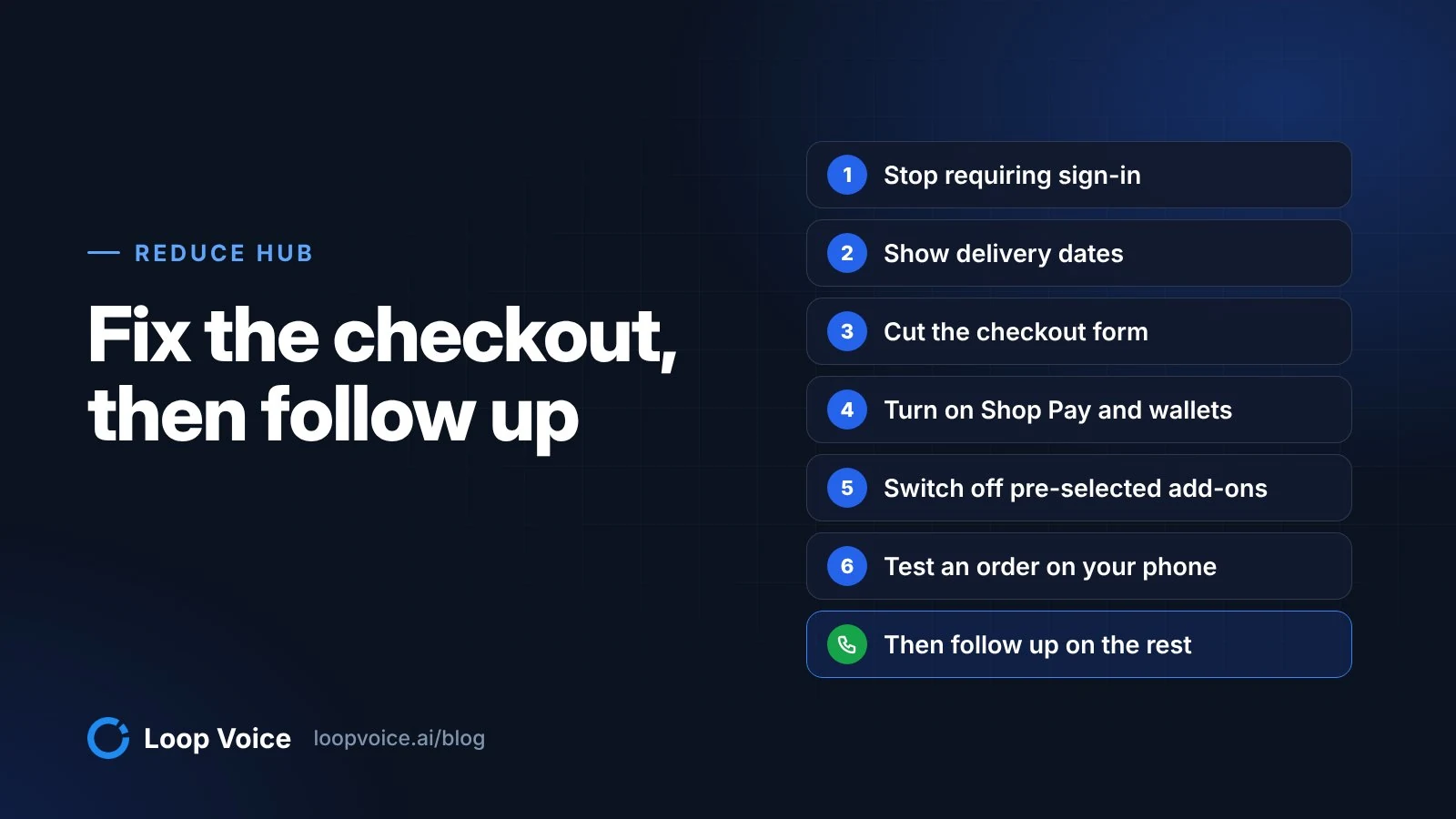
Start with what your own data shows: surprise costs at shipping, slow delivery dates and failed payments. Our checklist for reducing abandoned carts and the stage-by-stage Shopify recovery guide show where to look.
Measure both sides the same way
The comparison only works if both sides are incremental, use the same contribution margin and cover the same period. For recovery, hold a random share of eligible checkouts out of the new step and compare completion rates; our holdout test guide covers the setup. For ads, prefer the platform's lift or holdout tests over its attributed conversions, which also count shoppers who were coming back anyway.
If you call shoppers, Loop Voice attribution ties each recovered order to the call that produced it. That is the attributed side of the recovery number; the holdout gives you the incremental side, and the gap between them tells you how much of the attributed revenue to trust.
Three signs the comparison is broken
- Attributed orders add up to more than your total orders. Sum what each ad platform, email tool, SMS tool and call tool claims for the month. If the total beats your order count, channels are double counting, usually on the same returning shoppers.
- Conversion rate moved but orders didn't. That's a change in sessions, such as Shopify's September 2026 measurement update, not a channel effect.
- The cheap channel's cost per incremental order keeps rising while abandoned checkouts stay flat. You're reaching deeper into low-intent carts. Hold recovery spend where it is and send the next dollar to traffic or checkout fixes.
Frequently asked questions
Are recovered orders new customers?
Some are. Shopify's Abandoned checkouts emails report shows how many orders from its recovery emails came from first-time customers. Those buyers deserve the same repeat-purchase value you would credit to a customer won through ads, so if many recovered orders are first purchases, counting only first-order contribution understates the recovery side of the comparison.
Should retargeting ads count as recovery or as traffic?
Count them as recovery. Ads shown to people who already abandoned a cart compete with your emails, texts and calls for the same orders, so judge them with the same incremental yardstick and a holdout, not with the ad platform's attributed conversions. Otherwise one recovered order can be credited to two channels and look profitable in both reports.
Sources
- ShopifyQL sessions schema (Shopify.dev, 2026)
- Changes to sessions and conversion rate in Shopify Analytics (Shopify Help Center, 2026)
- Shopify Messaging email pricing (Shopify Help Center, 2026)
- Pricing and billing for SMS marketing campaigns (Shopify Help Center, 2026)
- The abandoned cart benchmarks report: 2026 data (Klaviyo, 2026)
- State of the Call (Hiya, 2026)
- Cart Abandonment Rate Statistics (Baymard Institute, 2025)
- Recovering abandoned checkouts (Shopify Help Center, 2026)
Hear it before you decide
Listen to real recovery calls, or see Loop Voice call a test checkout on your own store.