





Key takeaways
- Loop Voice costs about $0.95 to $1.49 per answered conversation on monthly billing.
- A US support rep costs about $31.36 an hour with benefits, including unanswered dials.
- Calling within minutes all day means paying for coverage hours, where human costs climb.
- Keep people for high-ticket, upset and regulated calls; let AI make the first call.
Three price tags, three different units
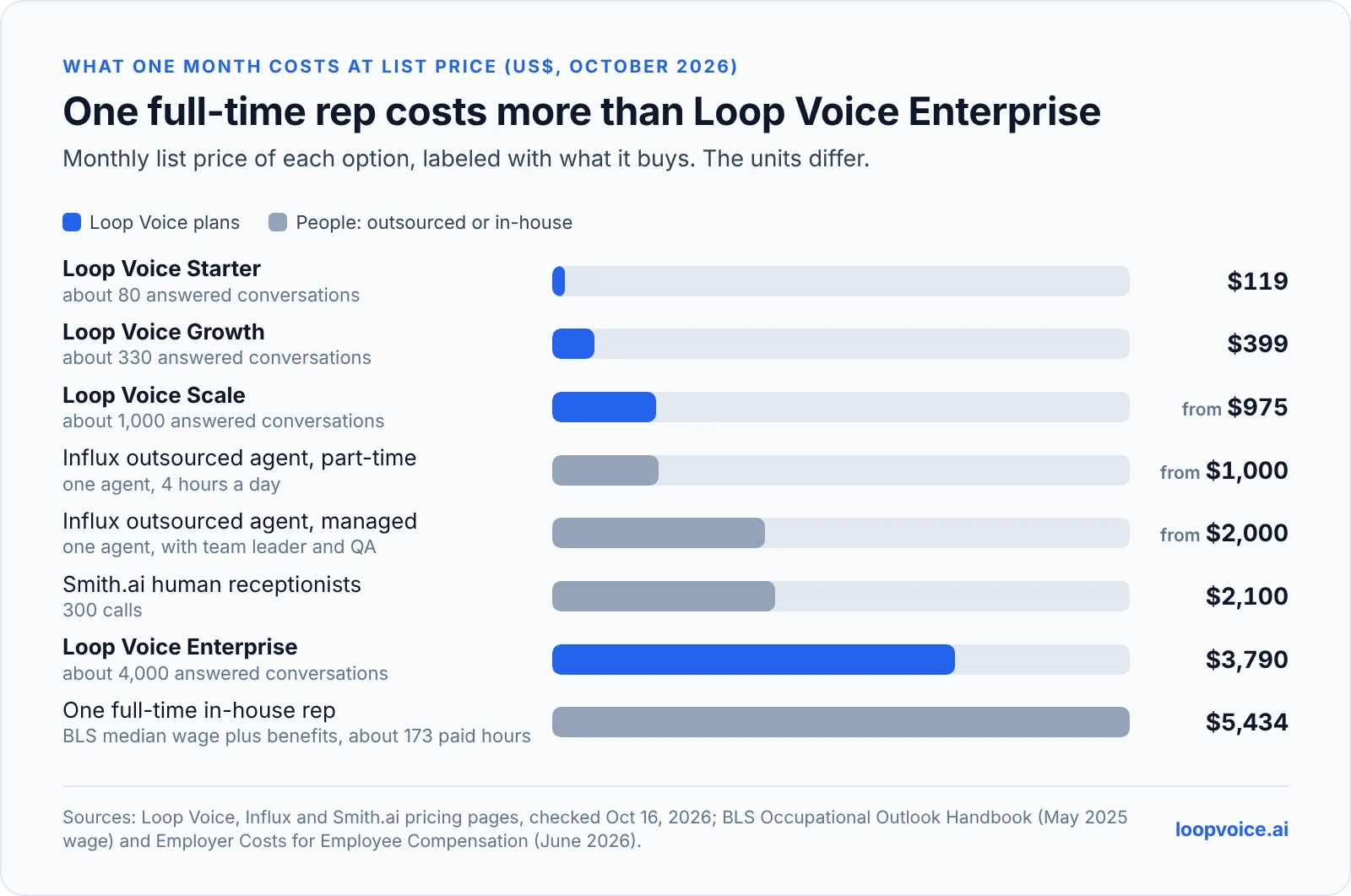
An AI voice agent on Loop Voice costs about $0.95 to $1.49 per answered conversation on monthly billing, or $0.76 to $1.19 on yearly billing. A US customer service rep costs about $31.36 an hour once employer benefits are added to the $21.53 median hourly wage, and one US human answering service, Smith.ai, publishes $7 to $10 per call.
Most cost comparisons go wrong because those prices use different units. Software here bills per answered conversation, an employee bills per hour whether or not anyone picks up, and outsourcers bill per call, per agent seat or per recovered sale. Put each option on its own unit first, then convert. To run your own numbers, use the AI voice agent cost calculator.
| Option | What you pay for | Published price |
|---|---|---|
| Loop Voice Starter | 120 credits, about 80 answered conversations | $119 a month, or $95 a month billed yearly |
| Loop Voice Growth | 500 credits, about 330 answered conversations | $399 a month, or $319 billed yearly |
| Loop Voice Scale | 1,500 credits, about 1,000 answered conversations | From $975 a month, or $779 billed yearly |
| Loop Voice Enterprise | 6,000 credits, about 4,000 answered conversations | $3,790 a month, or $3,032 billed yearly |
| In-house rep (US median) | Paid hours | $21.53 an hour in wages, about $31.36 with benefits |
| Smith.ai human receptionists | Calls handled | $300 for 30 calls, $810 for 90, $2,100 for 300 |
| Influx outsourced agent | One agent seat a month | From $1,000 (part-time) or $2,000 (managed) |
| LiveRecover human SMS agents | Base fee plus a cut of recovered sales | $199 a month plus 10% of recovered sales |
Prices are list prices checked on Oct 16, 2026, from each company's own pricing page (linked in the sections below).
Loop Voice: what an answered conversation costs on each plan
Loop Voice credits are used only when someone picks up, and an answered conversation uses about 1.5 credits on average. Divide the plan price by its credits, multiply by 1.5, and you get the effective price per answered conversation.
| Plan | Monthly billing | Yearly billing | Capacity a month |
|---|---|---|---|
| Starter | $1.49 | $1.19 | About 80 answered conversations |
| Growth | $1.20 | $0.96 | About 330 |
| Scale | $0.98 | $0.78 | About 1,000, with volume pricing up to 10,000 credits |
| Enterprise | $0.95 | $0.76 | About 4,000, with done-for-you setup |
These are capacity estimates at list price, not promised results. Answered calls that do not end in an order still use credits, and once a plan's credits run out, extra conversations are billed at the plan's per-extra-credit rate. Every plan includes the 24/7 AI calling agent, attribution tracking, integrations and unlimited agents and users; the full list is on the Loop Voice pricing page.
Loop Voice also runs a guarantee for qualifying brands only (about 17% qualify): if it does not recover at least 4x the plan cost in the first month, the next month is free.
What a human rep really costs per hour
The wage is only part of the bill. In private industry office and administrative support jobs, wages and salaries make up 68.7% of what employers spend on compensation and benefits make up the other 31.3% (BLS, June 2026). Apply that ratio to the $21.53 median wage for customer service representatives (BLS, May 2025) and one hour costs about $31.36.
A full-time rep works about 173 paid hours a month (40 hours times 52 weeks, divided by 12). At the median wage that is about $3,731 a month in pay and about $5,434 with benefits. BLS puts the lowest-paid 10% of reps under $15.27 an hour and the top 10% above $30.57, so local pay can move these numbers down by about 30% or up by about 40%.
Then add what neither number includes:
- A phone system with a dialer. Aircall's Professional plan, which adds a power dialer, lists $50 per license a month with a three-license minimum, so $150 a month even for one caller.
- Hiring and training. BLS says new reps usually get short-term on-the-job training that typically lasts 2 to 4 weeks, which you pay for before the rep is fully productive.
- Supervision and quality review. Someone has to write the script, listen to calls and coach. That time comes from a manager or founder.
- Coverage. One seat staffed around the clock needs 168 hours a week, or 4.2 full-time people before vacations and sick days. BLS notes that call center jobs may require early-morning or late-night shifts because some centers are open 24 hours a day.
What outsourcing costs, and what the price leaves out
Outsourcers price in three ways, and each one moves a different risk onto you.
Per call. Smith.ai's human receptionist plans charge $300 for 30 calls, $810 for 90 and $2,100 for 300, so $7 to $10 per included call, with overage of $8.50 to $11.50 per call. Its agents are US-based and the service is built around answering inbound calls: lead screening, intake and transfers. Ask any per-call vendor how it prices outbound dialing, because unanswered dials are where outbound programs lose money.
Per seat. Influx lists outsourced agents from $1,000 a month, including part-time agents working four hours a day, and fully managed agents with a team leader and QA from $2,000 a month. Prices vary by agent level, region and channel (digital or voice). You get a person's hours; you still decide how those hours are spent.
Per recovered sale. LiveRecover uses human agents who text shoppers after an abandoned checkout, at $199 a month plus 10% of recovered sales, or $499 plus 5%. Example: on $10,000 of recovered sales in a month, the Growth plan costs $1,199 and the Pro plan $999. It is text, not voice, but it is the cleanest published price for outsourced human cart recovery.
Worked example: 300 answered recovery calls a month
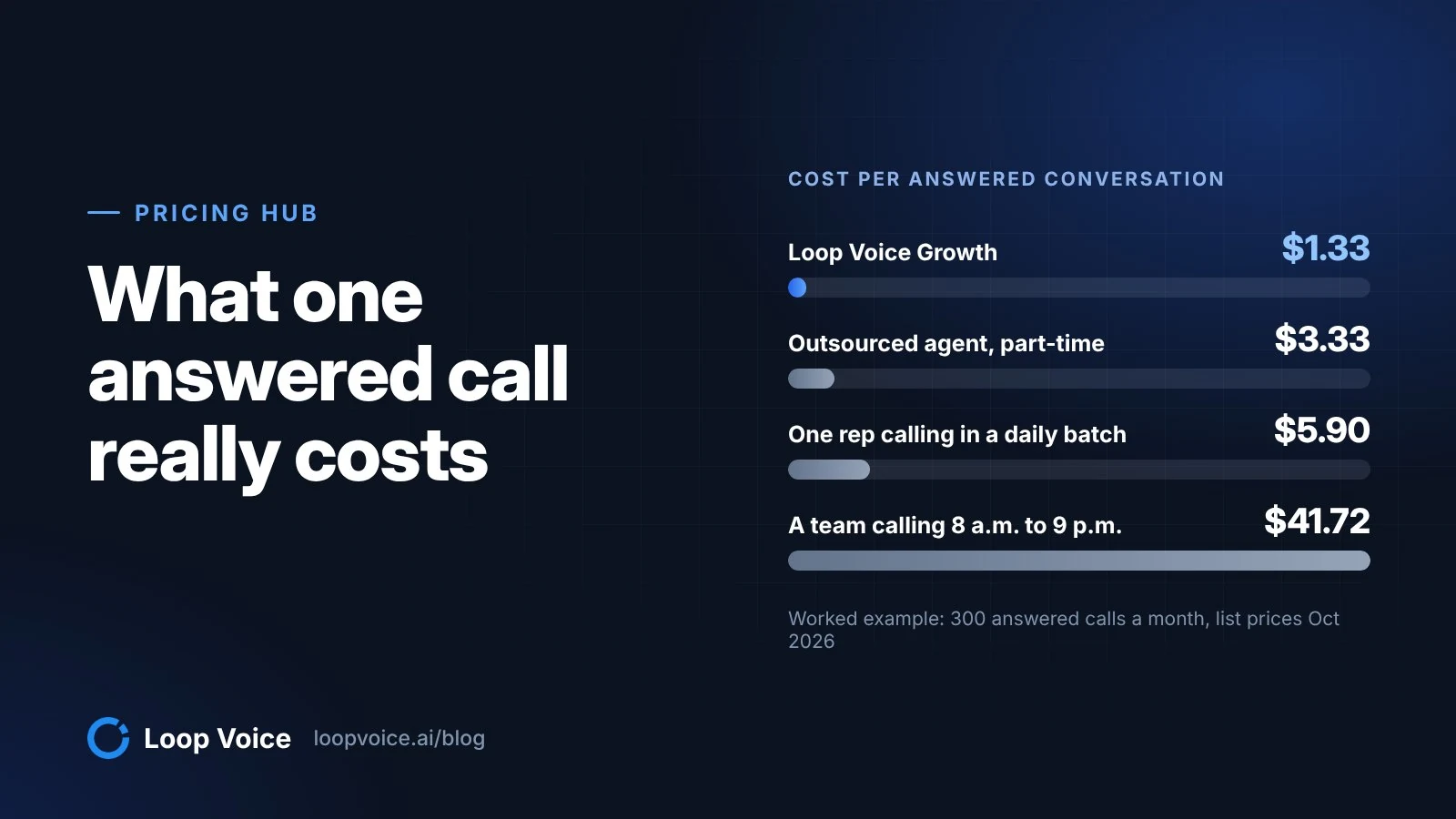
Example: a Shopify store wants 300 answered abandoned-checkout conversations a month. Assume it takes 1,000 dials to reach 300 people, a rep spends 8 minutes on each answered call including notes, and 1 minute on each unanswered dial. That is 3,100 minutes, or about 52 hours of calling time.
| Setup | Monthly cost | Per answered conversation | When the first call happens |
|---|---|---|---|
| Loop Voice Growth, monthly billing | $399 | $1.33 | 10 minutes after the checkout is abandoned by default, inside your calling window |
| Loop Voice Growth, yearly billing | $319 | $1.06 | Same |
| Outsourced part-time agent (Influx, 4 hours a day) | From $1,000 | From $3.33 | Only during the agent's shift |
| One in-house rep calling in a daily batch (52 hours at $31.36, plus a $150 phone system) | About $1,770 | About $5.90 | Hours later, when the rep's calling block starts |
| In-house team covering 8 a.m. to 9 p.m. every day (91 hours a week, about 2.3 full-time people) | About $12,515 | About $41.72 | Within minutes |
The 300 conversations use about 450 of Growth's 500 credits, so the plan covers them. The last row is the one that surprises people: if you want a human to call within minutes all day, you pay for the coverage hours, and the cost barely depends on how many calls you make.
Example, continued: the break-even test. Suppose each recovered order contributes $75 after product, shipping and discount costs. The batch rep costs $4.57 more per answered conversation than Growth on monthly billing, so the rep has to turn about 6 more of every 100 answered calls into orders just to break even. If you believe your best rep closes that much better, run the test in the section on measurement below.
For scale, Loop Voice's published customer results range from 5% of calls becoming a sale at CityMan USA to 11% at Modern Hearing, with Warrior Will Power at 7.1% and CastleFlexx at 8% (see the customer stories). Use your own numbers, not theirs, for the decision.
Why hourly pay hurts most on outbound calls
Most outbound dials never become a conversation. Hiya's State of the Call 2026 reports that 86% of calls from unknown numbers go unanswered. A rep is paid for every one of those rings and voicemails, while Loop Voice credits are used only when someone picks up.
Speed is the second cost. Loop Voice's default abandoned-checkout flow waits ten minutes and then calls, and merchants can change the delay. Matching that with people means staffing every hour that the calling-hour rules allow, which is the $12,515 row above.
Long, patient calls are the third. Some shoppers need someone to stay on the line through every checkout screen, and the full version of the call below ran about 18 minutes. At $31.36 an hour, 18 minutes of a rep's time costs about $9.40 in wages and benefits before any overhead.
Yep. That's the one. Go ahead and check that box so billing matches shipping, then try tapping place order again. What happens when you do that?
Okay. I'll see you in a minute. Okay. It finally took Just confirm.
Perfect. Sounds like it went through. Do you see an order confirmation page with an order number, or did you get a confirmation email or text?
I got I got eight order summary on that.
Got it. Does it show an order number on that summary? If it's easier, you can just read the last four digits.
see an order number. I can get confirmation code.
That works. What's the order number or confirmation code you see there? If you want, you can type it on your keypad.
More recordings like this sit in the public call library, which is a fair way to judge whether an AI agent's patience and tone are good enough for your customers.
Where a human team is still the better buy
Software is cheaper per conversation, but price is not the only test. People are the better choice in these cases:
- Very low volume. Loop Voice's own pricing page puts the minimum at roughly 50 to 100 abandoned carts a month and tells stores below 50 to focus on traffic first. At five carts a week, the founder should call the best ones personally.
- Consultative, high-ticket sales. Made-to-order products, B2B and wholesale quotes, and any deal that needs someone with authority to change terms.
- Upset customers and exceptions. Damaged-order disputes, chargeback threats and refunds outside policy. Loop Voice's escalation rules hand off on negative sentiment, complex refunds, and legal or medical questions, which tells you where the line sits.
- Regulated or medical advice. In one inbound call in the public library, the agent for a health device brand told a caller nine months out from knee surgery to get sign-off from a physical therapist or surgeon first, because the brand's safety guidance says so. That is the right behavior, and it means a qualified person owns those questions.
- Payments taken by phone. A Loop Voice agent texts the checkout link and the shopper pays on your checkout. If your process requires reading card details over the phone, that stays a human job with its own security controls.
- Languages you cannot cover. Loop Voice's inbound agents speak English and Spanish, plus 30 more languages, including Arabic. Anything else needs a person or another vendor.
A hybrid setup: AI on the first call, people on the exceptions
You do not have to pick one. A setup that works for most stores:
- Let the AI make the first call on every eligible abandoned checkout, inside the calling window and consent rules in our guide to calling rules.
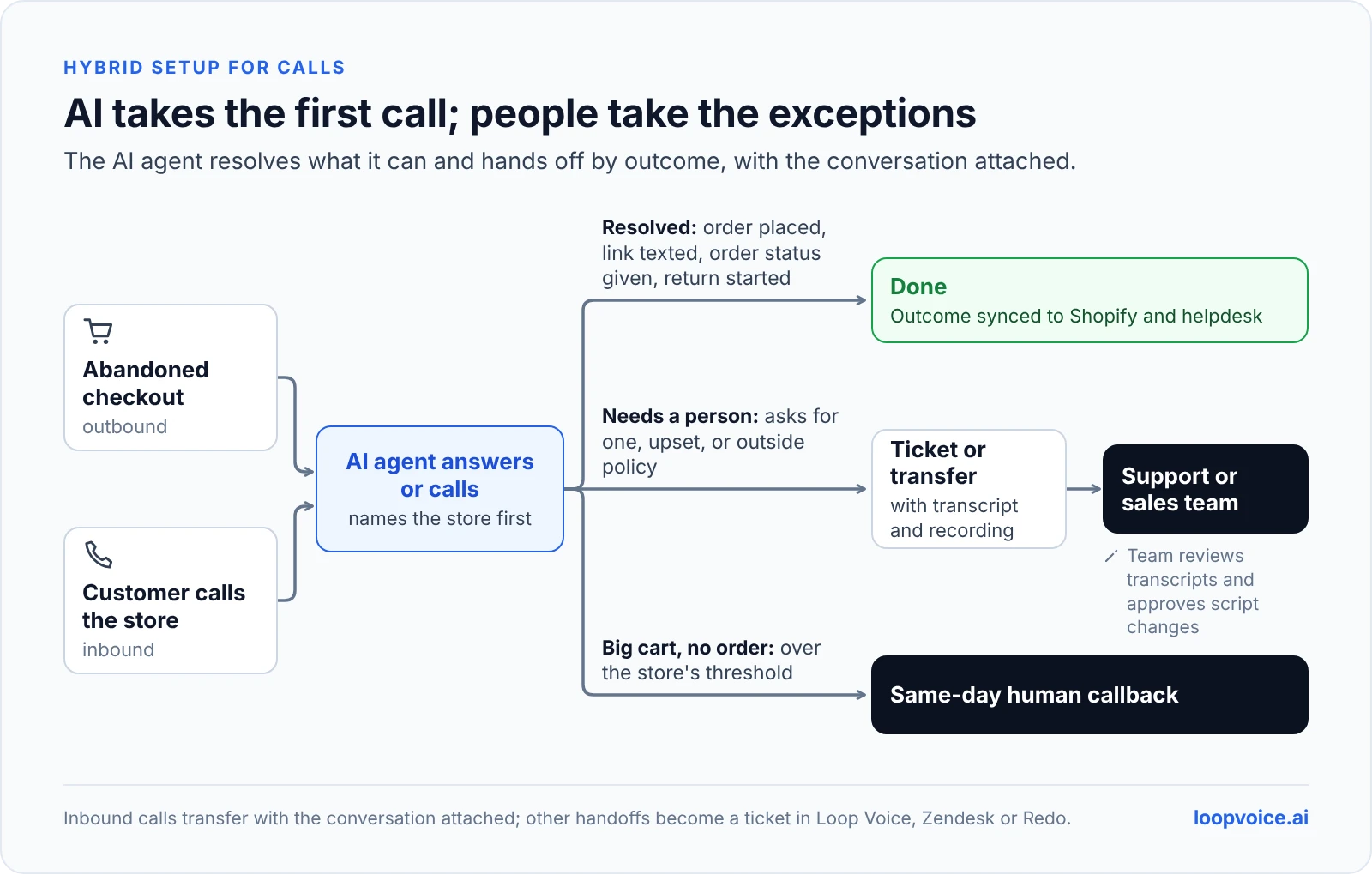
- Escalate by outcome, not by default. When a shopper asks for a person, gets upset or raises something outside policy, the agent hands off: inbound calls transfer with the conversation attached, and unresolved cases become a ticket with the summary, the order and the recording attached, in Loop Voice, Zendesk or Redo.
- Give big carts a human second touch. Example: a store selling $900 furniture has a salesperson call back, the same day, any cart over $500 whose AI call ended without an order. The calls log shows each outcome, so the list builds itself.
- Answer the phone on the first ring. Inbound agents handle order status, returns and where-is-my-order calls 24/7, or only after hours if your team covers the day, and transfer exceptions with the conversation attached. The setup steps are in our guide to AI phone support.
- Keep one human owner of the rules. That person approves discounts, policies and changes. LoopIQ suggests edits from real calls, but nothing changes until someone approves it.
Judge both on cost per incremental order
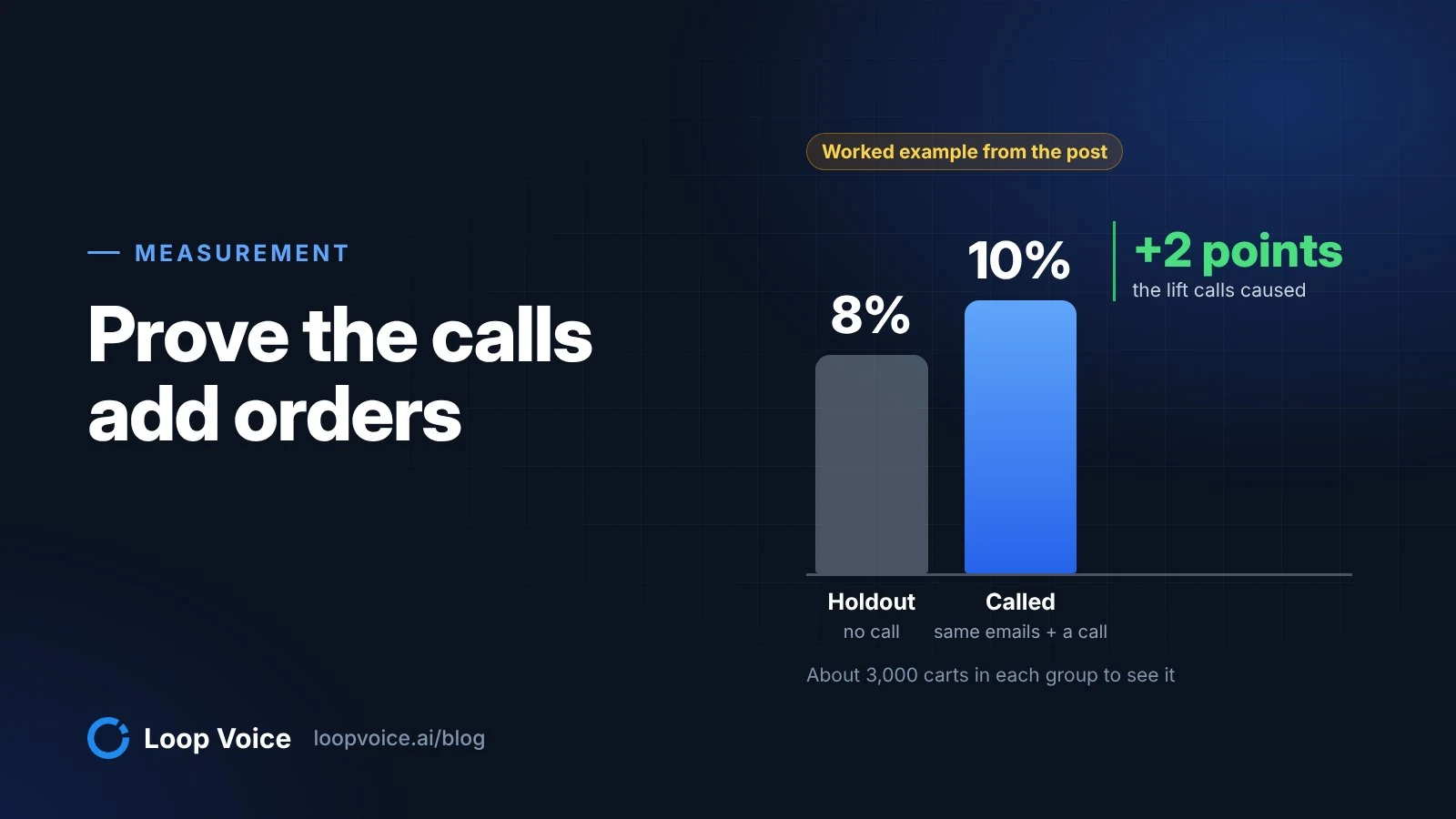
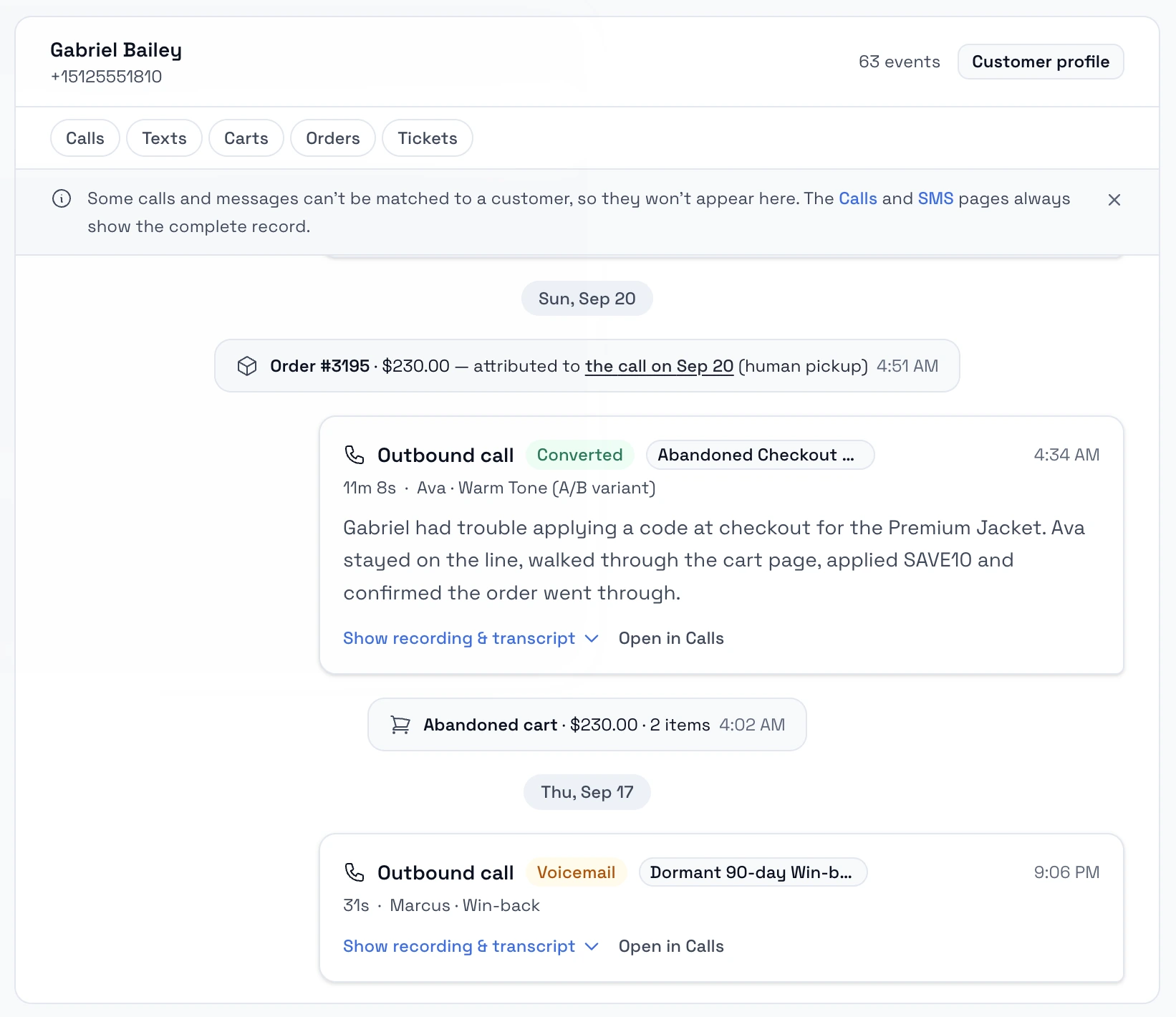
Attribution ties each recovered order to the call before it. A holdout group tells you how many of those orders the calls added, because some shoppers would have come back anyway. The honest number is cost per incremental order: total program cost divided by the extra orders the called group placed compared with a similar group you did not call.
Example: you call 900 eligible abandoned checkouts and hold out 100. The called group converts at 14% and the holdout at 9%, so calling added 5 orders per 100 checkouts, or 45 orders. At $399 a month, that is about $8.87 per incremental order; a $1,770 rep producing the same lift costs about $39.33.
The setup, sample sizes and pitfalls are in our holdout test guide. Run the same test on any vendor or in-house team you are comparing, with the same audience rules and the same calling window, or the comparison means nothing.
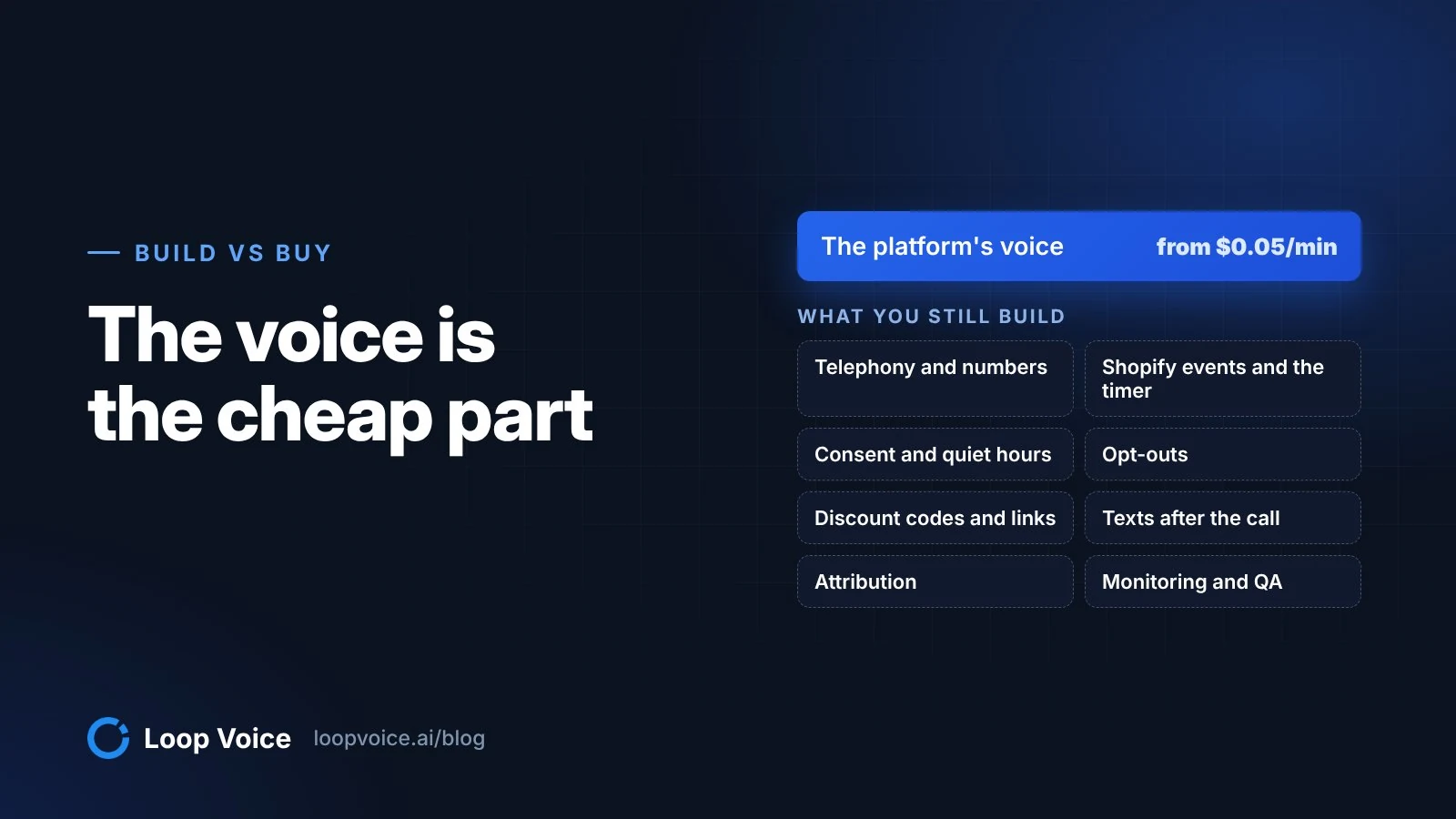
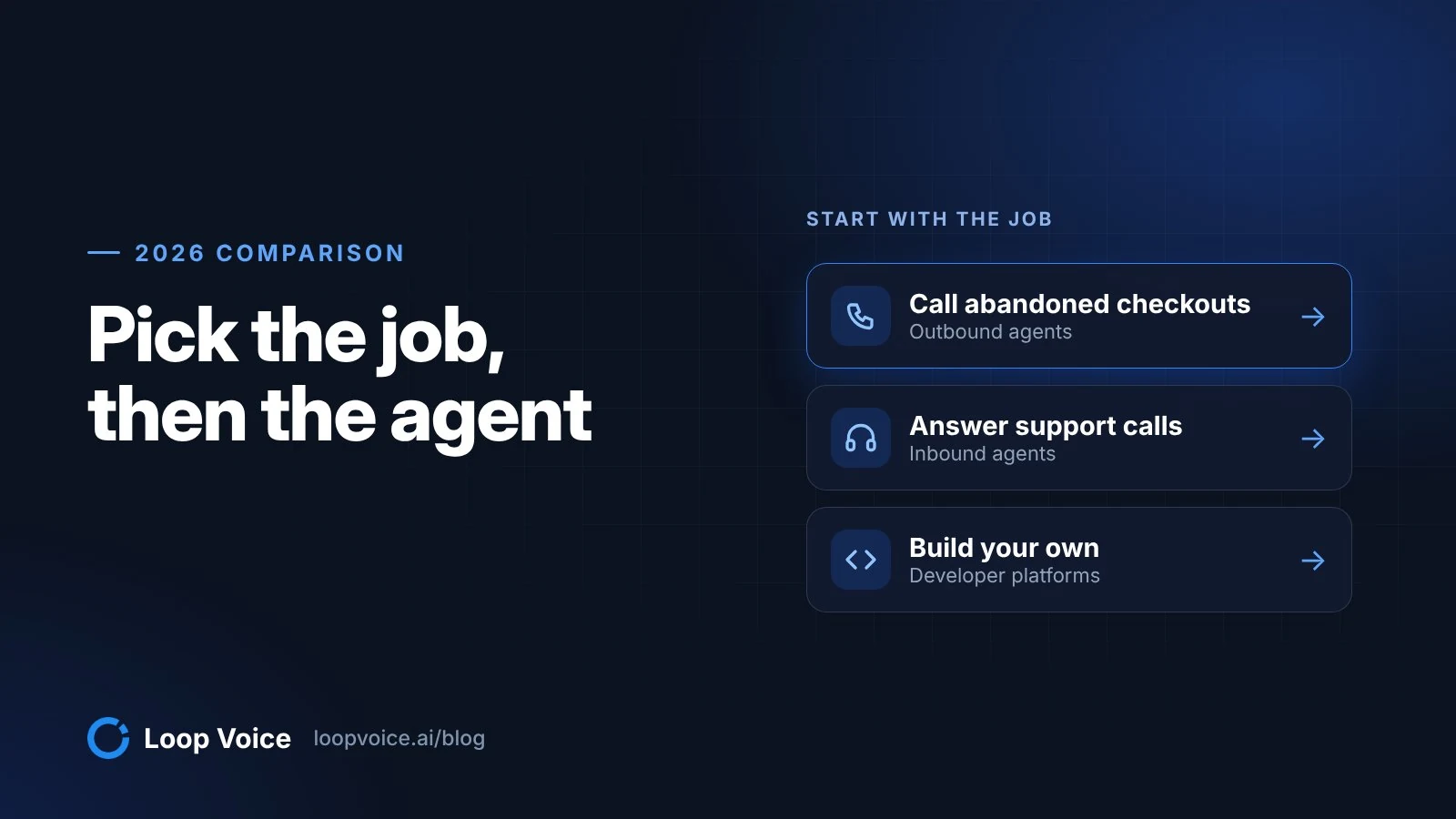
If you are weighing other AI vendors at the same time, our comparison of AI voice agents for Shopify lists their prices on the same units, and the build-or-buy breakdown covers what it costs to build your own on a developer platform.
Sources
- Plans and pricing (Loop Voice, 2026)
- Customer service representatives: Occupational Outlook Handbook (US Bureau of Labor Statistics, 2026)
- Employer Costs for Employee Compensation, Table 4 (June 2026) (US Bureau of Labor Statistics, 2026)
- Aircall pricing (Aircall, 2026)
- Plans and pricing for virtual receptionists (Smith.ai, 2026)
- Influx pricing (Influx, 2026)
- Conversations by LiveRecover pricing (vyg.ai, 2026)
- State of the Call 2026 (Hiya, 2026)
- Customer results (Loop Voice, 2026)
Hear it before you decide
Listen to real recovery calls, or see Loop Voice call a test checkout on your own store.