
Build vs Buy an Ecommerce AI Voice Agent: 2026 Costs
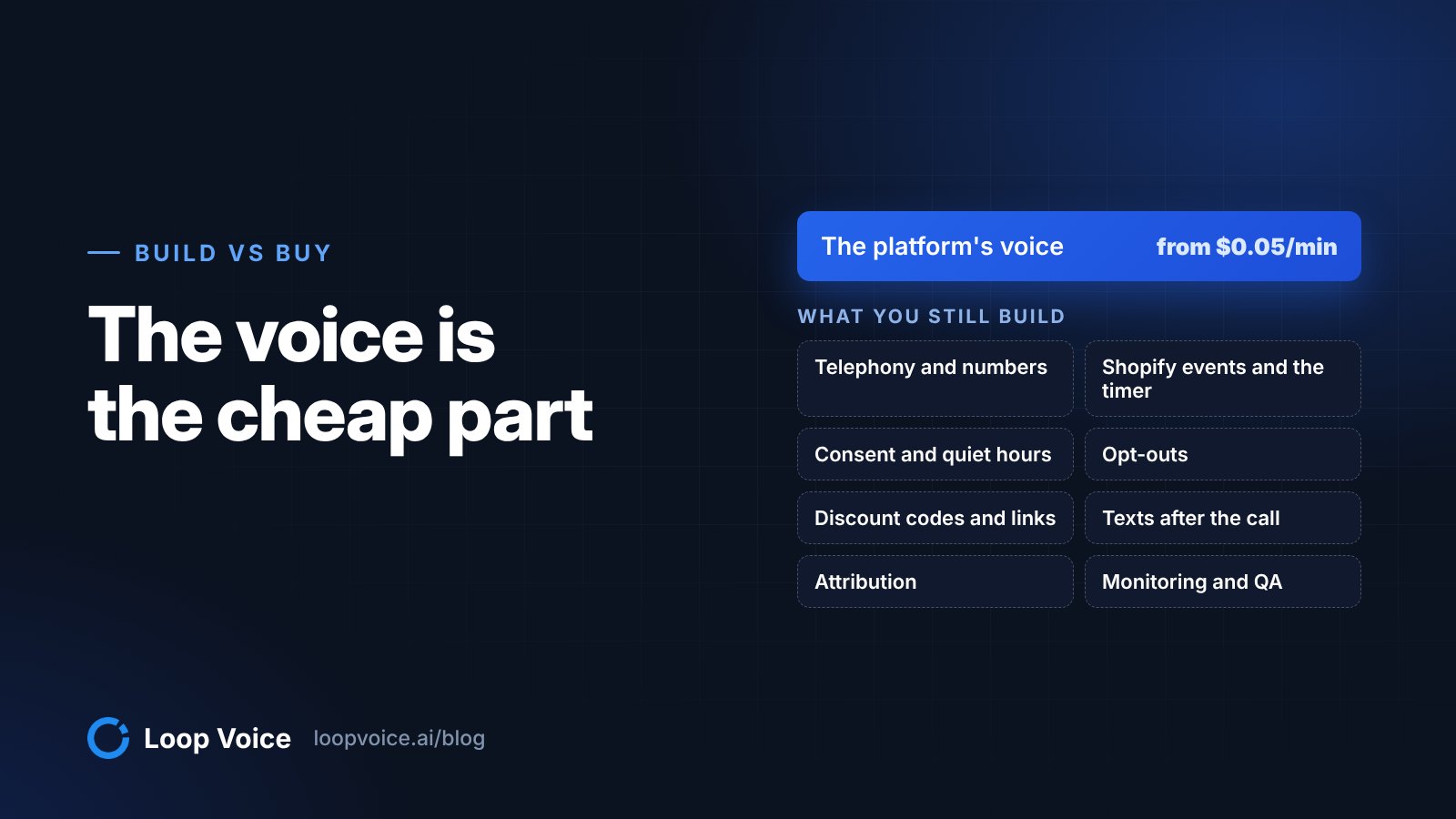
Buy a ready-made agent unless you have engineers, an unusual workflow or huge volume. The voice costs cents a minute; the Shopify, consent, SMS and attribution layer is the real build.

Key takeaways
- Developer platforms price the voice at $0.05 to $0.31 a minute; that is the cheap part.
- The real build is the ecommerce layer: Shopify events, consent, opt-outs, texts, discounts, attribution and QA.
- Building costs less per minute, so the case for it rests on volume and engineers you already have.
- Buy for standard Shopify plays; build when your workflow or scale is unusual.
The short answer
Buy a ready-made ecommerce voice agent unless you already employ engineers who own your Shopify integrations, your calls are not a standard ecommerce play, or you expect tens of thousands of answered calls a month. The voice is the cheap part: developer platforms publish prices from $0.05 a minute (Vapi's hosting fee, before models) to $0.31 a minute (the top of Retell AI's range), while the Shopify events, consent rules, opt-outs, texts, discount links and attribution around the voice are where the engineering time goes.
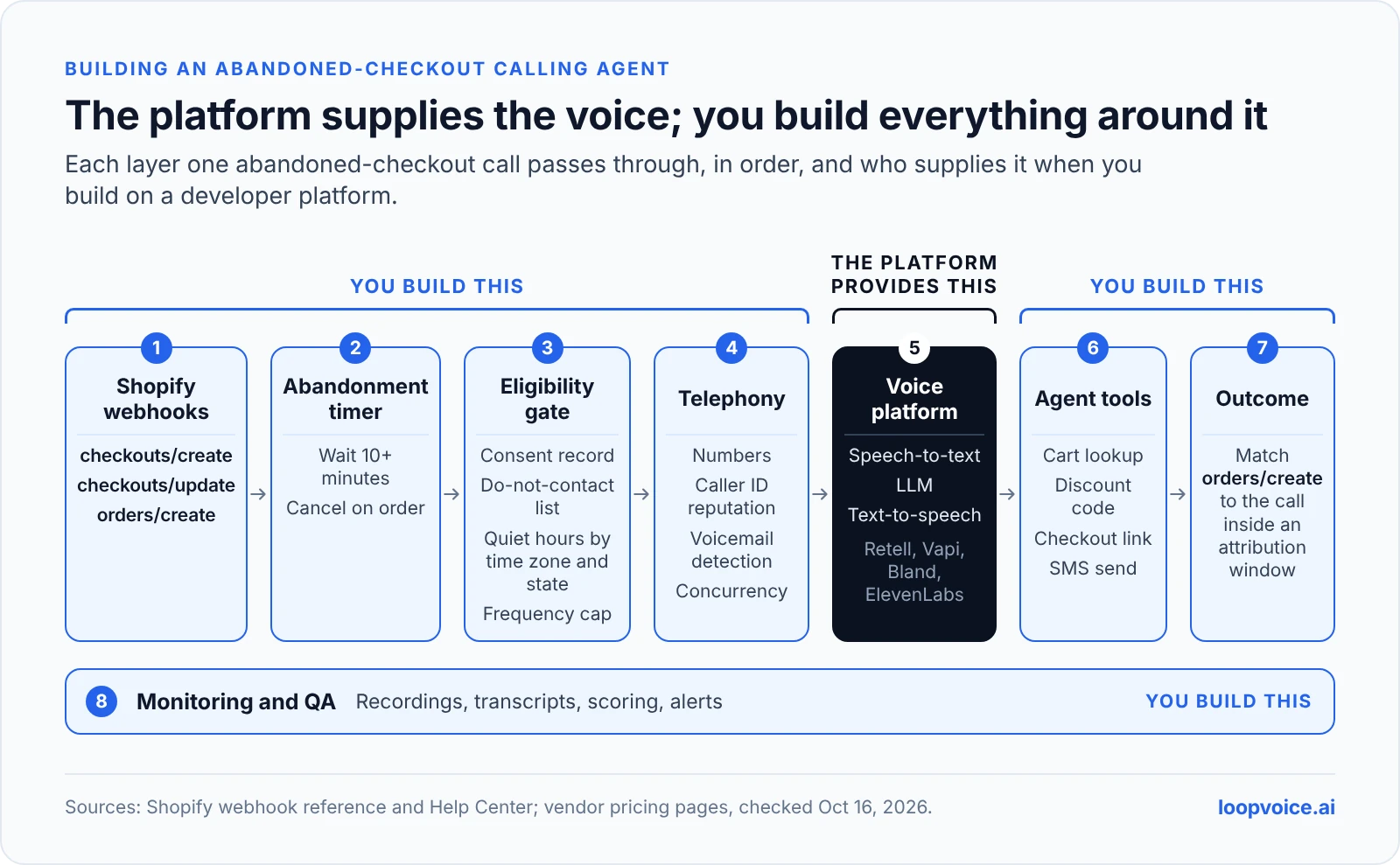
Loop Voice sells one of the ready-made agents, so weigh this post with that in mind. We also run on third-party voice infrastructure ourselves (the providers are listed on our security page), so we have built the layer this post describes. The eight components below are the ecommerce layer a platform leaves to you, which is what a ready-made agent adds.
Vendor prices come from each vendor's own pricing page, checked on October 16, 2026. Anything built on assumed inputs is labelled as an example.
Build vs buy at a glance
| Build on a developer platform | Buy a ready-made ecommerce agent | |
|---|---|---|
| What you get | Speech-to-text, a language model, text-to-speech, telephony hooks and an API | An agent already wired to store events, with flows, compliance settings, texts and reporting |
| First test call | Minutes to a day, by the vendors' own accounts | Minutes; Loop Voice setup takes under 10 minutes with no code |
| First real abandoned-checkout call | Weeks, because you write the Shopify, consent, SMS and attribution layer | As soon as the flow is live; Loop Voice's default flow calls ten minutes after a checkout is abandoned |
| Usage cost | About $0.10 to $0.14 a minute for a typical stack including telephony (example below) | Per plan; Loop Voice works out to about $0.76 to $1.49 per answered conversation, unanswered calls free |
| Shopify events, checkout links, discount codes | You build them | Included |
| Quiet hours, opt-outs, frequency caps | You build and maintain them, state by state | Settings |
| Texts after the call | You register for A2P 10DLC and build sending and STOP handling | Included |
| Attribution to orders | You build it | Included |
| Flexibility | Anything you can code, any model, any workflow | What the product supports |
| Who maintains it | Your engineers, for as long as it runs | The vendor |
Building wins on per-minute cost, model choice and control. Buying wins on time, on the compliance plumbing and on not owning a dialer. Ready-made agents also differ from each other; our comparison of AI voice agents for Shopify covers the options, including where other products beat Loop Voice.
What the developer platforms charge (as of October 2026)
These are self-serve list prices from each vendor's pricing page on October 16, 2026. All of them negotiate at volume, and most bill the language model, the voice or the phone line separately, so compare the full stack rather than the headline rate.
| Platform | Published price | Billed on top | Limits on the entry plan |
|---|---|---|---|
| Retell AI | $0.07 to $0.31 a minute, pay as you go: $0.055 voice infrastructure, plus the voice ($0.015 for Retell's own voices), plus the LLM you pick | US telephony $0.015 a minute (free on your own SIP trunk); numbers $2 a month; knowledge base +$0.005 a minute; AI quality assurance $0.10 a minute after 100 free minutes; texts $0.01 each | 20 concurrent calls free, then $8 per extra line a month |
| Vapi | $0.05 a minute hosting; models passed through at cost (its calculator shows Deepgram $0.0095 to $0.0099, OpenAI $0.0077 to $0.0452 and ElevenLabs $0.0146 to $0.0238 a minute) | Twilio outbound $0.014 a minute, billed by Twilio; optional support packages from $29 a month | 4 concurrent calls and one included number without a package |
| Bland AI | $0.14 a minute on Start ($0 platform fee) or $0.12 on Build ($299 a month); LLM, speech-to-text and text-to-speech included | Telephony on your own carrier, or Bland's at pass-through cost; transferred minutes $0.05 (Start) or $0.04 (Build) | Start: 10 concurrent calls, 100 calls a day |
| ElevenLabs Agents | $0.08 a minute beyond the minutes in your plan (free plan: 15 minutes; paid plans from $6 a month with 75 minutes) | LLM usage by model; your telephony provider bills you directly; texts $0.003 each | Concurrency by plan; overflow calls at $0.16 a minute |
| Synthflow | No public per-minute price | Scoped per contract | Enterprise contracts start at $30,000 a year |
Two limits matter more for a store than the rate. Bland's Start plan stops at 100 calls a day, and Vapi without a package runs 4 calls at once. Size concurrency for your busiest hour (a sale, a campaign send), not your daily average.
Billing rules matter as well. Retell tracks each connected call to the second, keeps billing through silence and hold time, and bills voicemail for as long as the agent is on the line, so voicemail drops and long pauses show up on the invoice.
Example: a Vapi stack with Deepgram, an OpenAI model and an ElevenLabs voice, dialing out on Twilio, lands between $0.096 and $0.143 a minute using the ranges above ($0.05 + $0.0095 + $0.0077 + $0.0146 + $0.014 at the low end). Take $0.12 a minute, the middle of that range; Retell's own calculator default of $0.11 a minute before telephony sits in the same place. If an answered conversation runs 4 minutes and the dials that reach voicemail add one more billable minute per answered conversation, usage comes to about $0.60, plus a cent for the follow-up text.
That is cheaper than buying. Loop Voice plans work out to about $0.95 to $1.49 per answered conversation on monthly billing and $0.76 to $1.19 on yearly billing, because an answered conversation uses about 1.5 credits and unanswered calls use none (plan details). The gap is $0.15 to $0.88 per answered conversation, and the real question is whether it pays for the people who build and run everything else.
Example continued: if building and running the system takes one engineer at an assumed $12,000 a month fully loaded, usage savings cover that salary at about 13,600 answered conversations a month against the most expensive plan rate ($12,000 divided by $0.88), and at about 80,000 against the cheapest ($12,000 divided by $0.15). Below that, buying costs less in total even though it costs more per minute. Our voice agent vs call center cost guide runs the same math for human callers.
Long calls move the build math. In our library of real recovery calls, the eight checkout calls that ended in an order and have full timings ran from about 8 to 21 minutes; at the example rate of $0.12 a minute, that is about $0.90 to $2.50 each. Patient calls run long, so model costs on your real call lengths rather than a 4-minute average, and do not cap call length to save money.
The eight things you build on top of the platform
A developer platform gives you a voice that can hold a conversation and call your code. For abandoned checkouts, everything that decides who gets called, when, with which link, and what happened afterwards is yours to build.
1. Telephony and numbers
Pick a carrier, buy numbers, choose local or toll-free caller ID, detect voicemail and size concurrency. Platforms resell this layer: Retell charges $0.015 a minute for US telephony and $2 a month per number, and sells verified numbers ($10 a month) and branded caller ID ($0.10 per outbound call) to fight spam labels.
Those extras exist because unknown numbers rarely get picked up: Hiya's State of the Call 2026 reports that 86% of unknown calls go unanswered. Caller ID decides your answer rate before the agent says a word. Our guide to local vs toll-free numbers covers the choice.
2. Shopify events and the abandonment timer
Shopify has no "checkout abandoned" webhook. You subscribe to checkouts/create and checkouts/update, start your own timer and cancel it when orders/create arrives (see Shopify's webhook topic reference). Shopify counts a checkout as abandoned once it stays incomplete for more than ten minutes after the shopper enters an email (Shopify Help Center), so a shorter timer calls people who are still typing their card number.
The checkout payload includes the phone number, an abandoned_checkout_url recovery link and a buyer_accepts_sms_marketing flag. Phone numbers are Level 2 protected customer data: a public app has to request the field and pass Shopify's review, and access for an app you create in your own admin varies by Shopify plan (Shopify protected customer data). Plan for that review before you plan the prompt.
3. Consent and quiet hours
AI-generated voices count as "artificial" voices under the TCPA (FCC declaratory ruling 24-17). The federal rules in 47 CFR 64.1200 require prior express written consent for artificial-voice telemarketing calls to cell phones and residential lines, bar telephone solicitations before 8 a.m. or after 9 p.m. at the called person's location, and require the message to identify the business at the start.
States add their own layer. Florida's telemarketing statute sets the cutoff at 8 p.m. and allows no more than three calls on the same subject in 24 hours, from any number (Fla. Stat. 501.616). In code, that means a consent record per phone number, a time zone and state for every shopper (the area code is only a proxy), and a scheduler that holds a call until the window opens instead of dropping it. Our guide to calling rules covers the consent side in depth.
4. Opt-outs
Artificial-voice telemarketing calls must offer an automated opt-out during the call, by voice or key press, and a request to revoke consent made in any reasonable way has to be honored within ten business days (both in 47 CFR 64.1200). Build one do-not-contact list that every flow, campaign and text checks before it runs.
Capture "don't call me" from the transcript as well as the keypad, record where each opt-out came from, and treat a STOP reply to a text as a stop for calls about the same cart. The bug that hurts is the second system that never heard about the first opt-out.
5. Discount codes and checkout links
The agent needs tools to look up the cart, read back the total, send the recovery link and offer only a discount you approved. Create the codes through Shopify's Admin API and give the agent its own code, so orders that use it are easy to trace.
Then stop the model from improvising offers. A language model told to close a sale can invent a discount unless your tool layer refuses anything outside the approved list. Treat the recovery link like a key, too: send it only to the phone number on that checkout.
6. Texts after the call
When a shopper wants the checkout link, the agent has to text it. From a US 10-digit number that means registering for A2P 10DLC first (our A2P 10DLC registration guide walks through it), paying per message (Retell lists $0.01 a text, ElevenLabs $0.003), handling STOP and HELP replies, and keeping texts inside quiet hours as well.
Texts also need the same stop rules as calls. A text queued after a call should check for an order before it sends.
7. Attribution
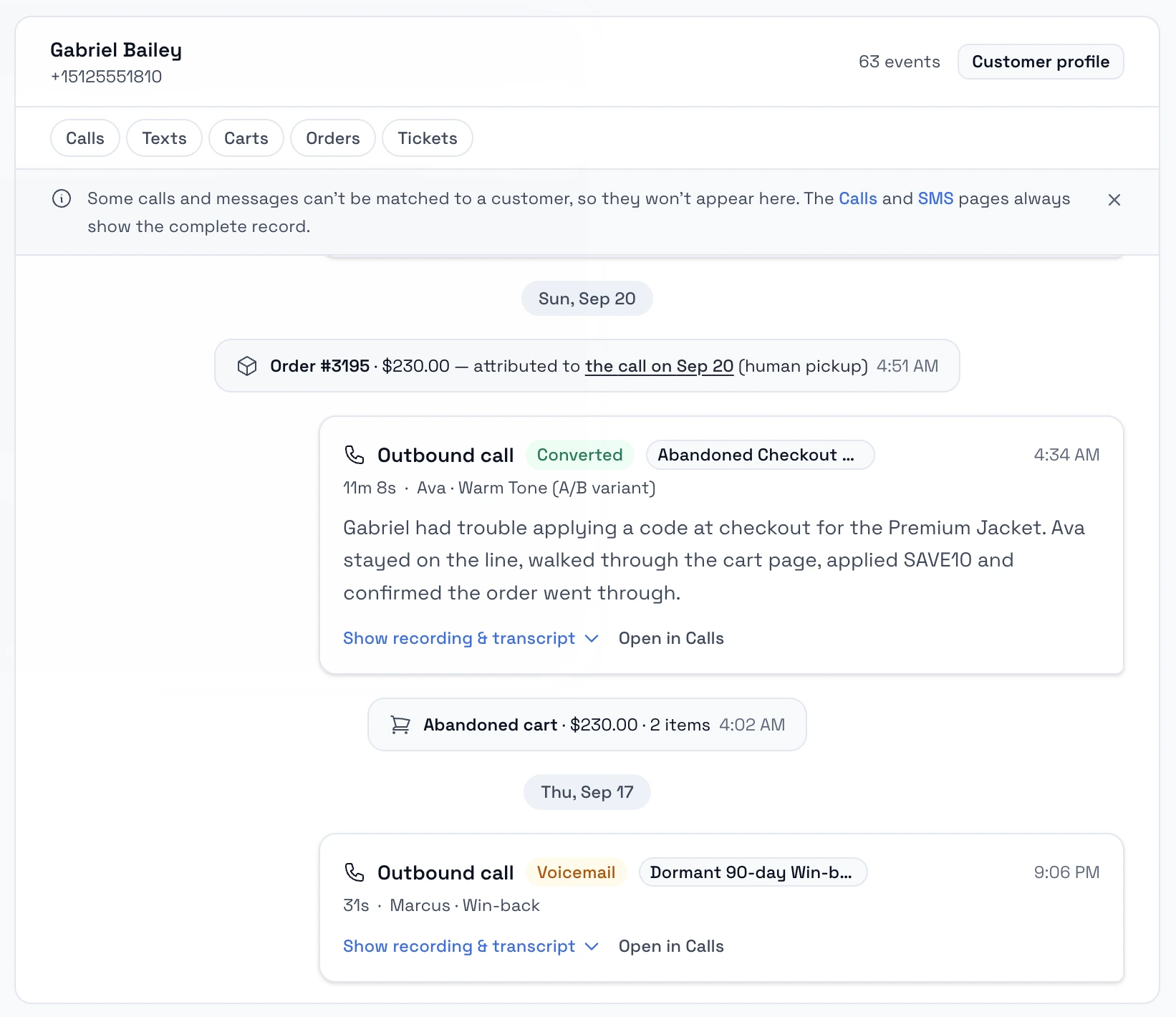
Decide what counts as a recovered order before launch: an order from the same checkout or customer within a set window after a call, with the agent's discount code as a second signal. Shopify's orders/create webhook gives you the order; you match it to your call log and store the result.
Attributed revenue still overstates impact, because some shoppers would have come back anyway. Run a holdout test to measure the lift before you scale spending.
8. Monitoring and QA
Calls fail in ways that logs do not show: the agent talks over people, mishears a discount code or loops on a question. You need recordings, transcripts, scored reviews and alerts, plus a person who listens to calls every week.
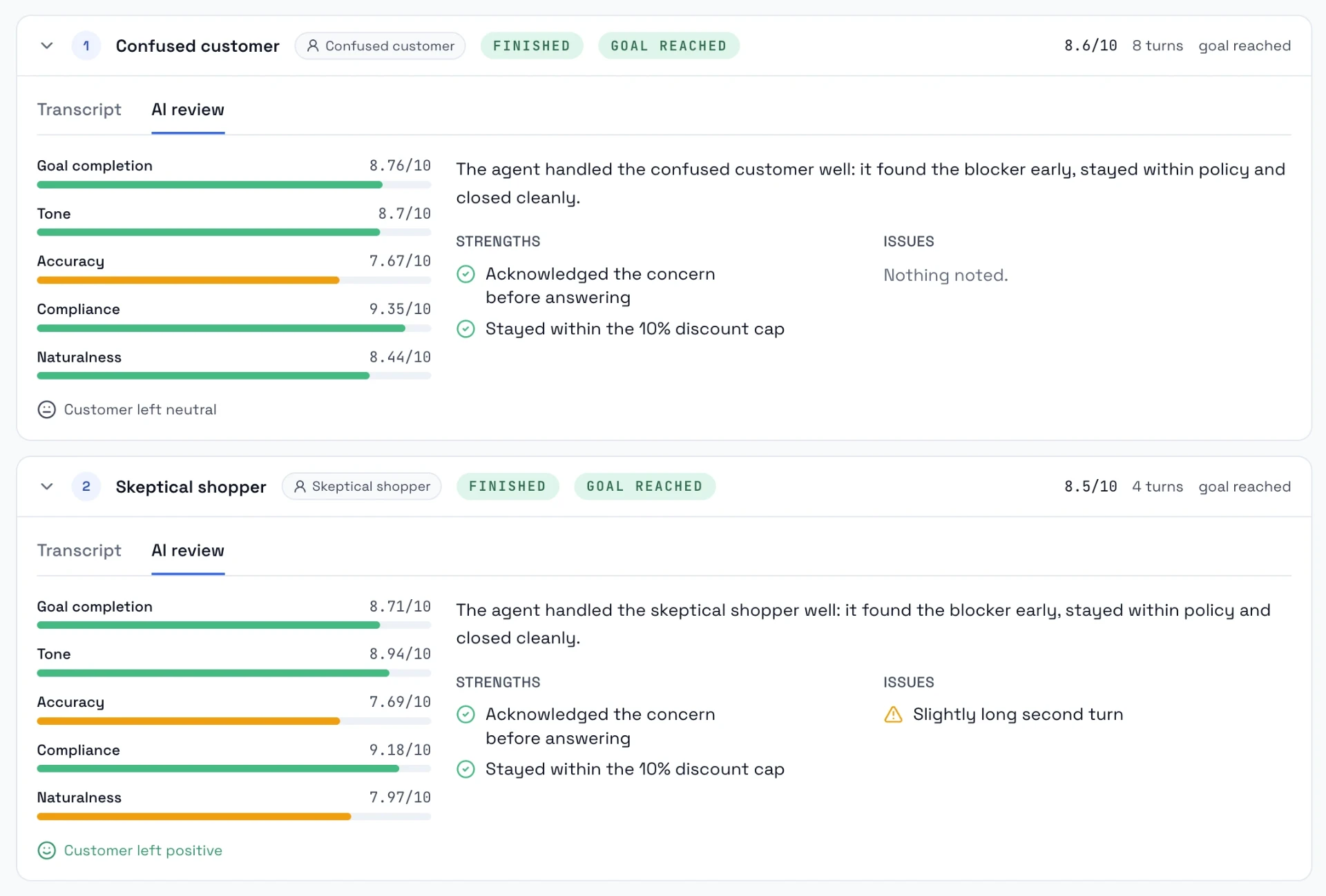
Platforms charge for parts of this. Retell's AI quality assurance costs $0.10 a minute after the first 100 free minutes, and Vapi keeps raw call data for 14 days without a package and 30 days on its $29 Core package. None of them knows what a good ecommerce call sounds like until you write the test cases: a confused buyer, a skeptic, a shopper who asks if it is a robot, a declined card.
How long each path takes
Vendors quote the time to a first agent, not to a production ecommerce flow. Retell says you can go from signup to a live agent in minutes. Bland says most teams deploy a first agent within a day on its self-serve plans, and its enterprise deployments follow a 28-day framework. Loop Voice setup takes under 10 minutes with no code.
Example: our estimate for one experienced engineer who already knows Shopify's APIs, not a benchmark.
| Workstream | Example estimate |
|---|---|
| Shopify app, webhooks, abandonment timer, order matching | 1 to 2 weeks |
| Numbers, caller ID registration, voicemail handling, retries | 1 week |
| Consent records, quiet hours by time zone and state, caps, opt-out sync | 1 to 2 weeks |
| Agent prompt, tools for cart, discount and link, guardrails, test cases | 1 to 2 weeks |
| Texts and A2P registration, attribution, dashboards, QA review | 1 to 2 weeks |
| Total before the first real customer call | 5 to 9 weeks |
Carrier registration for texting runs on its own review timeline, so start it on day one. After launch the work continues: products and policies change, prompts drift, numbers pick up spam labels and state rules move.
When building is the right call
Build when at least two of these are true:
- You already run engineering for your store. Someone on staff owns your Shopify integrations, data pipeline and on-call rotation, and voice becomes one more system they maintain.
- Your calls are not a standard ecommerce play. Quoting custom orders, booking fittings, B2B reorders at contract prices, or anything that needs data a ready-made agent cannot reach.
- Your volume is large. In the example above, usage savings start paying for one engineer somewhere between about 13,600 and 80,000 answered conversations a month, depending on the plan you would otherwise buy.
- You need contract terms a product cannot give you. A BAA, data residency or a dedicated server: Retell, Bland and ElevenLabs list some of these on enterprise plans, and Vapi sells a HIPAA add-on at $2,000 a month.
- Voice is your product. If the agent is what you sell, owning the stack is the point.
Buy when the job is abandoned checkouts, post-purchase calls, win-back and inbound order questions for a Shopify store, and nobody on your team wants to own a dialer, a consent database and a carrier registration.
A middle path works too: buy the agent for the standard plays and build one custom flow on a developer platform for the job no product covers. If you do, keep a single do-not-contact list that both systems read before every call and text.
How Loop Voice does this
Loop Voice is the ready-made option for Shopify, WooCommerce and Checkout Champ stores. Flows start from store events such as an abandoned checkout and stop when the customer orders, says stop, is on the do-not-contact list, or after a negative call. Quiet hours run in the shopper's local time, opt-outs land on one do-not-contact list, texts carry the checkout link, and recovered revenue is attributed to the call that caused it.
You can buy numbers in 90+ countries or bring your own through Twilio or SIP, and test an agent in the simulator before it calls anyone. See the full feature list.
Frequently asked questions
Which language model should a self-built agent use?
Choose on latency and accuracy first, then cost. On Retell's price list, language model charges run from $0.0016 a minute to $0.32 a minute at standard speed, so the model can cost more than the platform fee. Test candidates on your own hard cases, such as spelling a discount code, reading back an address and handling a declined card, before you compare prices.
Can I switch from a ready-made agent to my own build later?
Yes, if you keep what you own portable. Hold phone numbers in your own carrier account where you can, export call logs and do-not-contact lists regularly, and keep consent records in your own systems. Loop Voice supports bringing your own number through Twilio or a SIP trunk, so a later move in either direction is mostly rebuilding flows and prompts rather than losing your caller ID.
Sources
- Retell AI pricing (Retell AI, 2026)
- Vapi pricing (Vapi, 2026)
- Bland AI pricing (Bland AI, 2026)
- ElevenAgents pricing (ElevenLabs, 2026)
- Enterprise voice AI pricing (Synthflow, 2026)
- Webhook topics reference (Shopify, 2026)
- Work with protected customer data (Shopify, 2026)
- Recovering abandoned checkouts (Shopify Help Center, 2026)
- Declaratory Ruling FCC 24-17 (AI-generated voices under the TCPA) (Federal Communications Commission, 2024)
- 47 CFR 64.1200, Delivery restrictions (Cornell Law School LII, 2026)
- Florida Statutes 501.616, Unlawful acts and practices (The Florida Senate, 2025)
- State of the Call 2026 (Hiya, 2026)
- Loop Voice pricing (Loop Voice, 2026)
- Loop Voice security and subprocessors (Loop Voice, 2026)
Hear it before you decide
Listen to real recovery calls, or see Loop Voice call a test checkout on your own store.