




Abandoned Cart Recovery Calls: Results, Timing and Real Calls
Yes, for shoppers who meant to buy. Four Loop Voice customers report 5% to 11% of recovery calls becoming a sale. Which carts to call, when, and what the calls sound like.

Key takeaways
- Four published Loop Voice customers report 5% to 11% of recovery calls becoming a sale.
- Call checkouts with real intent, enough margin and calling consent, about ten minutes after they stall.
- In our public call library, 9 of 12 recovery calls fixed checkout mechanics, not hesitation.
- 86% of unknown calls go unanswered (Hiya), so caller ID matters, and only a holdout proves calls pay.
Do recovery calls work? The published numbers
Yes, when the shopper meant to buy and something got in the way. Loop Voice publishes results from four customers: between 5% and 11% of their recovery calls became a sale, and the biggest, Modern Hearing, has recovered $300,000+.
| Customer | What they sell | Recovered revenue | Calls that became a sale |
|---|---|---|---|
| Modern Hearing | Hearing aids | $300,000+ | 11% |
| CastleFlexx | Mobility and recovery | $30,000+ | 8% |
| Warrior Will Power | Health and wellness | $200,000+ from 1,184 calls | 7.1% |
| CityMan USA | Streetwear | $45,000+ | 5% |
Three of the four sell health-related products, the kind people want to ask about before they pay. Modern Hearing's CEO, Jorraine, put it plainly: "Our customers have a lot of questions before they commit to a hearing aid." CityMan USA, the streetwear brand at the bottom of the table, uses its calls for more than recovery: restock reminders, sizing help and bigger orders.
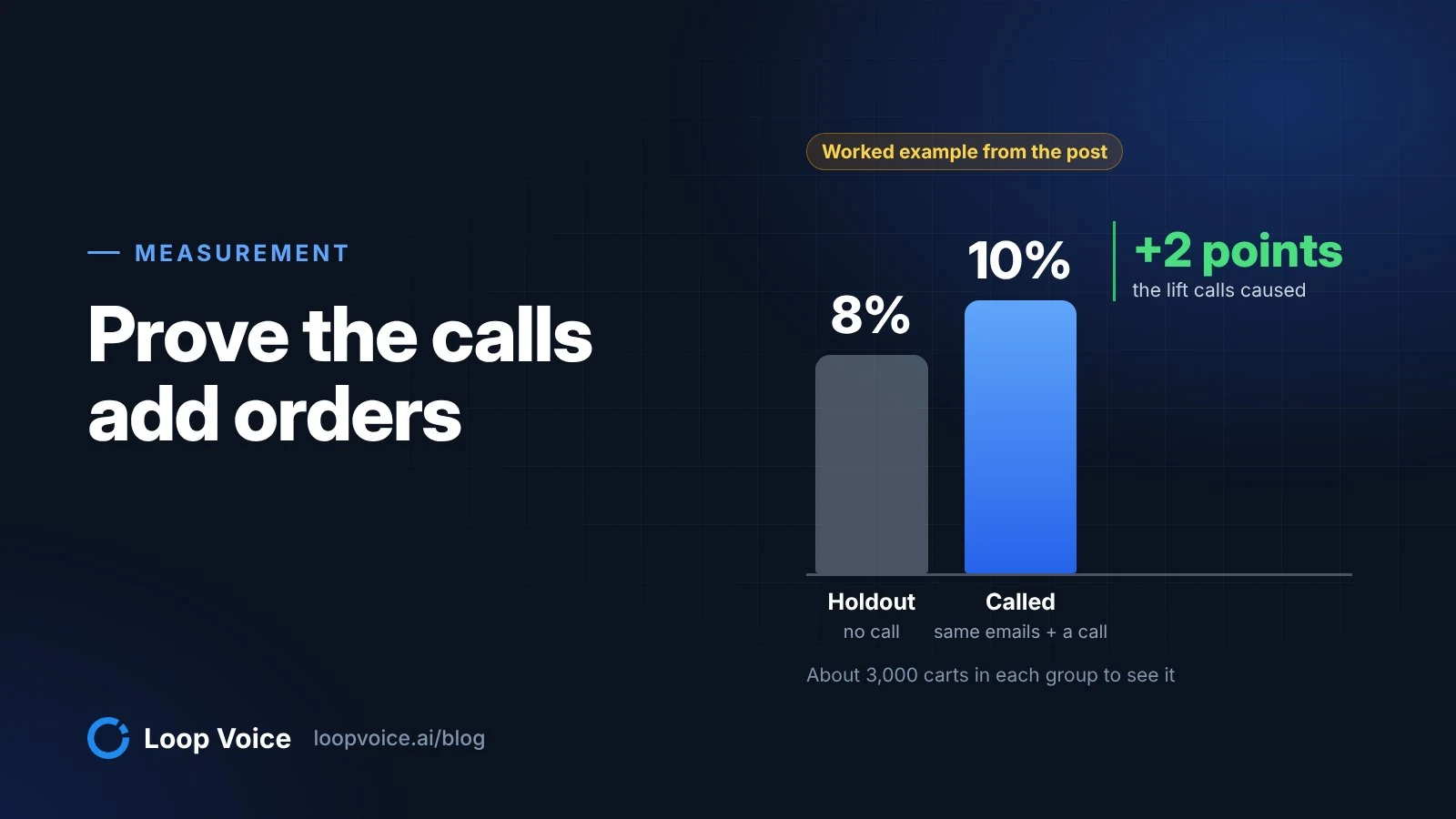
Two caveats before you plan around these numbers. First, they are attributed results: an order counts when it followed a call, which is not proof the call caused it. The measurement section at the end of this page shows how to get the incremental number for your own store.
Second, calls don't suit every store. Loop Voice's own pricing page says they work best with an average order of $50 or more, at least 100 abandoned carts a month and mostly US customers, and suggests stores below 50 abandoned carts a month work on traffic first.
What the calls actually fix
We listened back through the 12 abandoned-cart recordings in our public call library and wrote down what was blocking each order. Nine were checkout mechanics, not hesitation: a card form that kept bouncing back, an order the shopper believed had gone through, a billing checkbox, a discount-code field, a declined payment, a site that would not load, optional add-on screens and a subscription set by default. Two shoppers needed product advice, and one balked at the cost of shipping. The library is hand-picked, so treat this as a pattern to check against your own calls, not as a statistic.
Baymard Institute's research points the same way. Set aside the shoppers who were just browsing, and its survey of US shoppers finds 40% abandoned over extra costs, 17% over a long or complicated checkout, 17% because the site had errors or crashed and 10% because their card was declined (Baymard Institute). A reminder email can't fix any of those while the shopper is still at the screen. A call can, which is why the calls below sound more like tech support than sales.
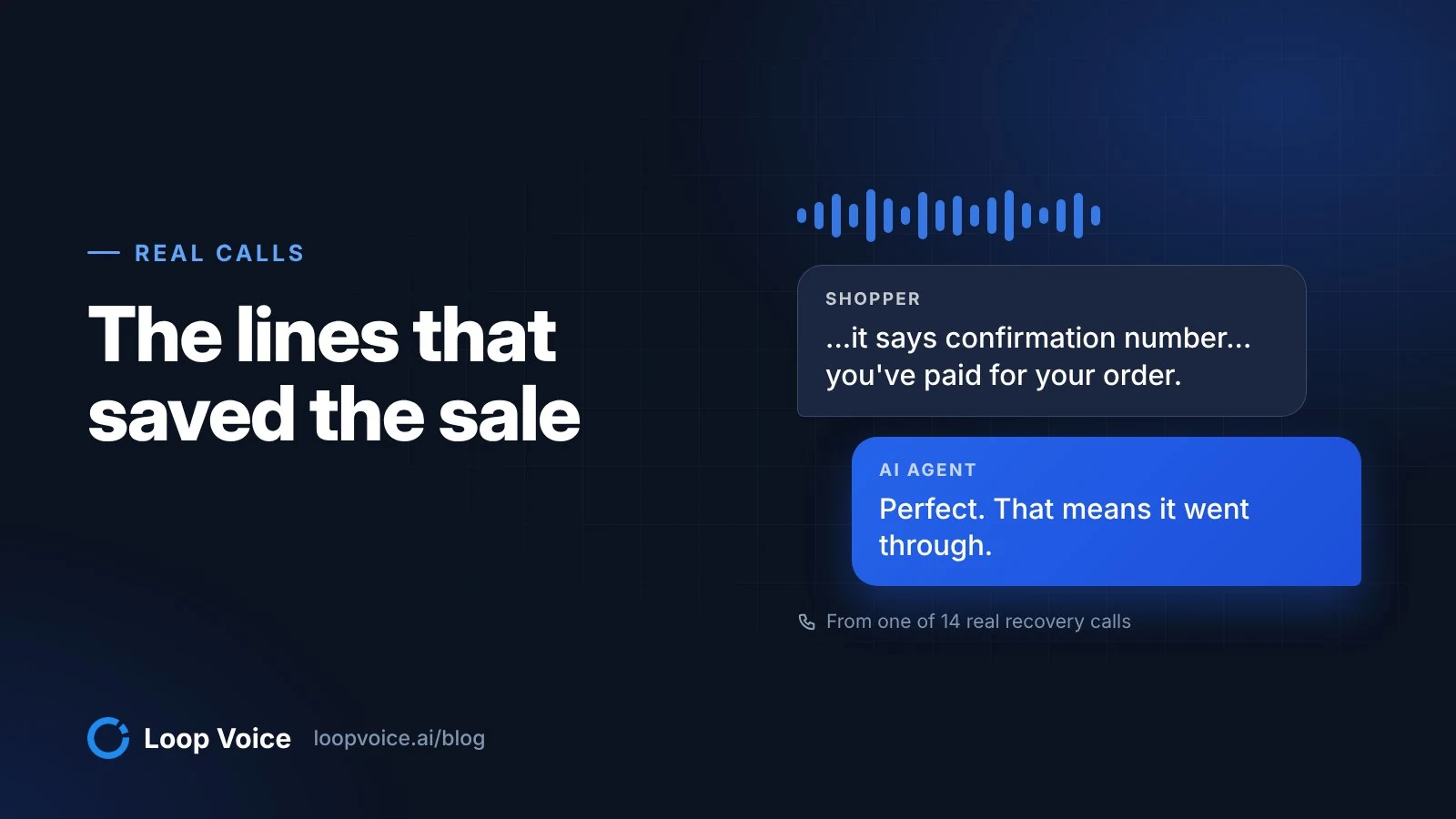
Here is the featured call from Modern Hearing. Melvin was still re-entering his card when the agent rang, because the payment page kept sending him back to the card form. The agent stayed on the line until the confirmation screen came up.
The technique is worth copying into any script: one instruction, then a question about the screen. "Okay, go ahead and click pay now once, and then just tell me what happens on the screen." The agent never asks for the card number. Melvin paid in the store's own checkout on his own computer, and the agent then confirmed the paid order on its side.
A declined payment
Card declines are the 10% in Baymard's list, and a reminder email can only tell the shopper to try again. In this call from an auto parts store, Sofia's first order had been canceled after her payment was declined. The agent texted her the order status link, walked her to the page's buy again button to rebuild the cart, and waited while she paid.
It says it's processing, and the confirmation code is [confirmation code redacted].
Got it. Confirmation code [confirmation code redacted]. Does the page then change to order confirmed? Thank you. Or is it still stuck on process
It says that order was confirmed.
thing.
Perfect. Then you're all set, and it went through. Do you want me to quickly confirm on our side that it shows as paid and active?
You can find these carts yourself. In your Shopify admin, go to Orders > Abandoned checkouts, open a checkout and look at its Timeline: every payment attempt is logged there, and the payment event's Message field says why it failed (Shopify Help Center). A shopper who already tried to pay is as warm as an abandoned cart gets.
An add-on the shopper didn't want
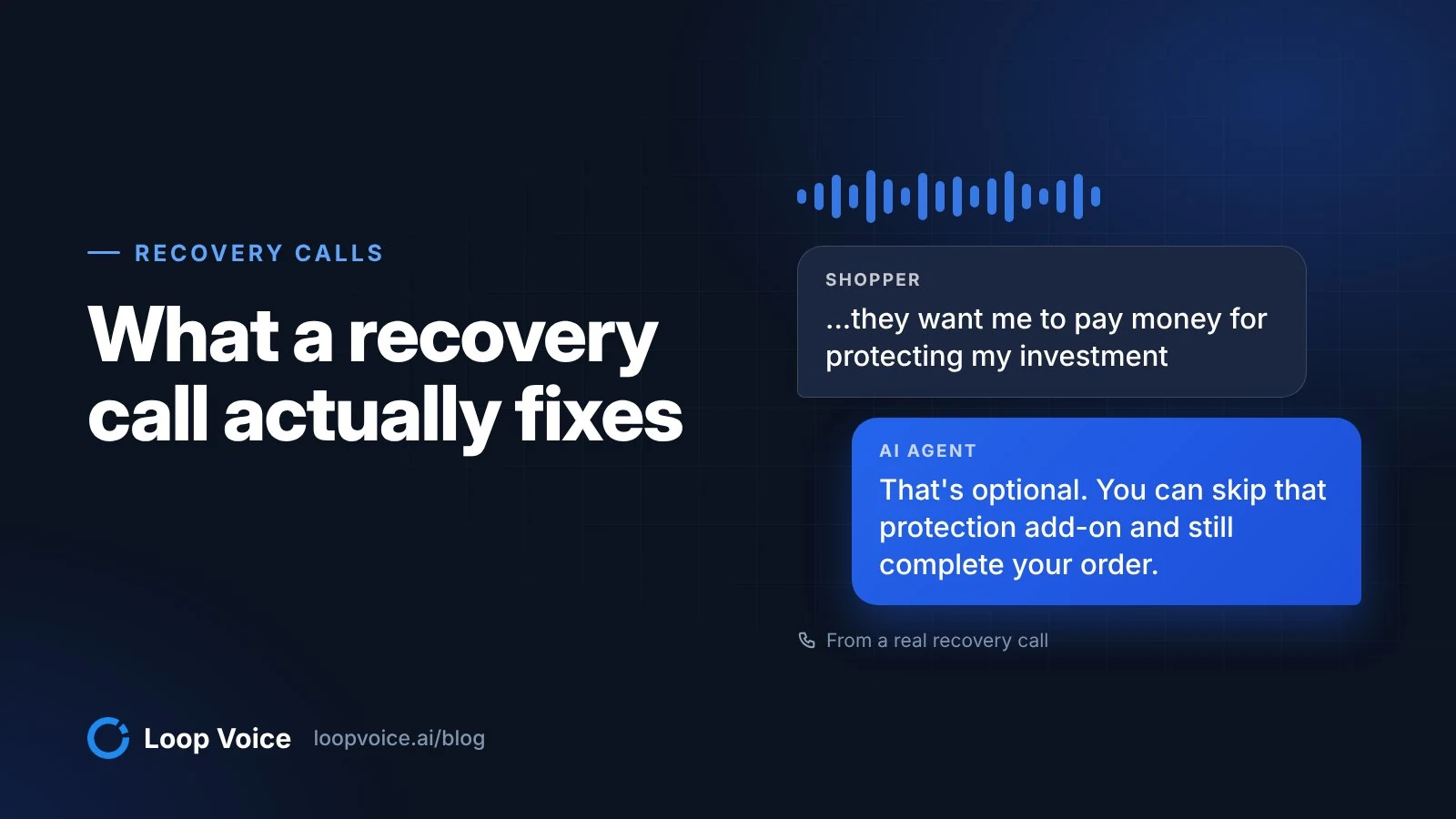
Three of the twelve calls stalled on optional extras: protection plans in two of them, shipping protection in the third. In each case the shopper paused, unsure whether the extra was required. Franklin's call is typical.
No, they want me to pay money for protecting my investment, but I'm not going to do that.
Got it. That's optional. You can skip that protection add-on and still complete your order. On that screen, do you see a button or link that says no thanks, skip, or continue without protection?
Yes. I just pushed it. No. I'll risk paying for a replacement later.
Got it. You declined the protection. That's totally fine. What does the next screen say now? Do you see a thank you order confirmation page, or is it still asking for anything else?
Your order is confirmed. It's still trying to add something on. I don't want that, so I told them I didn't want it.
Two fixes follow. Give the agent a ready answer for every add-on your checkout shows; Franklin heard "That's optional. You can skip that protection add-on and still complete your order." Then ask whether the add-on app earns more than the orders it stalls, because shoppers who don't get a call have nobody to ask.
A question about cost
Barbara, shopping at a gardening store, stopped at the shipping charge. The agent first asked what had made her pause, and only after she named the shipping cost did it offer the store's 10% code, spelled out letter by letter.
If it helps, we do have a code for 10% off your order. Loop 10. Could I give you that code to apply at checkout?
Sure.
It's 10% off your order. The code is loop 10. Let me spell that slowly. L as in Lima, O as in Oscar, O as in Oscar, P as in Papa, 1, 0. Again, loop 10. Could you read that back to me so I know I got it right?
10. L-O-O-P 10.
Perfect. That's it. Want me to text you the code as well so you can just copy and paste it?
No, that's fine. I can do it.
The order matters: ask first, offer second. An agent that opens with a discount gives margin away to shoppers who would have paid full price, and it teaches repeat customers to abandon for a code. A Loop Voice agent can only offer the codes you approve, and you decide when, for example only after a price objection. Our recovery call script template has objection lines for shipping, price, sizing and payment problems.
Which carts to call
Call a cart when four things are true: the shopper showed real intent, the order's margin can pay for the conversation, you have permission to call, and the cart is fresh. Then remove anyone who has bought, opted out or been called recently.
| Check | Call when | Skip when |
|---|---|---|
| Intent | The shopper reached checkout and entered contact details, or tried to pay | They only added to cart, or the details look fake |
| Margin | One recovered order pays for many answered conversations | A single conversation eats most of the profit |
| Permission | The shopper agreed to be called | There's no calling consent, or the number is on your do-not-contact list |
| Recency | The checkout stalled within the last hour or two | It's days old (that's win-back, not recovery) |
| Exclusions | None apply | They ordered since, opted out, hit your call cap, or Shopify flagged the checkout as high risk |
Margin. On Loop Voice's monthly plans an answered conversation costs about $0.95 to $1.49, and calls nobody answers cost nothing. Divide an order's contribution (what's left after product cost, shipping, fees and any discount) by that cost to get the most conversations one recovered order can pay for. Example: $45 of contribution ÷ $1.20 per conversation on the Growth plan = 37 conversations. Our email vs SMS vs calls guide works through the full break-even, including the carts where calls don't pay.
Permission. A phone number typed into checkout is not the same as permission to call. The FCC confirmed in 2024 that AI-generated voices count as "artificial" voices under the TCPA (FCC 24-17), and federal rules require prior express written consent for artificial-voice telemarketing calls (47 CFR 64.1200). Our guide to calling rules covers consent, quiet hours and opt-outs.
Exclusions. Check them right before dialing, not only when the flow starts, because an order, an opt-out or another call can land while a call waits. Shopify puts checkouts it blocked as high risk in a separate Blocked view and warns that some abandoned checkouts still come from bots; leave both out. Treat returning customers the same way as new ones: a past order is useful context for the conversation, not a reason to call more often.
High-ticket and health products bring considerations of their own, from longer research cycles to sensitive questions; see recovery calls for high-ticket and health products.
When to call: ten minutes, inside the shopper's hours
Loop Voice's default abandoned-checkout flow waits ten minutes after the checkout is abandoned, then calls, and you can change the delay. Ten minutes lines up with Shopify's definition of abandonment (a checkout incomplete for more than ten minutes after the shopper entered an email), and it reaches many shoppers while the checkout is still open in front of them, as it did with Melvin. Email runs on a slower clock: Klaviyo's pre-built abandoned cart flows wait four hours before the first message (Klaviyo Help Center).
A short delay has a cost too. Some shoppers would have finished on their own, and a call that reaches them uses credits and takes credit for an order it didn't cause. If you test a longer delay, compare revenue per eligible cart between the two settings, not revenue per call.
Calls only go out inside the shopper's local calling window. The federal rule bars telephone solicitations before 8 a.m. or after 9 p.m. at the called person's location, and some states go further: Florida stops commercial solicitation calls at 8 p.m. and allows no more than three on the same subject in 24 hours (Florida Statutes 501.616). Set the window to the strictest rule that applies to your shoppers, and check the calling-hours rules in our TCPA guide. Loop Voice applies quiet hours in each customer's own time zone, so a checkout abandoned late at night waits for morning, and if the shopper orders overnight, the flow stops before it dials.
Keep attempts low. The example flow on Loop Voice's features page is: wait ten minutes, call, text the checkout link, wait, call again with a discount, send a last note. That is as far as a recovery should go. Set a per-customer cap as well (Loop Voice caps calls per customer by week, month, quarter, six months or year), so a shopper who abandons several checkouts in a week doesn't get a call for every one.
From abandoned checkout to recovered order, step by step
Here is the whole path for one cart, with what has to be true at each step.
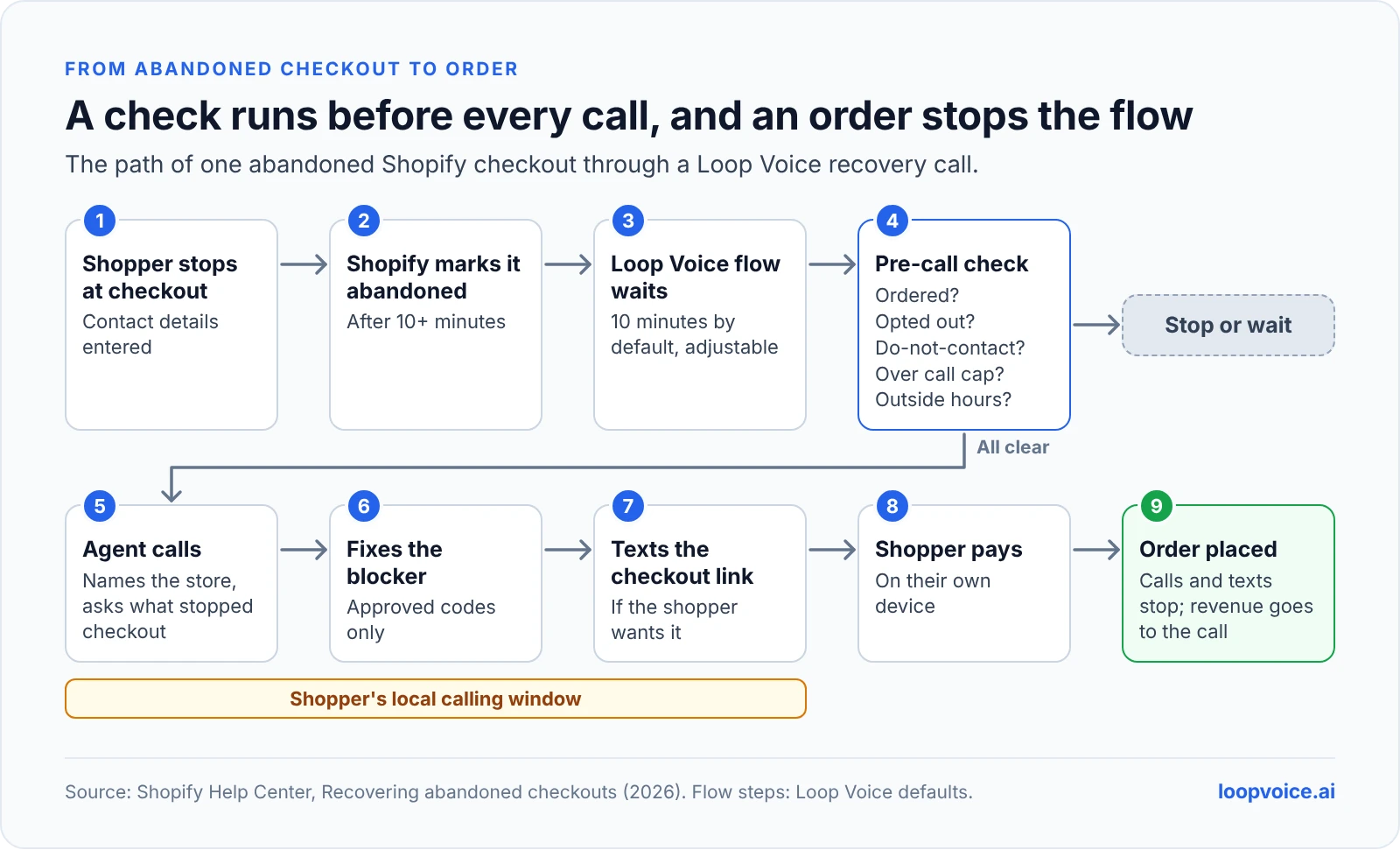
- The shopper stops at checkout. Shopify only counts a checkout as abandoned once the shopper has entered an email, so every cart in the flow has one. Only carts with a phone number that passed your permission check go further.
- The flow waits. Ten minutes by default, longer if you set it.
- The pre-call check runs. Has the shopper ordered or opted out? Are they on the do-not-contact list, over the call cap or outside their local calling hours? Any yes stops or delays the call. A Loop Voice flow also stops after a negative call.
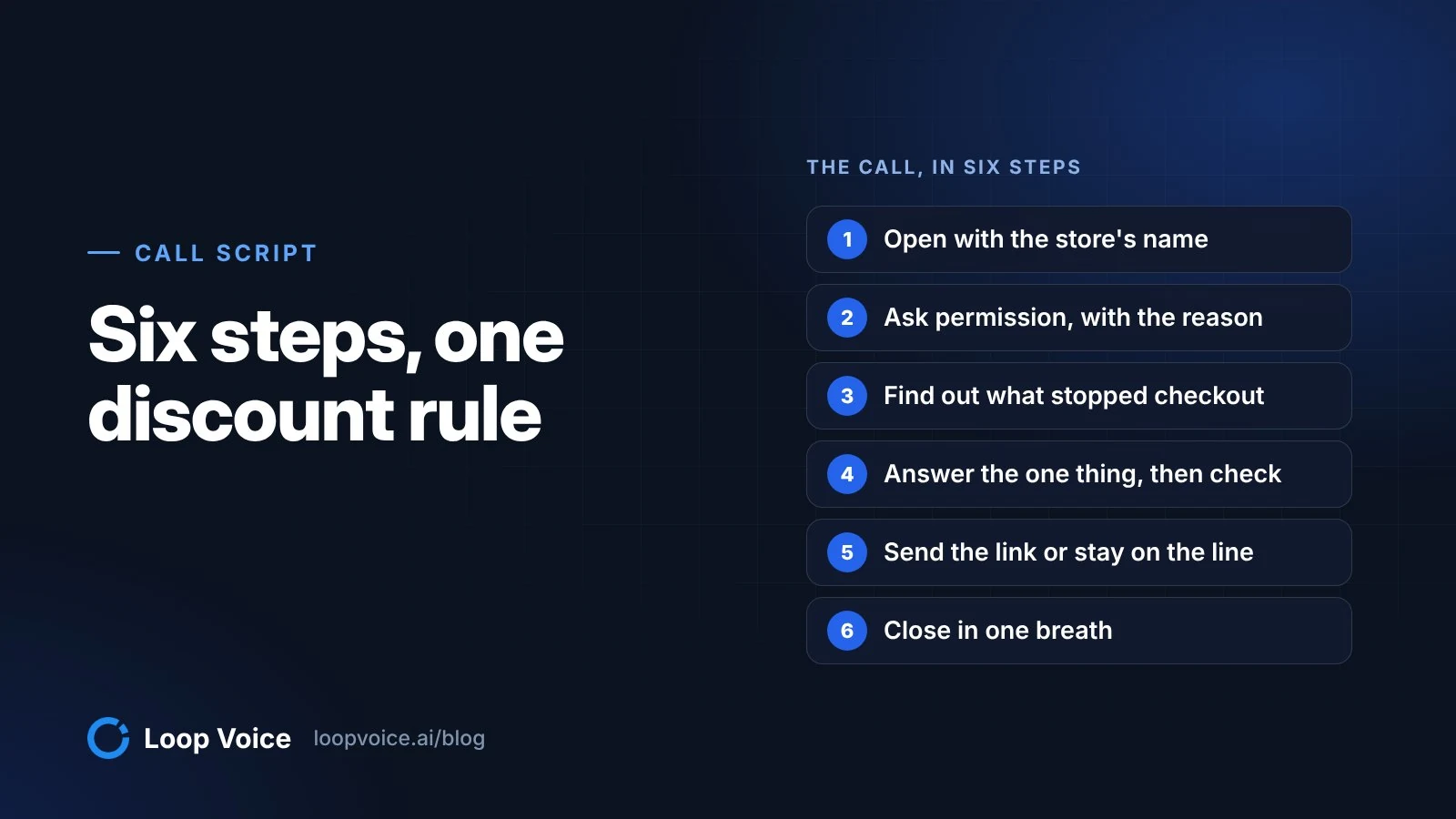
- The agent calls and names the store. It introduces itself with the store's name and never claims to be human.
- The agent finds the blocker. It asks what stopped checkout, using the cart contents and what its knowledge base learned from your website, your Shopify data and any documents you uploaded.
- It fixes what it can and hands off the rest. It walks the shopper through the screen, answers product and policy questions, and offers your approved code if your rules allow. Anything it can't resolve becomes a ticket with the AI summary, the order and the recording attached, in Loop Voice and also in Zendesk, Redo or by SMS.
- It texts the link if the shopper wants it. "Do you want me to text you a direct link back to your cart so you can finish faster?" is a line from a real call. Send it only to the shopper on the phone: Shopify warns that anyone who opens an abandoned checkout link can continue that checkout.
- The shopper pays in your checkout. On their own device. The agent never takes card details, and Loop Voice stores no card data.
- The order stops everything. Pending calls and texts stop, and the revenue is attributed to the call. The recording, the transcript and a short summary go into the calls log.
When calls backfire, and how to prevent it
Calls go wrong in predictable ways, and almost all of them are settings problems, not script problems.
| What goes wrong | What the shopper experiences | The fix |
|---|---|---|
| Calling the wrong people | An unexpected sales call | The permission check above, before anything else |
| Wrong hour | A call during dinner or late at night | Quiet hours in the shopper's time zone, matching the calling window above |
| Too many attempts | Missed call after missed call from the same store | A per-customer call cap and no more than two attempts per checkout |
| Calling after the order | A reminder about an order they already placed | Stop on order, tested with a real purchase before launch |
| Ignoring a no | The pitch continues after the shopper declines | A guardrail to respect refusals; "don't call me" goes on the do-not-contact list before the next step |
| Discount first | Shoppers learn to abandon for a code | Approved codes only, offered after a price objection |
| Confident wrong answers | A delivery promise the store can't keep | A knowledge base built from your site and policies, a "never hallucinate" guardrail and a handoff to a person |
| Pretending to be human | Lost trust the moment the shopper realizes | The agent names the store and never claims to be human |
Some of the best calls in our library include a no. On an inbound call to a health device brand, a shopper asked whether a rolling pressure device was safe nine months after knee surgery. The agent didn't sell.
It sent him to his physical therapist and surgeon, explaining: "Our safety guidance specifically calls out recent surgery as a don't use category without medical sign off. And I can't override that on a call." He called the conversation "a home run" and noted, unbothered: "I do know I'm talking to an AI assistant."
Before an agent calls a real shopper, run it through the simulator's hard personas (angry customer, skeptical shopper, suspicious of AI); nothing is dialed and nothing is charged. Then use the test console to have it call your own phone, and say no to it a few times.
Answer rates and caller ID
Plan for most calls to go unanswered: Hiya's State of the Call 2026 report finds 86% of unknown calls go unanswered (Hiya). Phones now screen calls too. On iPhone, Screen Unknown Callers can be set to Ask Reason for Calling, which asks the caller why they're calling before the phone even rings (Apple Support), and Pixel's Call Screen tells the owner who's calling and why before they pick up (Google Phone app Help).
There's no trick around this. Three things help:
- Say who's calling and why in the first sentence. A screened call is decided on that sentence, so the agent names the store and the reason before anything else.
- Call from a number that looks familiar. Loop Voice's Super Number (included on Scale) calls each shopper from a number matching their area code, and you can register a caller ID name. Our local vs toll-free caller ID guide compares the options.
- Look after your numbers' reputation. If you bring your own numbers through Twilio or SIP, register them for free with Hiya's number registration and the Free Caller Registry, which covers First Orion, Hiya and TNS. The registry is clear that registration doesn't guarantee how each provider will treat your calls, but it costs nothing.
Then measure instead of guessing. Loop Voice's Insights shows pickup by attempt and by caller ID, who answered (a person, voicemail or a call screener) and the hours your customers pick up. If the answer rate is low, change the number, the hour or the first sentence before you add attempts.
How to measure recovery calls
Judge the calls against every cart you could have called, not only the ones that connected. Five numbers cover it:
- Answer rate: answered conversations ÷ calls placed.
- Recovery rate: recovered orders ÷ eligible carts, with unanswered calls left in.
- Revenue per eligible cart: recovered revenue ÷ eligible carts.
- Cost per recovered order: calling spend ÷ recovered orders.
- Opt-out rate: "don't call me" requests ÷ answered conversations, read next to complaints.
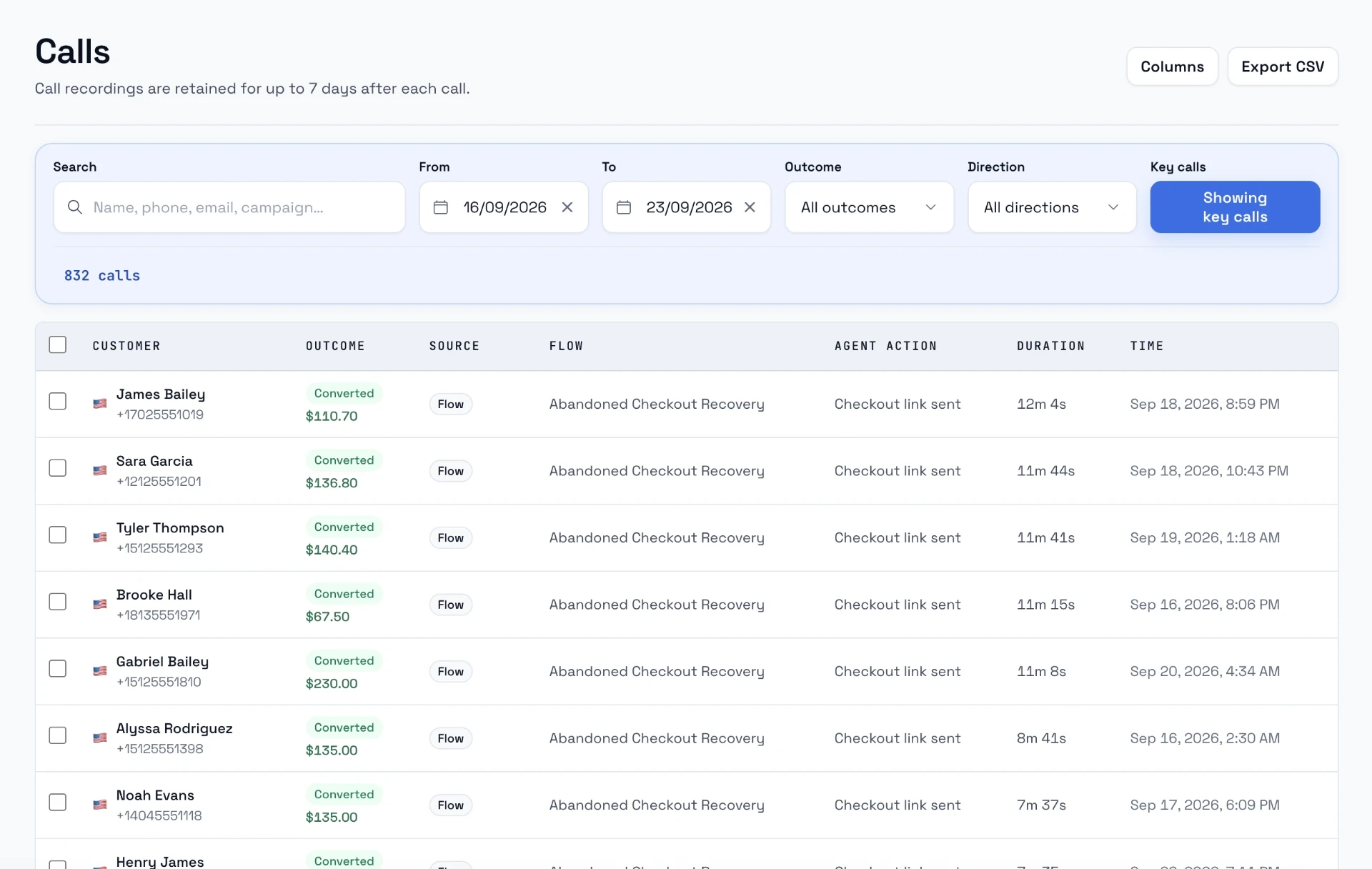
Loop Voice ties each recovered order to the call that preceded it, using an attribution window you set per workspace, and you can export the calls log to CSV. That is the right view for day-to-day decisions. It can't tell you how many of those shoppers would have bought anyway after your email.
To learn that, hold a random slice of eligible carts out of the calling step, give both groups the same emails and texts, and compare. Our holdout test guide has the sample-size math and how long to run it.
And listen. Ten recordings a week, including calls that didn't convert, will surface checkout bugs faster than any dashboard, and because recordings are only kept for a limited time, it has to be a weekly habit. When the same problem keeps coming up, such as a confusing add-on or a shipping surprise, fix it on the site so the next shopper never needs the call.
Frequently asked questions
Can the agent take the shopper's card number over the phone?
No. The shopper always pays in your own checkout, on their own phone or computer, while the agent stays on the line and explains each screen. Loop Voice stores no card data. When a shopper in one of the recorded calls asked the agent to place the order for him, it walked him through the checkout instead and confirmed the paid order once it appeared on the store's side.
What happens if a shopper asks to speak to a person?
The agent hands off. You decide when it must escalate, for example on negative sentiment, a do-not-contact request, a complex refund, or a legal or medical question. The handoff arrives as a ticket with the AI summary, the order and the recording attached, in Loop Voice and also in Zendesk, Redo or by SMS, so nobody has to ask the shopper to start over.
Do recovery calls work outside the US?
Loop Voice can call from local numbers in 90+ countries, and you can bring your own numbers through Twilio or a SIP trunk. Its own pricing page says voice calls are most effective in North America, and expectations around phone calls differ by country. Start with your US carts, measure them with a holdout, then add other markets one at a time.
Sources
- Cart Abandonment Rate Statistics (Baymard Institute, 2025)
- Recovering abandoned checkouts (Shopify Help Center, 2026)
- Declaratory Ruling FCC 24-17 on AI-generated voices and the TCPA (Federal Communications Commission, 2024)
- 47 CFR 64.1200, Delivery restrictions (Cornell Law School Legal Information Institute, 2026)
- 2026 Florida Statutes 501.616, Unlawful acts and practices (The Florida Senate, 2026)
- How to create an abandoned cart flow (Klaviyo Help Center, 2026)
- State of the Call 2026 (Hiya, 2026)
- Manage unknown callers on iPhone (Apple Support, 2026)
- Screen your calls before you answer them (Google Phone app Help, 2026)
- Number Registration (Hiya, 2026)
- Free Caller Registry (First Orion, Hiya and TNS, 2026)
- Modern Hearing customer story (Loop Voice, 2026)
- Warrior Will Power customer story (Loop Voice, 2026)
- CityMan USA customer story (Loop Voice, 2026)
- CastleFlexx customer story (Loop Voice, 2026)
Hear it before you decide
Listen to real recovery calls, or see Loop Voice call a test checkout on your own store.