




Big news for AI calls: no written consent needed, court rules
A federal appeals court ruled the TCPA doesn't require written consent, even for AI and prerecorded sales calls. What changed, the one line I still recommend, and the opt-in steps for the strictest setup.

Key takeaways
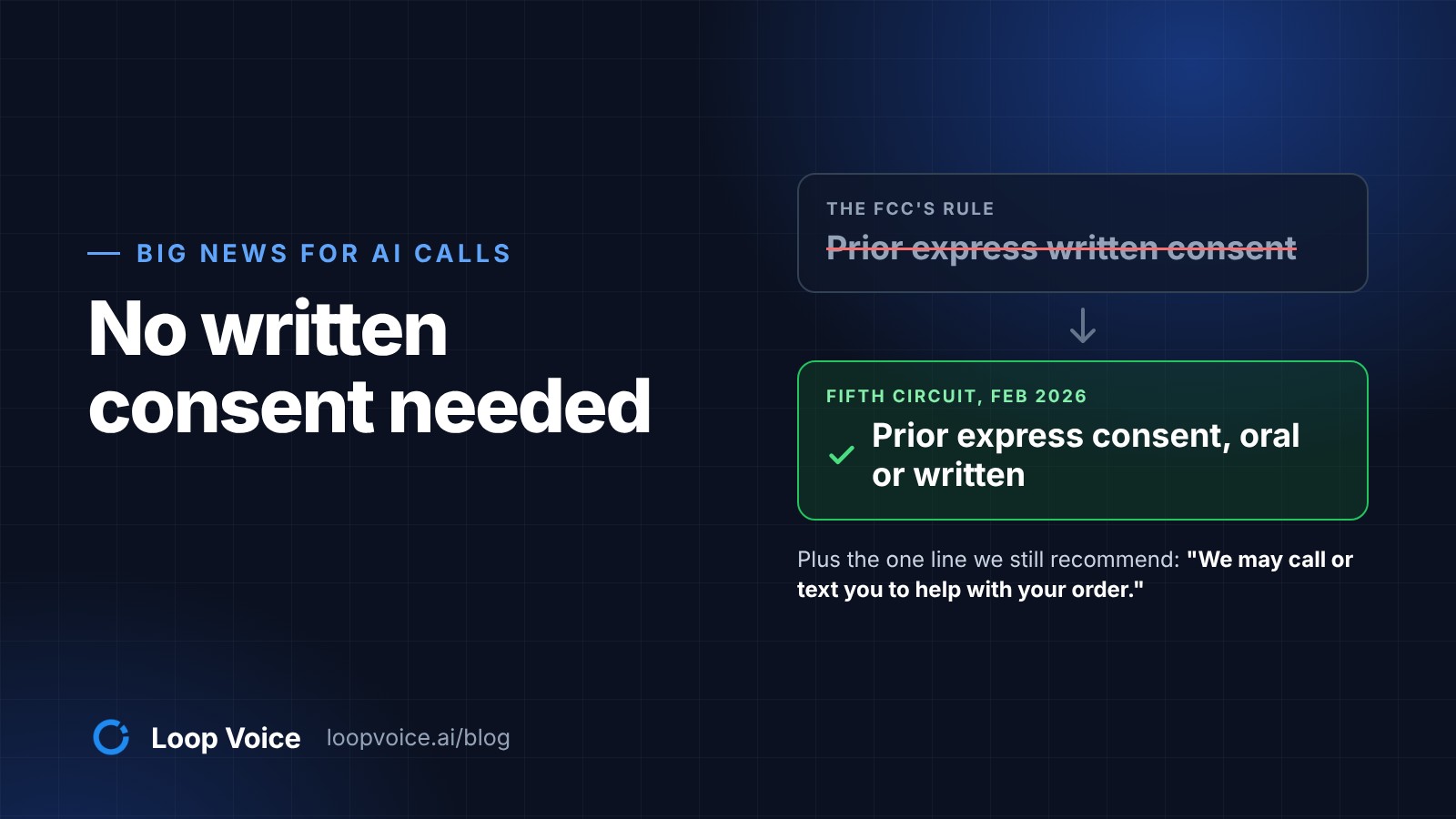
- A federal appeals court ruled that the TCPA doesn't require written consent, even for AI and prerecorded sales calls. Oral or written consent both count.
- We still recommend one line where shoppers enter their number: "We may call or text you to help with your order."
- For Florida, Oklahoma, Maryland and for texts, use one unticked checkbox that is only about consent.
What the court decided
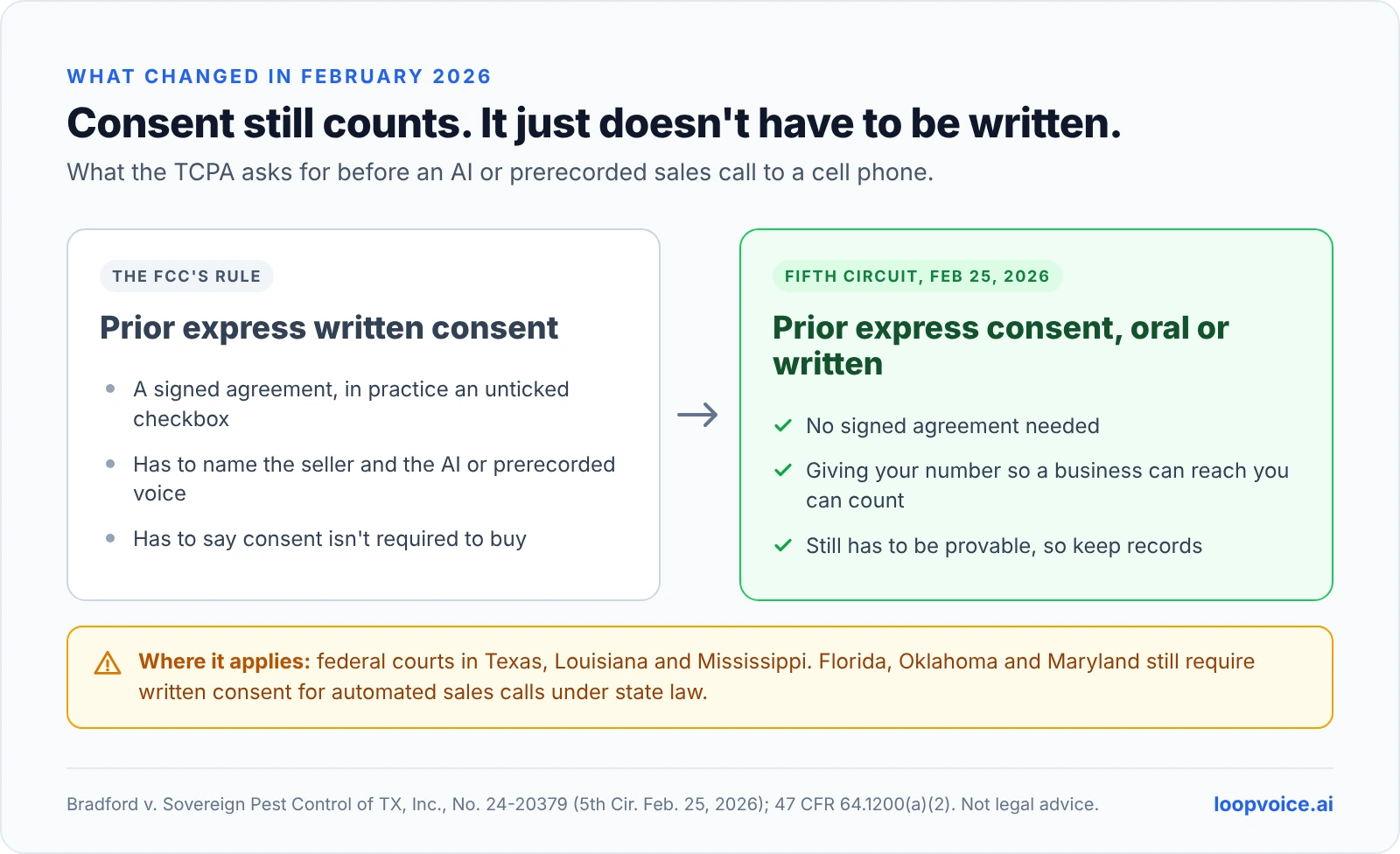
Big news for anyone running AI calls or texts. On February 25, 2026, the US Court of Appeals for the Fifth Circuit ruled in Bradford v. Sovereign Pest Control that the Telephone Consumer Protection Act (TCPA) does not require written consent for autodialed or prerecorded calls to cell phones, sales calls included. Oral or written consent both count.
That wasn't the case before. For more than ten years, the FCC's rule in 47 CFR 64.1200 said a sales call with an artificial or prerecorded voice to a cell phone needed prior express written consent, which in practice meant an unticked checkbox with specific wording. The court read the statute itself, which says "prior express consent", and found no written requirement in it.
The case was simple: a customer gave a pest control company his cell number so it could reach him, then sued over its prerecorded calls. The court held that giving the number, with no limits on it, was consent. Nixon Peabody has a short summary.
Why it matters for AI agents: the FCC counts AI-generated voices as artificial voices (FCC 24-17), so these rules cover every AI call. What changed is the form the consent takes.
What it means for your store
You still need consent. Under this ruling, it doesn't have to be written.
For abandoned carts, that's a big deal. A shopper who types their number into your checkout to buy from you has given it to you for that order, and under Bradford that can be the consent for a call about it. We never cold call anyway: Loop Voice only calls shoppers who started a checkout, placed an order or bought from you before (see how abandoned cart calls work).
Three things to keep in mind:
- Where it applies. It binds federal courts in Texas, Louisiana and Mississippi. Courts elsewhere can follow it or not, and the FCC's written consent rule is still on the books.
- Some states have their own laws. Florida, Oklahoma and Maryland require written consent for automated sales calls. Our TCPA guide has the details.
- Keep proof. Oral or implied consent needs a record, so keep the checkout or order record that shows where each number came from.
What I recommend: one line under the phone field
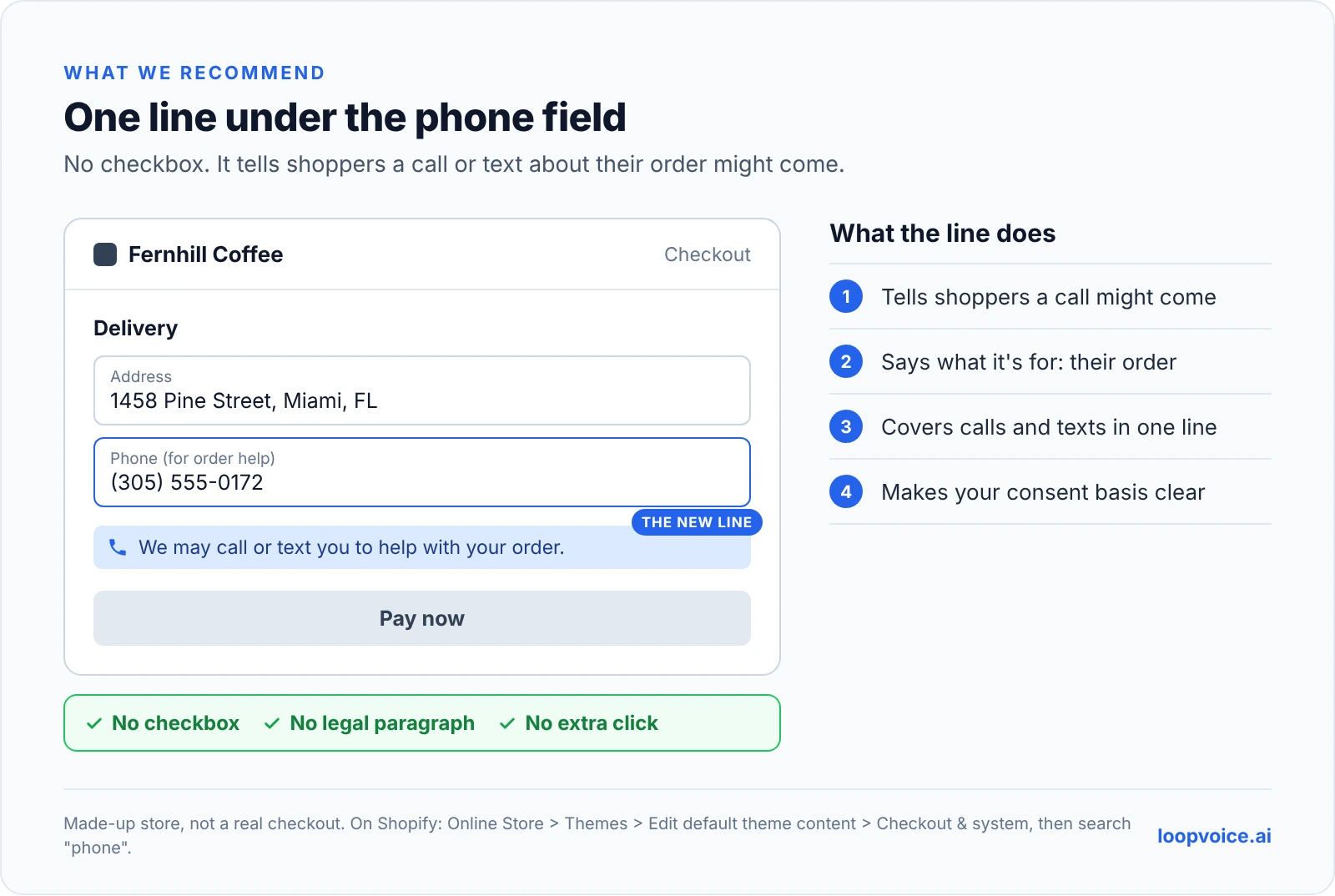
Even with no checkbox, tell shoppers a call might come. An expected call gets a warmer welcome. Add one line where they enter their number:
"We may call or text you to help with your order."
No checkbox, no legal paragraph. It sets expectations and makes your consent basis clear.
On Shopify:
- Go to Online Store > Themes, click ... next to your live theme and choose Edit default theme content.
- Open the Checkout & system tab and search for "phone".
- Put the line in the phone tooltip, and add a short hint to the phone label, like "Phone (for order help)".
- Save, then test a checkout on your own phone.
On Shopify Plus, Shopify's free Checkout Blocks app can show the line as visible text near the phone field.
The strictest setup: treat calls like SMS
If you call into Florida, Oklahoma or Maryland, or want no gray area at all, collect opt-in for calls the way you already do for texts. Four steps.
1. Add one checkbox, only about consent
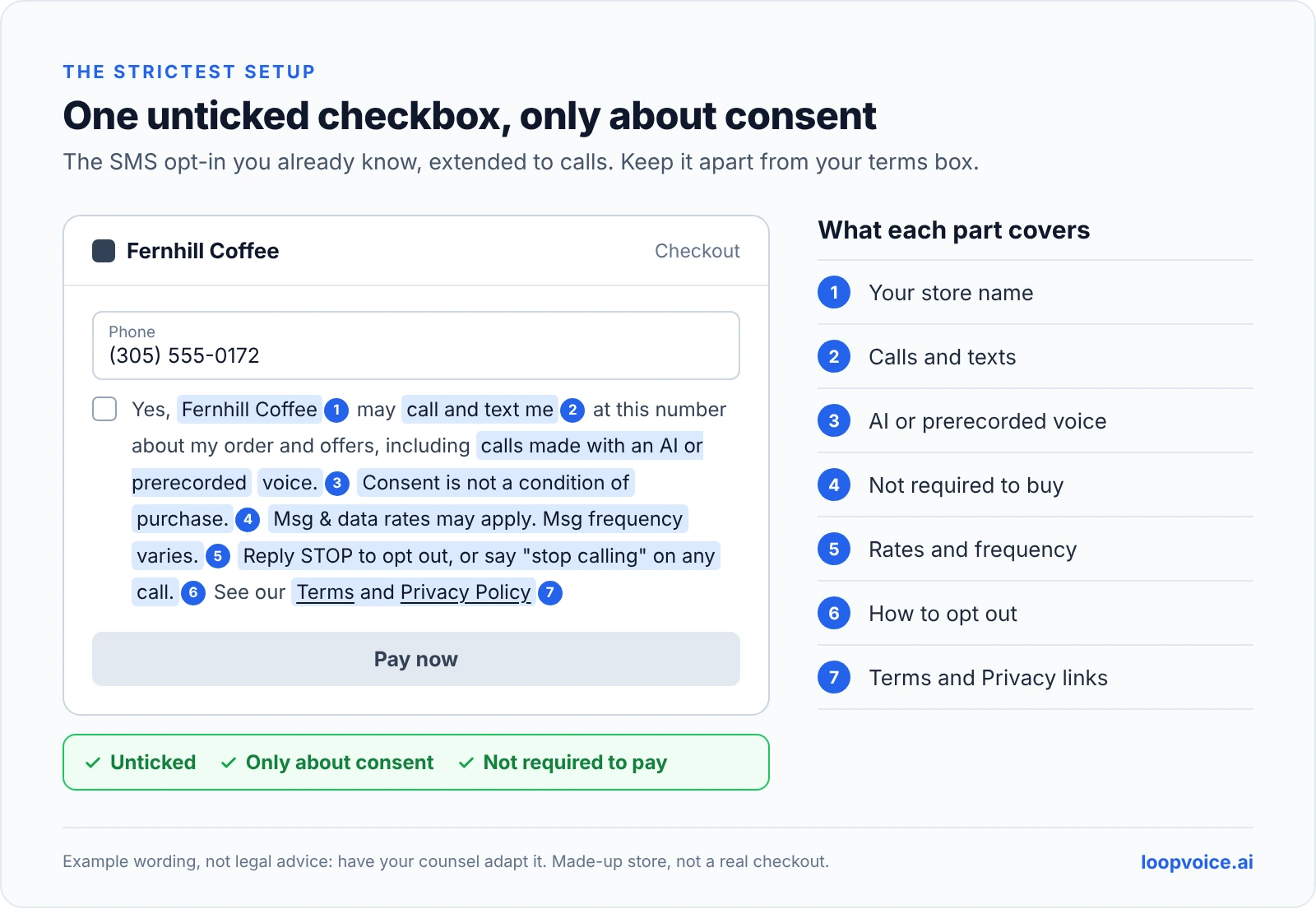
Unticked by default, right under the phone field, and only about consent: don't bundle it with your terms or newsletter. Copy this and add your store name:
| Checkbox text |
|---|
| Yes, [Store name] may call and text me at this number about my order and offers, including calls made with an AI or prerecorded voice. Consent is not a condition of purchase. Msg & data rates may apply. Msg frequency varies. Reply STOP to opt out, or say "stop calling" on any call. See our Terms and Privacy Policy. |
2. Add a line to your Terms and Privacy Policy
The checkbox points to your Terms, so add this line there:
| For your Terms of Service and Privacy Policy |
|---|
| By providing your phone number and opting in, you agree to receive calls and texts from us and our service providers, including automated, prerecorded and AI-generated voice calls. Consent is not a condition of purchase. Calls may be recorded. You can opt out anytime by replying STOP to any text or telling the agent to stop calling. |
3. Save the opt-in before the shopper leaves
The step most stores miss. Shopify's help page says an SMS opt-in from checkout is saved only when the shopper submits the checkout. Someone who ticks the box and leaves may have no saved consent, and that's exactly who you want to call.
So ask in your sign-up popup or account page too, where the opt-in saves right away, and test it with an abandoned checkout.
4. Switch Loop Voice to opted-in shoppers only
We can set your flows to only call and text shoppers who ticked the box, and campaigns can target a Shopify or Klaviyo segment of opted-in shoppers. Tell your Loop Voice contact and we'll switch it on.
Texts still need opt-in
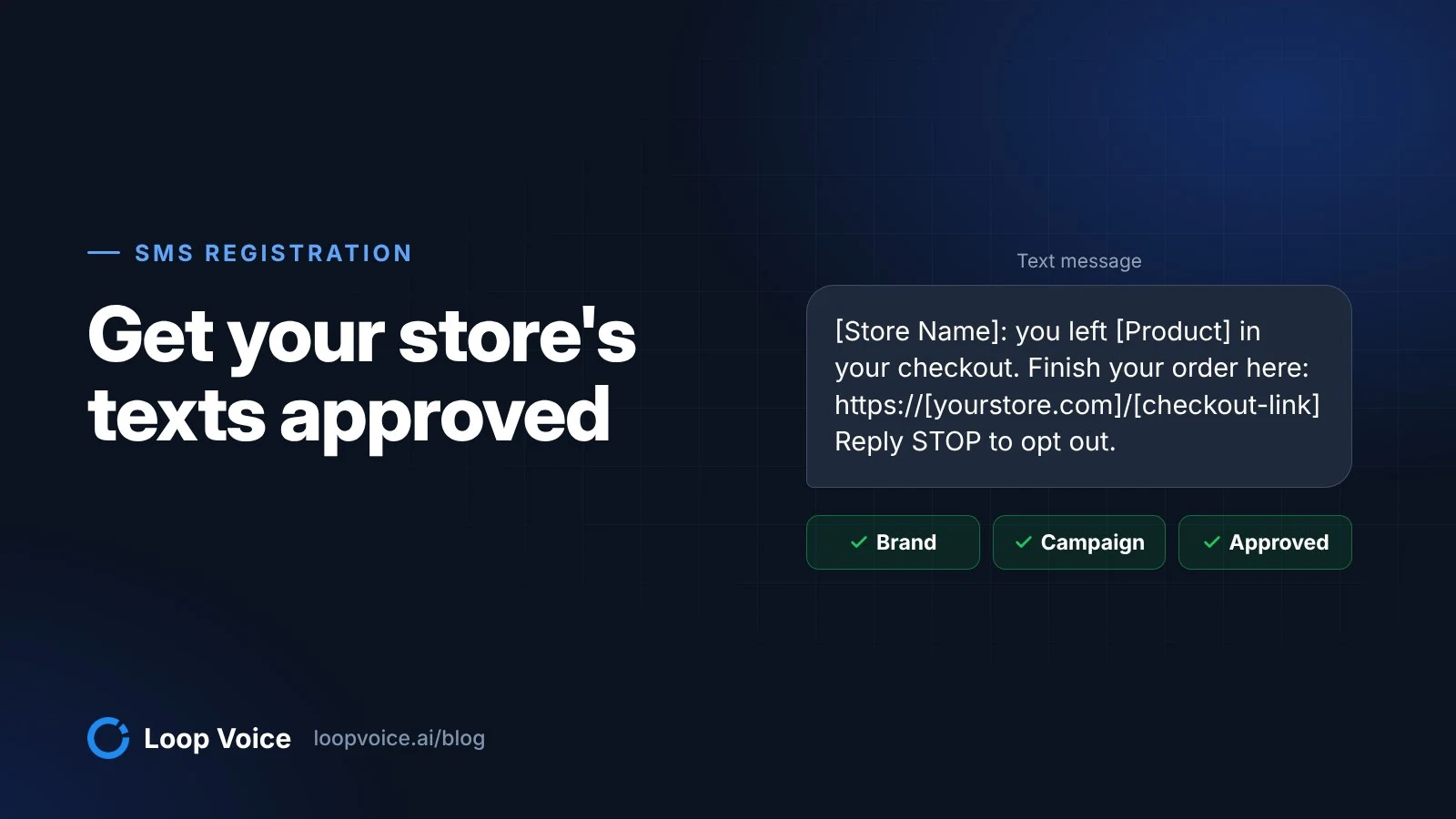
The ruling is about the TCPA. Texts have a second gatekeeper: the carriers. US business texting runs on registered A2P 10DLC numbers, and carriers expect a clear opt-in before marketing texts. So our SMS agent works like any SMS program: opt-in first, STOP honored every time.
The checkbox above covers both calls and texts, and our A2P 10DLC guide walks through registration.
What didn't change
The ruling is about the form of consent. The rest still applies:
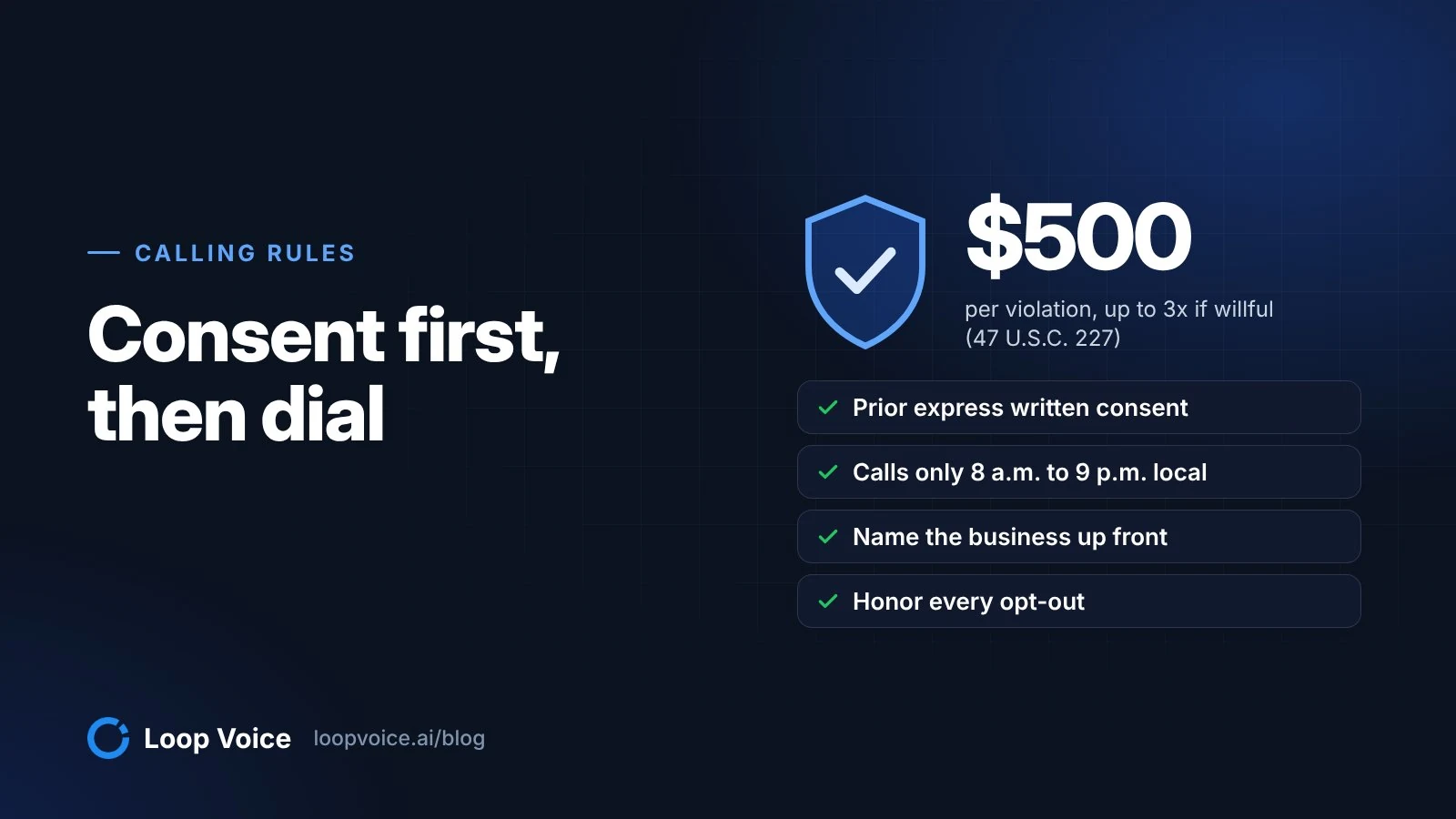
- Calling hours. 8 a.m. to 9 p.m. in the shopper's local time, and until 8 p.m. in Florida, Oklahoma and Maryland.
- Say who's calling. Name the store at the start. Loop Voice agents do, and they never claim to be human.
- Stop means stop. In any words, honored within 10 business days at most. Loop Voice puts the number on your do-not-contact list before the next call or text.
- Do Not Call Registry. Unchanged, and the TCPA guide covers the exceptions.
I'm not a lawyer and this isn't legal advice, so have your counsel check your setup, especially for Florida, Oklahoma and Maryland. How we handle call data is on our security page, and to see consent handling on a live account, book a demo.
Frequently asked questions
Does the Fifth Circuit's written consent ruling apply in every state?
No. It binds federal courts in Texas, Louisiana and Mississippi. Other courts can follow it or not, and Florida, Oklahoma and Maryland still require written consent for automated sales calls under state law.
Do I need a checkbox before calling shoppers who abandon checkout?
Not under the Fifth Circuit's reading of the TCPA, where a shopper giving their number at checkout can be the consent. We still recommend a line under the phone field, and a consent checkbox for Florida, Oklahoma and Maryland or for the strictest setup.
Sources
- Bradford v. Sovereign Pest Control of TX, Inc., No. 24-20379 (opinion) (US Court of Appeals for the Fifth Circuit, 2026)
- Fifth Circuit holds the TCPA does not require prior express written consent (Nixon Peabody, 2026)
- Declaratory Ruling FCC 24-17: Implications of Artificial Intelligence Technologies on Protecting Consumers from Unwanted Robocalls (Federal Communications Commission, 2024)
- 47 CFR 64.1200: Delivery restrictions (Cornell Law School, Legal Information Institute, 2026)
- 47 U.S.C. 227: Restrictions on use of telephone equipment (Cornell Law School, Legal Information Institute, 2026)
- Collecting customer contact information (Shopify Help Center, 2026)
Hear it before you decide
Listen to real recovery calls, or see Loop Voice call a test checkout on your own store.