




Post-Purchase Upsell Calls: When They Pay Off, When They Annoy
A post-purchase call pays off when it's about the order just placed: a refill, the matching piece, a problem fixed. Who to call, when, what to offer and how to measure it.

Pays off or annoys: the short version
A post-purchase call pays off when it's about the order the customer just placed: the refill they'll need, the piece that completes the set, or a delivery problem you can fix. It annoys when it's a second sales pitch with no link to what they bought. Call only buyers who agreed to marketing calls, make one relevant offer, and judge the program against a holdout group, because recent buyers come back on their own.
| It pays off when... | It annoys when... |
|---|---|
| The add-on completes or refills what they bought | The offer is whatever you're overstocked on |
| They've had time to use the product | The call lands before the box has shipped |
| There's a reason to talk: sizing, setup, a delivery check | The call exists only to sell |
| One offer, asked once | A second and third offer follow a no |
| Any problem with the order gets fixed first | The pitch lands in the middle of a complaint |
| The add-on's margin covers the calls | A discount wipes out the add-on's margin |
| The buyer agreed to marketing calls | The number was given for delivery updates only |
Who should get the call
Build the eligible list from rules, not from whoever ordered yesterday:
- Consent to marketing calls is on file. More on what that means below.
- The order has an obvious next item: a consumable that runs out, an accessory the product needs, or a piece that completes a look.
- They don't already own it. Klaviyo's post-purchase flow guide warns not to assume a product feed leaves out past purchases. Check the order history before the call goes out.
- Nothing is wrong with the order. No open ticket, return or complaint.
- They haven't been called lately. Cap calls per customer across every flow, so a buyer who just had a recovery call isn't rung again three days later. Loop Voice sets these caps per agent, by week, month, quarter, six months or year.
- The margin works. Example: an add-on with $18 of margin that sells on 1 in 12 answered calls costs about $14.40 in calls per sale at $1.20 per answered conversation (Loop Voice's Growth plan). That works, barely. At 1 in 20 it costs $24 per sale and loses money.
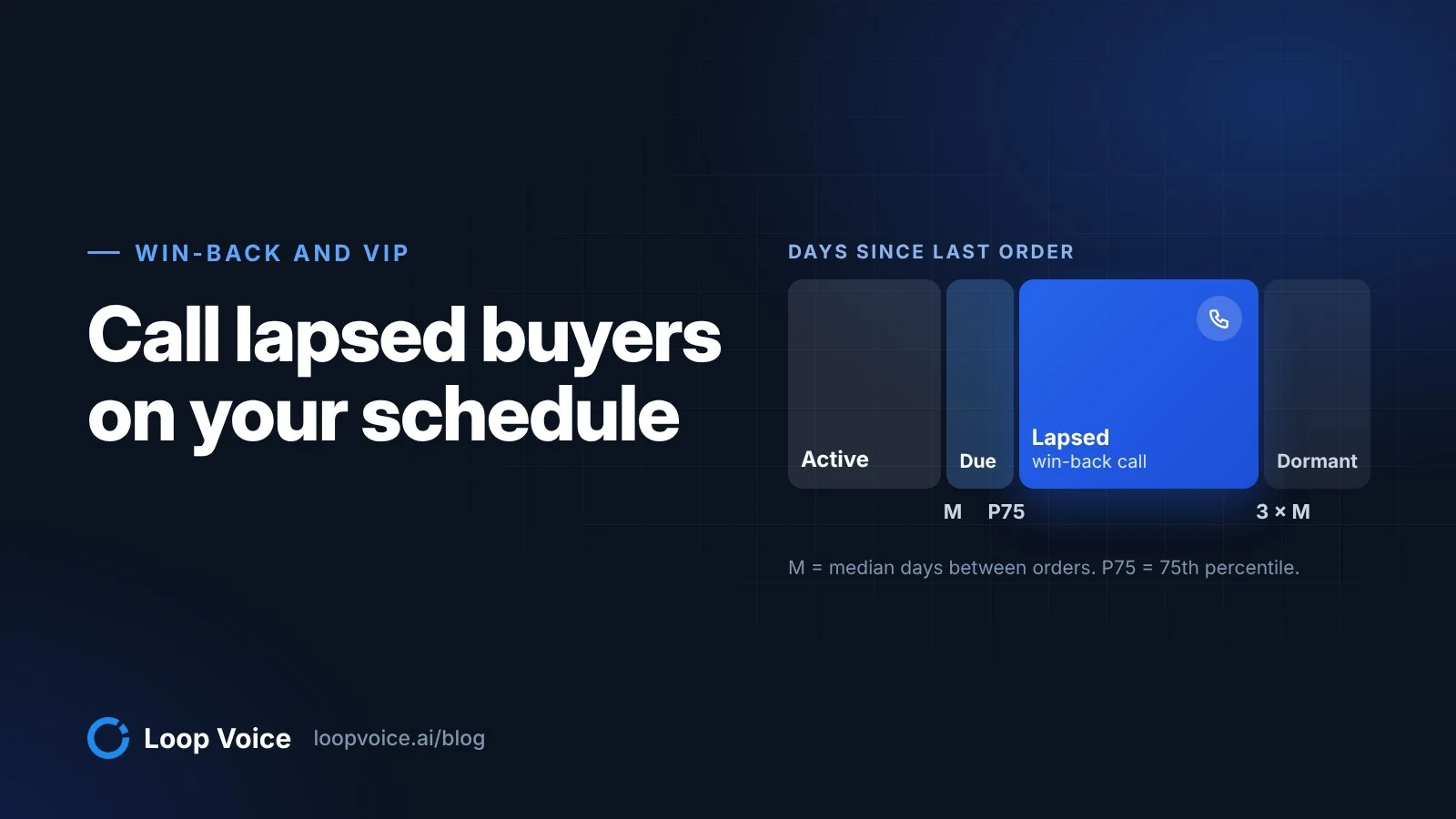
Customers who bought once and went quiet belong in a win-back campaign instead, with different timing and a different offer.
When to call
| What you're offering | When to call | Why then |
|---|---|---|
| Accessory or matching piece | 1 to 3 days after delivery | They've opened the box and know what's missing |
| Refill or subscription | Shortly before the first unit runs out, based on your reorder data | It's a reminder they'd want anyway |
| Setup or sizing help, with an offer attached | A few days after delivery | The help is the reason for the call; the offer comes second |
| An add-on to the same order | Right after checkout, on the page rather than the phone | Shopify's post-purchase page appears seconds after payment; a call can only text a link to a separate checkout |
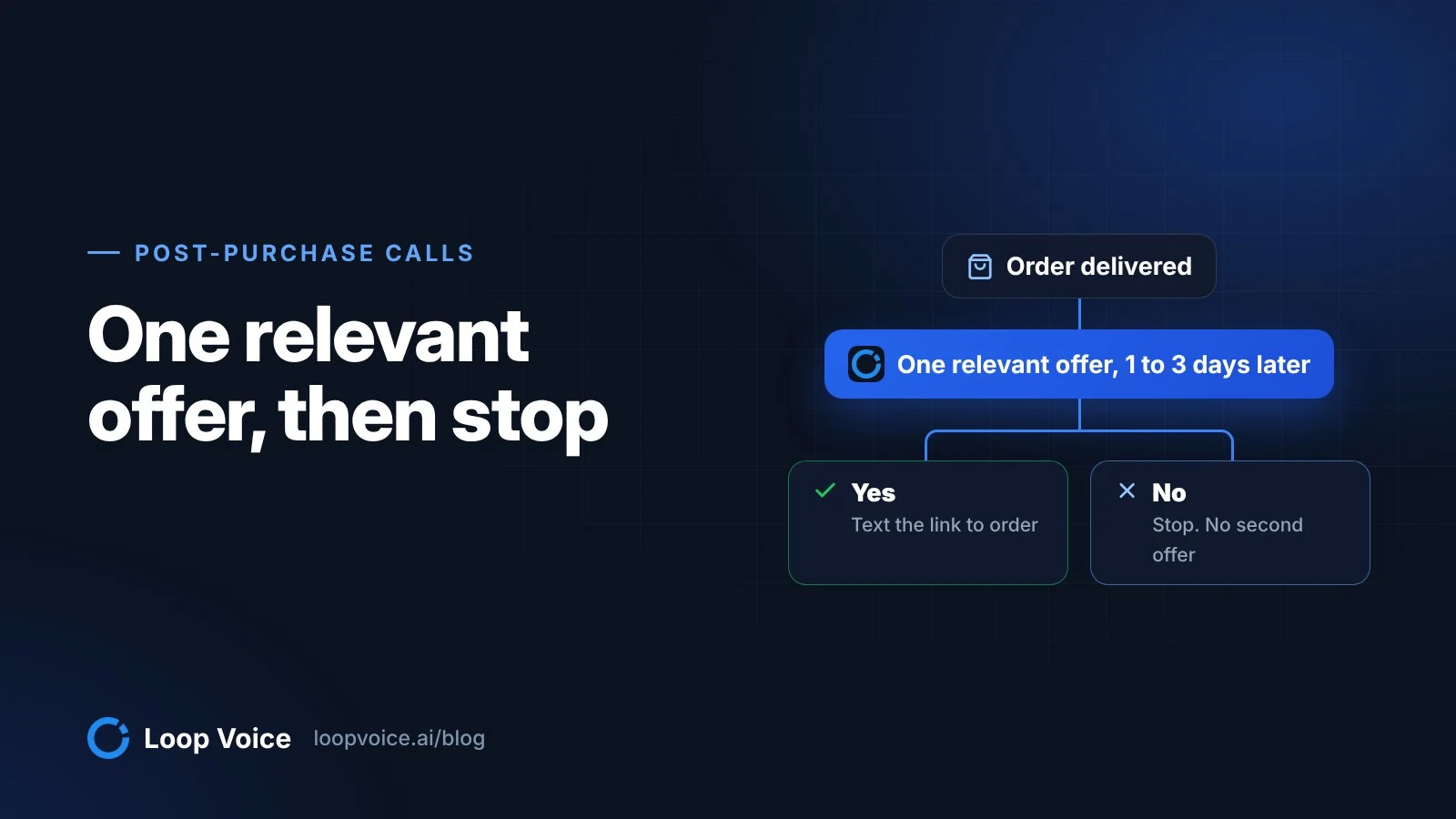
The 1-to-3-days-after-delivery window is the one Loop Voice's post-purchase upsell template uses, and our post-purchase upsell page has Loop Voice's benchmark results for these calls. Flows start from store events such as order placed or order fulfilled, so add a wait step that covers transit time.
The minutes right after checkout belong to on-page offers: Shopify's post-purchase page appears after the order is confirmed and before the thank-you page, which is where one-click upsell apps (compared in our Shopify upsell apps roundup) show their offers. A call covers two gaps that page leaves. The page isn't shown at all when the buyer checks out with an installment or wallet service, such as Klarna, Afterpay, Apple Pay or Google Pay, or pays with a gift card (Shopify developer docs). And it can't answer a question.
What to offer
The offer has to make sense out loud, in one sentence, to someone who just bought from you.
- Complete the set; don't widen the catalog. CityMan USA's agent suggests pieces that go with what the shopper was looking at, to lift order value, and the store found that styled suggestions (the denim that works with the tee) landed where generic "you might also like" pitches didn't (CityMan USA story). CityMan does this on recovery calls, and the rule carries straight over to post-purchase.
- Refills and subscriptions for consumables. "You'll probably run low around [date]. Want me to text you a link to reorder, or set it up as a subscription?"
- One offer per call. If they say no, the call moves to the close.
- A discount only for a price objection, and only if the margin survives it. Most add-on objections are "do I need it?", which a code doesn't answer.
- Go easy on protection plans. In our recorded checkout calls, shoppers pushed back on protection add-ons more than once ("...they want me to pay money for protecting my investment, but I'm not going to do that"). The call script template has more objections from real calls.
Two real post-purchase calls
Our public call library has two post-purchase calls, both from a dog-chew brand, and neither is a hard sell.
Leon's call was a delivery check. He loved the chews but had received the wrong flavor, loose instead of packed. The agent confirmed the mismatch, offered a replacement or a refund, opened a support ticket, and only then mentioned a 10% code for his next order:
Anything else you want to make sure is blueberry only on your next order?
Um, yes, that's the one she likes the best.
Got it, blueberry only. If you want, on your next order, you can use our 10% off code loop 10. L as in Lima, O as in Oscar, O as in Oscar, P as in Papa, 1, 0.
Can you repeat the code back to me just so I know it's clear?
Loop 10.
Perfect, loop 10. I'll let support know it's a blueberry only replacement to the same address and you're all set.
Perfect, thank you so much for all your help.
You're welcome, Leon. If anything looks off when the replacement arrives just reply to that text and we'll jump on it.
Holly's call was a subscription check-in. Earlier in the call the agent suggested a chew holder; she said no, and it never came back. When she said the chews were "Perfect as is. I have shih tzus," the agent wrapped up: "Then I'll get out of your hair. If you ever do need a backup, we've got a 10% off code for a future order."
Two rules fall out of these calls. Fix the order before you sell anything. And when a customer says everything is fine, close with a reason to come back instead of a second pitch. If finding problems like Leon's is the main goal, run a post-purchase survey call with no offer at all.
Consent: if it has an offer, it's a marketing call
Treat any post-purchase call that includes an offer as a marketing call, even when it opens as a check-in. Klaviyo draws the same line for email: a message only counts as transactional if it has no marketing in it (Klaviyo Help Center).
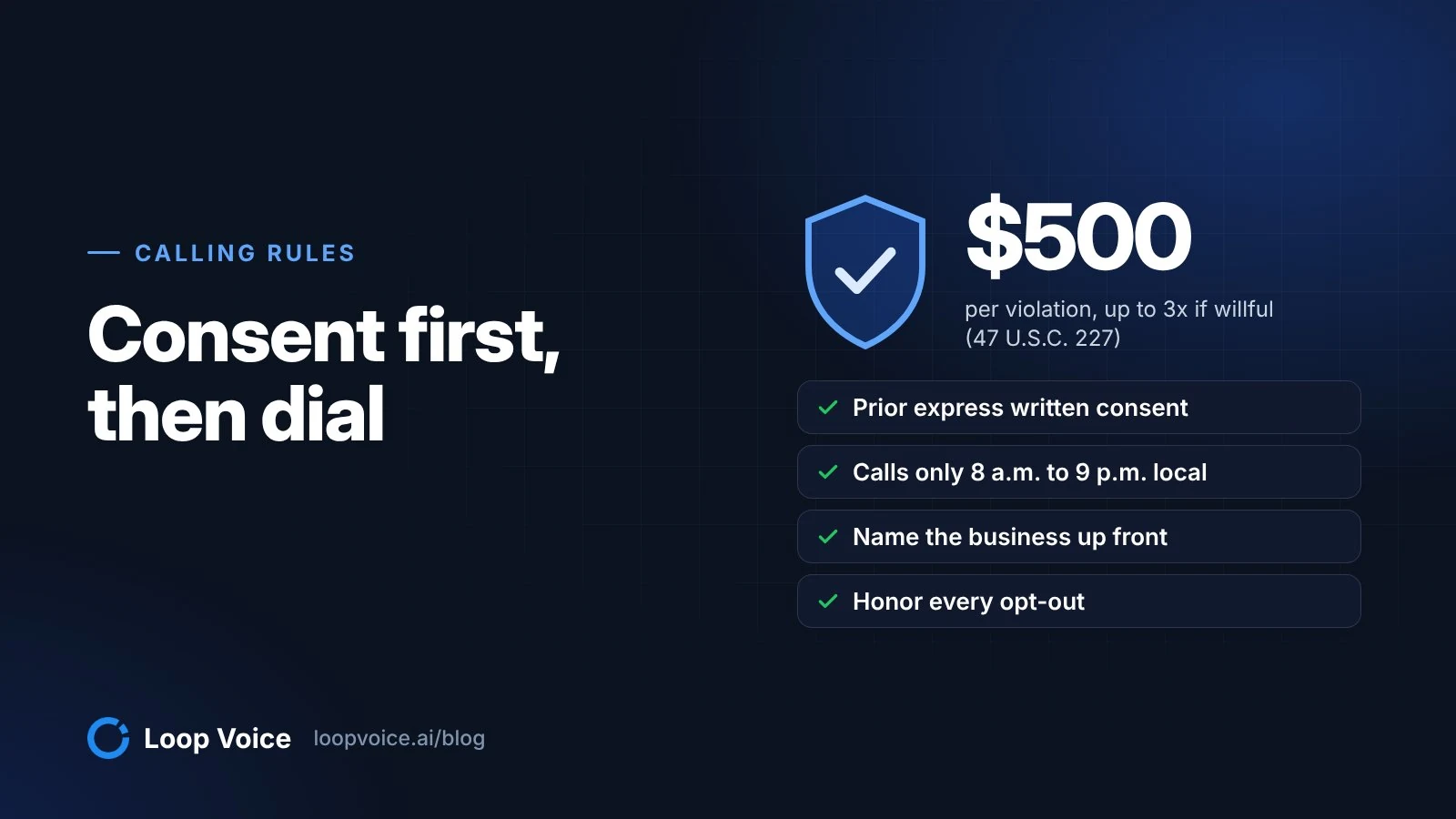
Two federal points matter for AI calls. The FCC has confirmed that AI-generated voices are "artificial" voices under the TCPA, and telemarketing calls made with an artificial voice need prior express written consent: a signed written agreement that clearly authorizes those calls to that number (47 CFR 64.1200). A phone number typed into checkout for delivery updates usually doesn't meet that bar. Our guide to calling rules covers the consent wording, quiet hours and opt-outs.
Measure it against a holdout, not attributed revenue
Recent buyers are your likeliest repeat customers, so attributed revenue flatters a post-purchase flow. Loop Voice ties each order to the call that caused it, which tells you where an order came from but not whether it was extra. For that you need a holdout: a random slice of eligible buyers who get everything except the call.
- Hold out a random 10 to 20% of eligible buyers before anyone is called. In Klaviyo, a conditional split with a Random sample condition does this; add a Property update on each path so the call campaign can target only the call group.
- Use one window for both groups, such as 30 or 60 days after the order.
- Compare add-on orders and revenue per eligible buyer, net of refunds, plus opt-outs. Returns matter here: the NRF expects 19.3% of online sales to be returned in 2025, and an add-on that comes back isn't a sale.
- Check the sample size before you read the result, with a sample size calculator.
Example: 3.5% of held-out buyers order the add-on within 30 days, against 6% of called buyers. Detecting a lift that size takes roughly 930 buyers in each group (80% power, 5% significance), so a store with 2,000 eligible buyers a month should split them 50/50 for a month or two rather than hold out 20% and guess.
Then do the margin math on the lift only: extra add-on orders times the add-on's margin, minus the cost of every answered call in the test group and any discount given. If that's negative, change the pairing before you rewrite the script. Our holdout test guide walks through the setup step by step.
Frequently asked questions
Should first-time buyers and repeat buyers get the same call?
No. Klaviyo's post-purchase guide splits new and returning customers because their needs differ, and calls work the same way. A first-time buyer gets a check on fit, setup or delivery, with an offer only if it solves something they mention. A repeat buyer already knows the product, so a refill, subscription or matching piece is the natural reason to call.
Should a review request and an upsell share one call?
Keep them apart. A review request works best once the product has been used: Loop Voice's review request template calls 3 to 5 days after delivery, while the upsell template uses 1 to 3 days. Asking for a favor and a purchase in the same call weakens both, and a buyer with a complaint should get help first, not either request.
Sources
- How to create a post-purchase flow (Klaviyo Help Center, 2026)
- Post-purchase product offers (Shopify.dev, 2026)
- Declaratory Ruling FCC 24-17 on AI-generated voices (Federal Communications Commission, 2024)
- 47 CFR 64.1200, Delivery restrictions (Cornell Law School, Legal Information Institute, 2026)
- Consumers expected to return nearly $850 billion in merchandise in 2025 (National Retail Federation, 2025)
- How to A/B test flow branches (Klaviyo Help Center, 2026)
- Sample Size Calculator (Evan Miller, 2026)
- How to add an update profile property action to a flow (Klaviyo Help Center, 2026)
- CityMan USA customer story (Loop Voice, 2026)
Hear it before you decide
Listen to real recovery calls, or see Loop Voice call a test checkout on your own store.