





Key takeaways
- No code on the first call: answer the question that stopped the order first.
- Offer a code only when price is the stated objection, and only one code the agent owns, so you can count it and switch it off.
- Keep codes out of calls where price isn't the problem, such as failed payments and most support calls.
The short answer
Give the agent one discount code, one reason to use it and several reasons not to. No code on the first call, a code only when price is the stated objection, one use per shopper, a short expiry, and never on calls where price isn't the problem, such as failed payments.
That keeps the code for the shoppers it actually wins. A code on every call pays the shoppers who would have ordered anyway once their question was answered.
Why a code on every call costs more than it wins
Price is a real reason people leave. In Baymard Institute's survey, 40% of US shoppers who abandoned a checkout named extra costs such as shipping, tax and fees. The rest of the list is delivery that was too slow, not trusting the site with a card, being asked to create an account, and a checkout that errored. A code fixes none of those.
Example: 100 shoppers order after talking to the agent, each with a $150 cart. Say 70 of them would have ordered at full price once their question about sizing or delivery was answered. A 10% code on every call hands those 70 shoppers $1,050 they didn't need, to help win the other 30. Holding the code for shoppers who say price is the problem keeps most of that $1,050.
Codes also teach. A shopper who gets a code every time they leave checkout learns to leave checkout. Keeping the code for the second call, and only for price, stops the call from turning into a coupon line.
Six guardrails for codes on AI calls
- No code on the first call. The first call is for the question that stopped the order: shipping cost, sizing, delivery dates, a declined card. Loop Voice's default abandoned checkout flow works this way: it calls, texts the checkout link, then calls again with a discount.
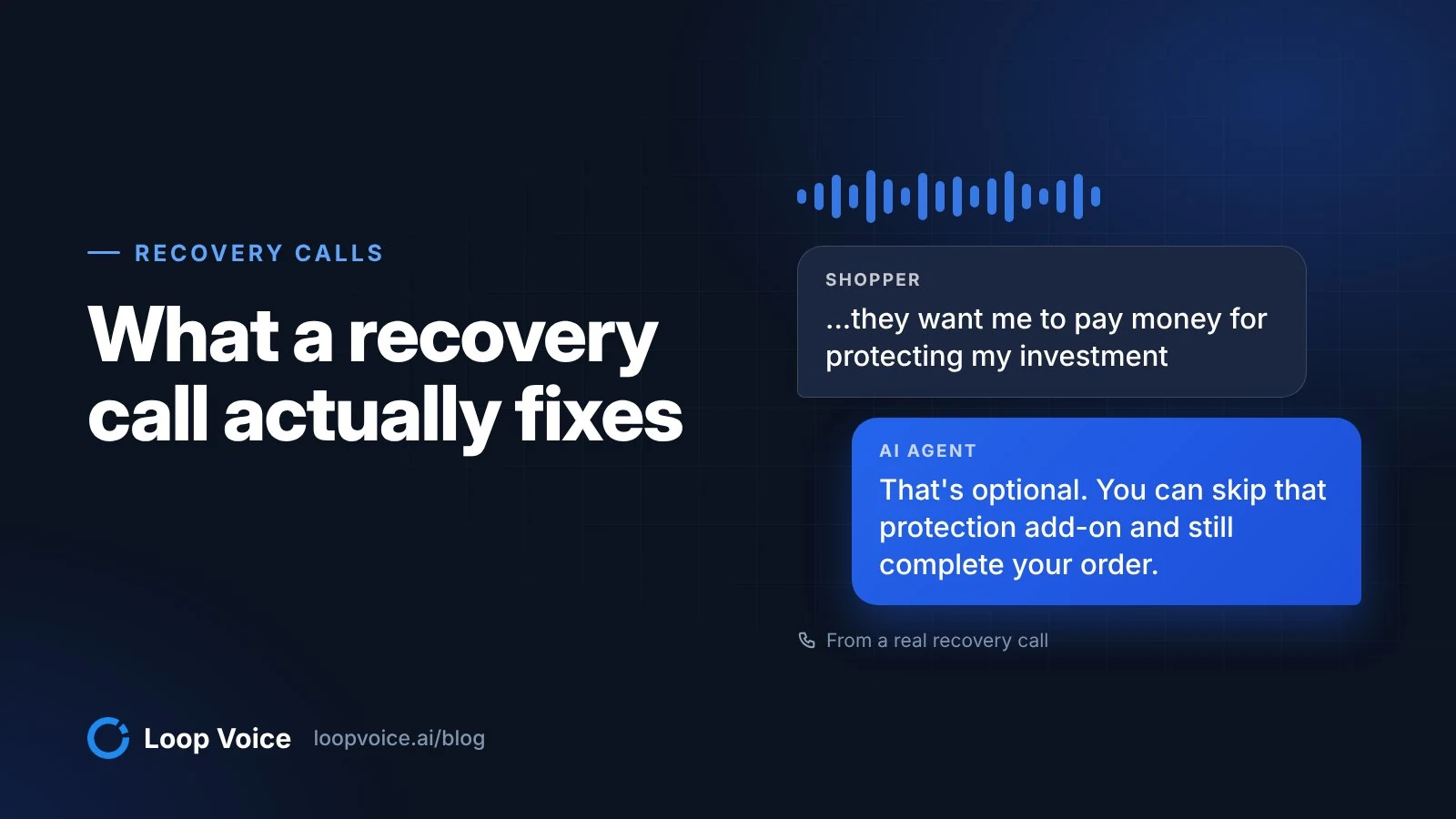
- A code only when price is the objection. If the shopper hesitates on delivery time or fit, the agent answers that instead. Write the rule into the agent's objection handling in plain words: offer the code only when the shopper says the price or the shipping cost is the problem.
- One code the agent owns. Create a code only the agent hands out, for example CALL10, rather than reusing your welcome code. You can count exactly which orders it touched and switch it off in one place: Shopify lets you deactivate an unexpired discount, and anyone who tries it after that gets an invalid-code message.
- Cap it in Shopify. On the code, turn on "Limit to one per customer", set a minimum purchase amount and set an end date a few days out. All three are standard settings on Shopify amount-off codes.
- Don't let it stack. In the code's Combinations section, leave other product and order discounts unticked, so a shopper can't add the agent's 10% to a welcome code. Shopify only combines two discounts when both of them allow it.
- Put the code in writing. A code read out on a call gets misheard. Put it in the flow's last text, next to the checkout link. If your email tool sends codes too, keep them apart: Klaviyo's unique coupon codes give each recipient a single-use code, and the agent's code should be a different one so you can tell which touch won the order.
Which calls get a code
| Call | Code? | Why |
|---|---|---|
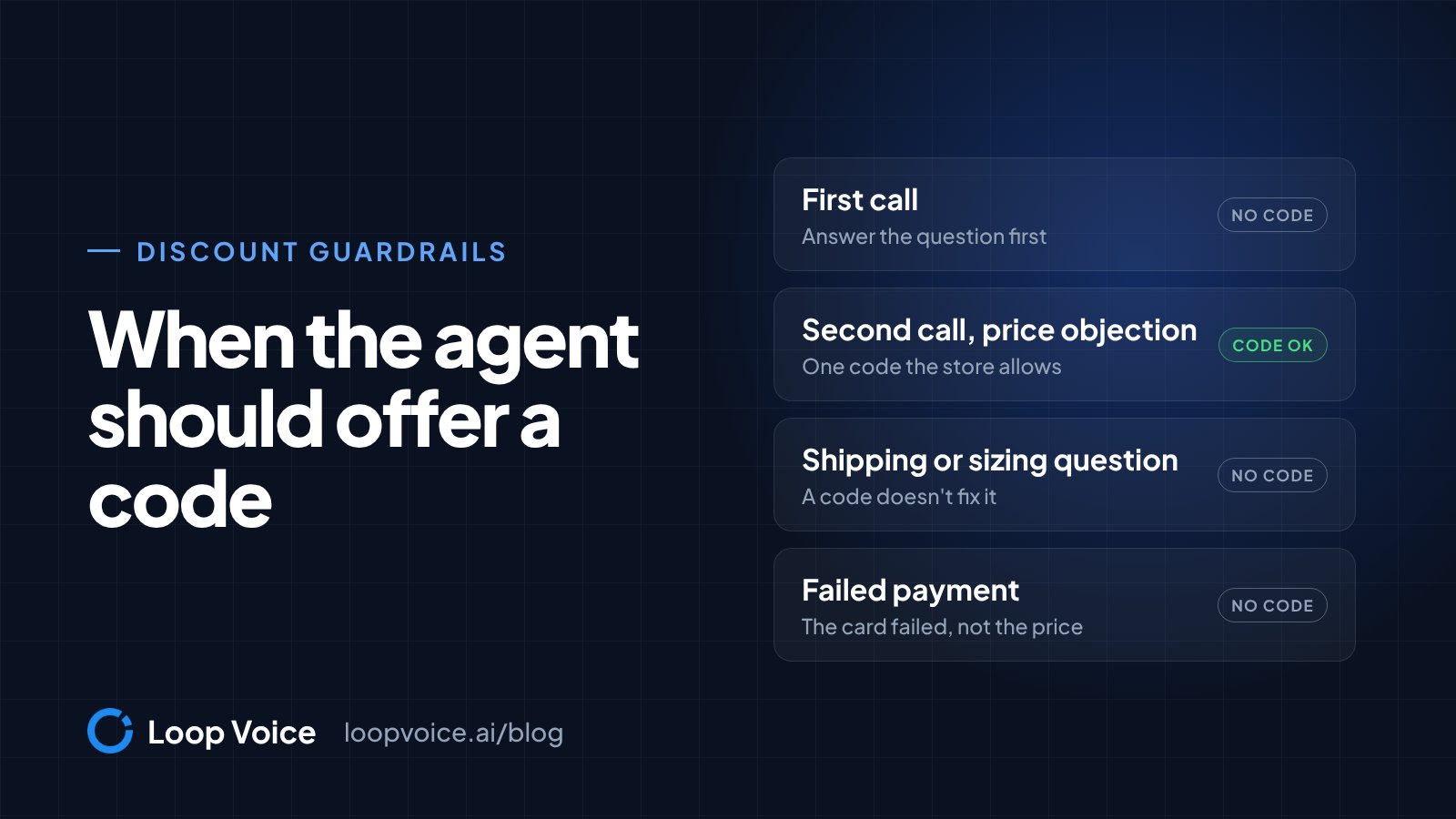
| Abandoned checkout, first call | No | Answer the question that stopped the order first |
| Abandoned checkout, second call | Only if price was the objection | The shopper already heard the answer to everything else |
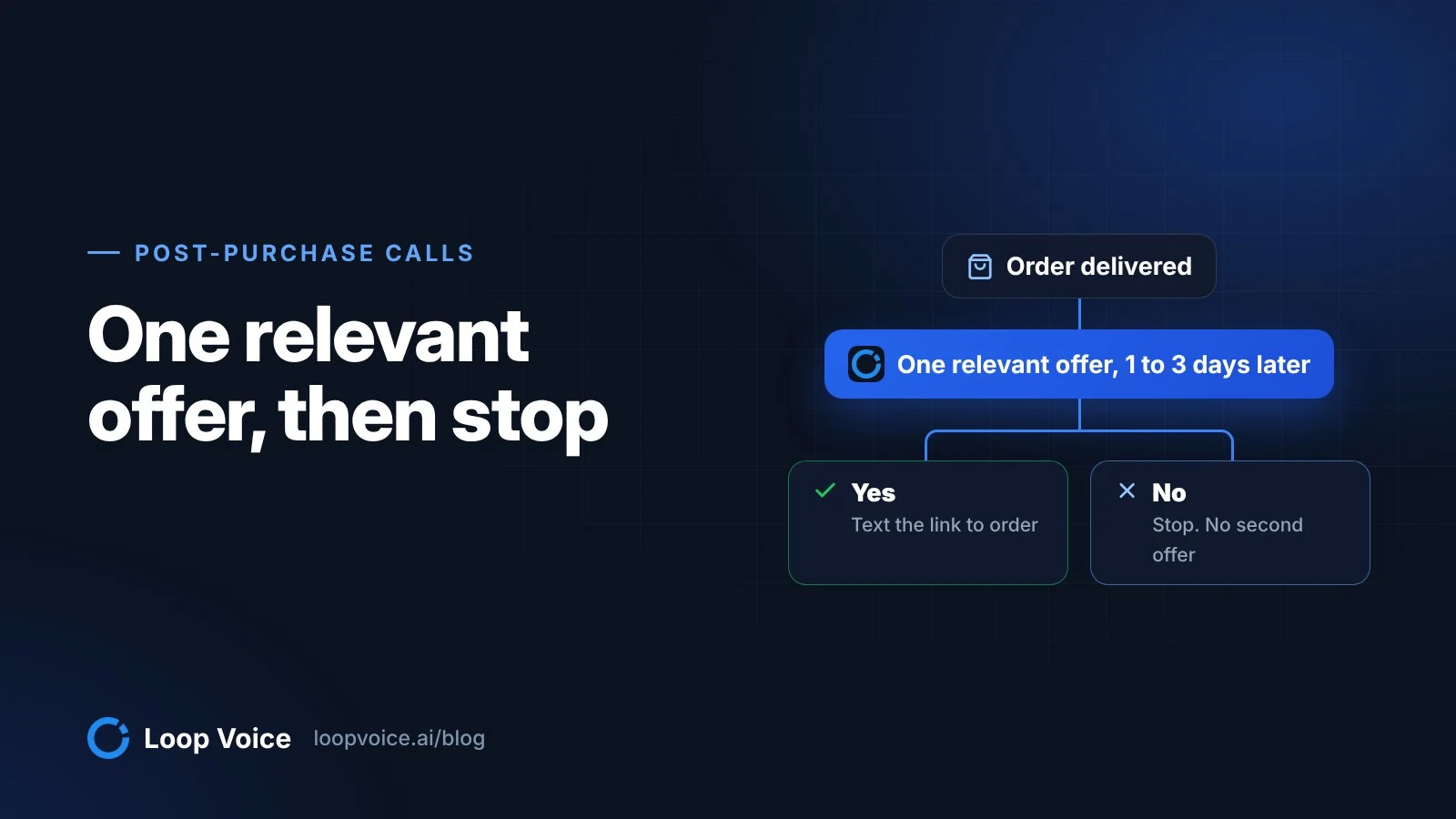
| Post-purchase upsell | An add-on offer, not a store-wide code | They just bought at full price; a store-wide code teaches them to wait next time |
| Win-back | Yes, once they are past your usual repurchase window | A lapsed customer needs a reason to come back; keep it one per customer |
| Failed payment | No | The card failed, not the price; the call's job is the card-update link |
| Inbound support | Only where your policy already offers one | A late or damaged order may earn a goodwill code; set the rule, don't let the agent make one up |
On failed payment calls a code is pure cost: the subscriber already chose the product at that price. For upsells, our post-purchase upsell guide covers add-on offers, and the win-back blueprint covers when a lapsed customer has earned one.
Measure what the code actually wins
Track three numbers for a month:
- The share of answered calls where the agent offered the code. If it climbs, read those calls: the agent may be offering it before the shopper names price.
- Orders that used the agent's code against orders after a call without it, with the average order value of each.
- Revenue per contact after the discount, not before it.
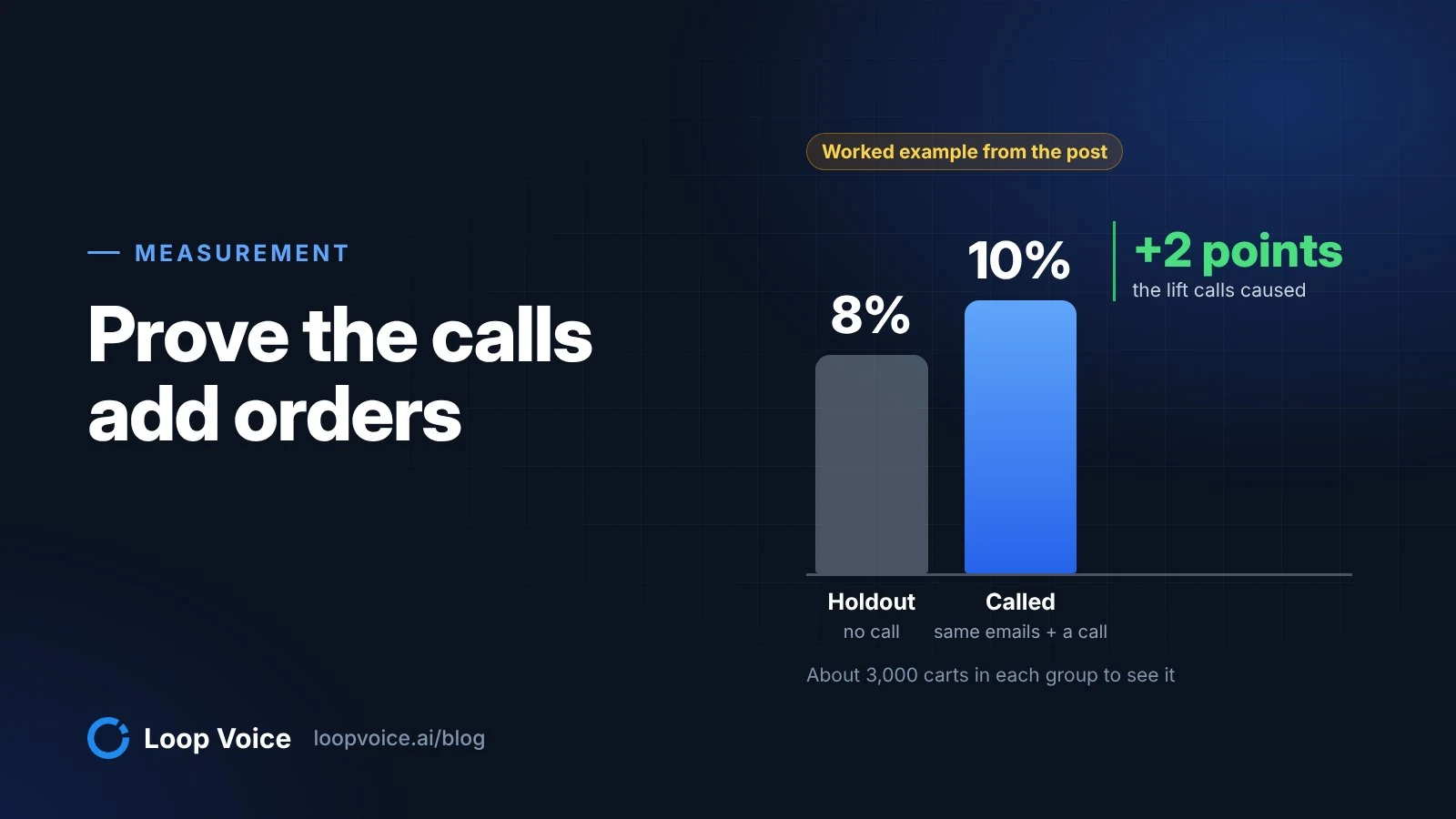
Then test it. Offer the code on half the second calls and none on the other half for a few weeks, and compare revenue per contact. To know what the calls add at all, run a holdout test.
Our October benchmark tracks discount levels too, but no level reached the 200-shopper minimum, so there is no published conversion rate by discount yet.
Set it up in Loop Voice
- Create the code in Shopify with one use per customer, a minimum purchase amount, an end date and no combinations.
- In the abandoned checkout flow, add it as the code the agent may offer on the second call.
- In the agent's objection handling, write when it may offer the code: only after the shopper names price or shipping cost as the reason.
- Put the code in the flow's last text, with the checkout link. The same flow can run as one sequence of texts and calls.
- After a week, open Conversations, read the calls where the code came up, and check the agent waited for the price objection.
For the whole call-first playbook, see the abandoned cart recovery playbook.
Frequently asked questions
Should an AI agent offer a discount on abandoned cart calls?
Only on the second call, and only when the shopper says price is the problem. On the first call the agent should answer what stopped the order, and most of those reasons, such as delivery time or a checkout error, aren't fixed by a code.
How big should the agent's code be?
Big enough to cover the cost the shopper named and no bigger. If shipping cost is the objection, a code that covers shipping often does more than a percentage off.
Can the agent offer a code on a failed payment call?
It shouldn't. The subscriber already chose the product at that price, and the call's job is to get the card updated.
How do I stop the agent's code from leaking?
Limit it to one use per customer, give it an end date a few days out and set a minimum purchase amount. If it turns up somewhere it shouldn't, deactivate it in Shopify and create a new one for the agent.
Sources
- Cart abandonment rate (Baymard Institute, 2026)
- Discount combinations (Shopify Help Center, 2026)
- Amount-off discounts (Shopify Help Center, 2026)
- Managing discount codes (Shopify Help Center, 2026)
- Unique coupon codes (Klaviyo Help Center, 2026)
Hear it before you decide
Listen to real recovery calls, or see Loop Voice call a test checkout on your own store.