


Missed Call Text Back for Online Stores: What to Text When Shoppers Don't Pick Up
What an online store should text after a shopper misses its sales call: the copy, the timing, the consent and registration rules, and what Loop Voice's September 2026 benchmark says about the text's share of sales.

Key takeaways
- Texts were the credited touch on 78.6% of attributed conversions in September, partly by design: an answered call takes the credit, and most shoppers never picked up.
- 8.1% of the 8,459 shoppers texted converted with a text as the credited touch within 5 days; after abandoned-checkout calls it was 13.9%.
- Keep the text to one job: store name, checkout link, no code on the first send and a STOP line, sent minutes after the missed call from a registered number.
Text one link, minutes after the miss
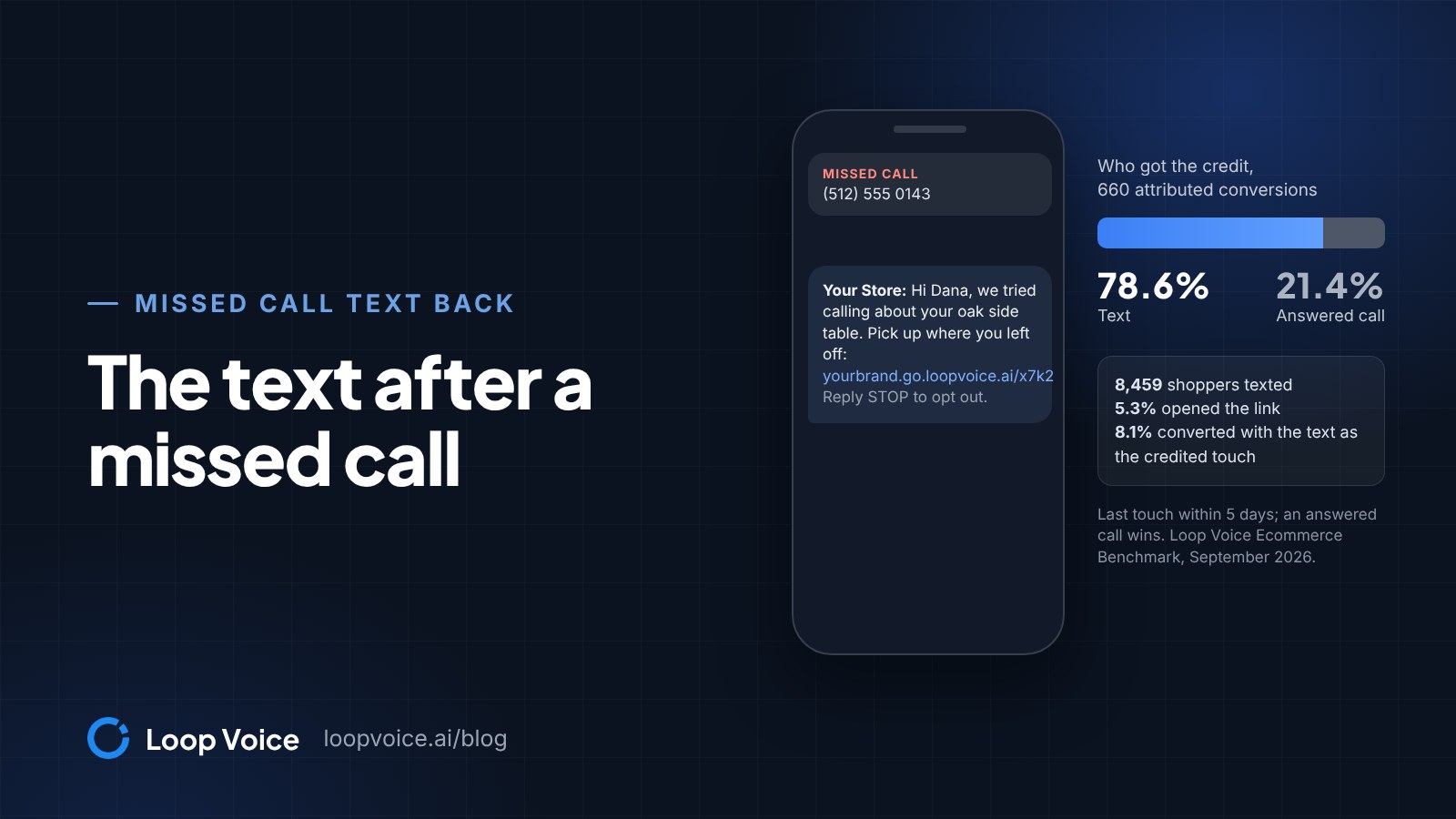
When a shopper misses your call, text them within minutes: your store's name, one link back to the checkout they left and a STOP line. In Loop Voice's September 2026 benchmark, texts were the credited touch on 78.6% of 660 attributed conversions and answered calls on 21.4%, partly because most shoppers never picked up.
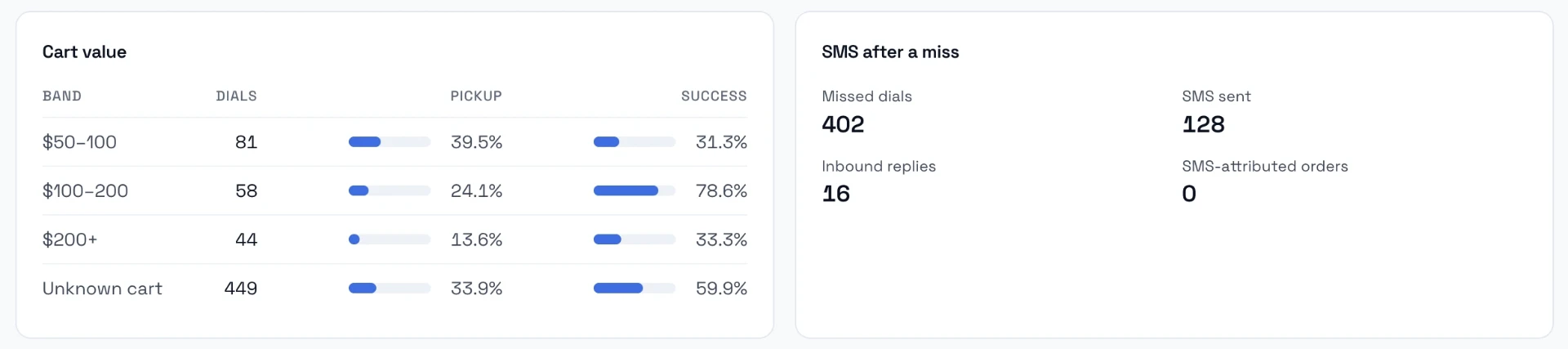
Of the 8,459 shoppers who got a text after a missed call or a conversation, 5.3% opened the link and 8.1% converted with a text as the credited touch within 5 days (95% CI 7.5 to 8.7). These numbers are from the Loop Voice Ecommerce Benchmark, September 2026, which covers 7 online stores; Loop Voice publishes it under CC BY 4.0, so anyone may quote it with credit.
This post covers that outbound follow-up: the text an online store sends after its own call to a shopper goes unanswered. Most guides to missed call text back, such as Aloware's guide, mean the reverse: an automatic text to someone who called a business and didn't get through.
How the benchmark decides a text made the sale
The 78.6% depends on the rule behind it. The report's method puts it in one sentence: "Each sale is credited within 5 days to its last touch: an answered call wins; otherwise a text (sent, or its link clicked) wins."
In practice:
- An answered call takes the sale. If the shopper picked up a call in the 5 days before ordering, the call gets the credit, even when a text came later.
- A text takes the sale only without an answered call. Whether it also needs a click is less clear: the method says "sent, or its link clicked", but the report's charts describe the split as last click.
- Sales with no touch in the window are left out of the split, though they still count in the report's conversion and lift figures.
Example: a shopper abandons checkout at 2:10 pm, misses the call at 2:20 pm, gets the checkout-link text a minute later, and that evening taps the link and orders. The text is credited. Had she answered at 2:20 and then finished through the texted link, the call would get the sale.
So the split leans toward texts by design. Only 15.9% of shoppers called picked up at least once, so for the other 84.1%, a text was the only touch that could take the credit. Read 78.6% as the share of sales whose credited touch was a text, not as proof that texts outsell calls.
Nor does the split show what the text added. The benchmark's only estimate of added orders covers calls and texts together: +2.8 points of 5-day conversion against enrolled shoppers the flows never reached in the same 6 stores (95% CI 1.9 to 3.7), an estimate, not a randomized holdout. To measure the text alone, hold it back from a random share of shoppers, as in our holdout test guide.
Where texts converted, and where they didn't
By use case, the split barely moved: for abandoned checkouts, a text was the credited touch on 77.8% of 609 attributed orders and an answered call on 22.2%. The text's own conversion rate moved a lot.
| Texts sent after | Shoppers texted | Converted, text credited, 5 days | 95% CI |
|---|---|---|---|
| Abandoned checkout calls | 4,534 | 13.9% | 12.9 to 14.9 |
| Post-purchase upsell calls | 3,925 | 1.5% | 1.2 to 1.9 |
| All use cases | 8,459 | 8.1% | 7.5 to 8.7 |
Source: Loop Voice Ecommerce Benchmark, September 2026. A text that sends a shopper back to a checkout they started did far better than one sent after an upsell call. Since October, Loop Voice's upsell calls text the buying link only after the customer says yes.
What the text should say
Give the text one job: get the shopper back to the checkout they left. Loop Voice texts carry merge fields for name, product, checkout link and discount code, plus the required STOP footer.
Example: after a missed first call.
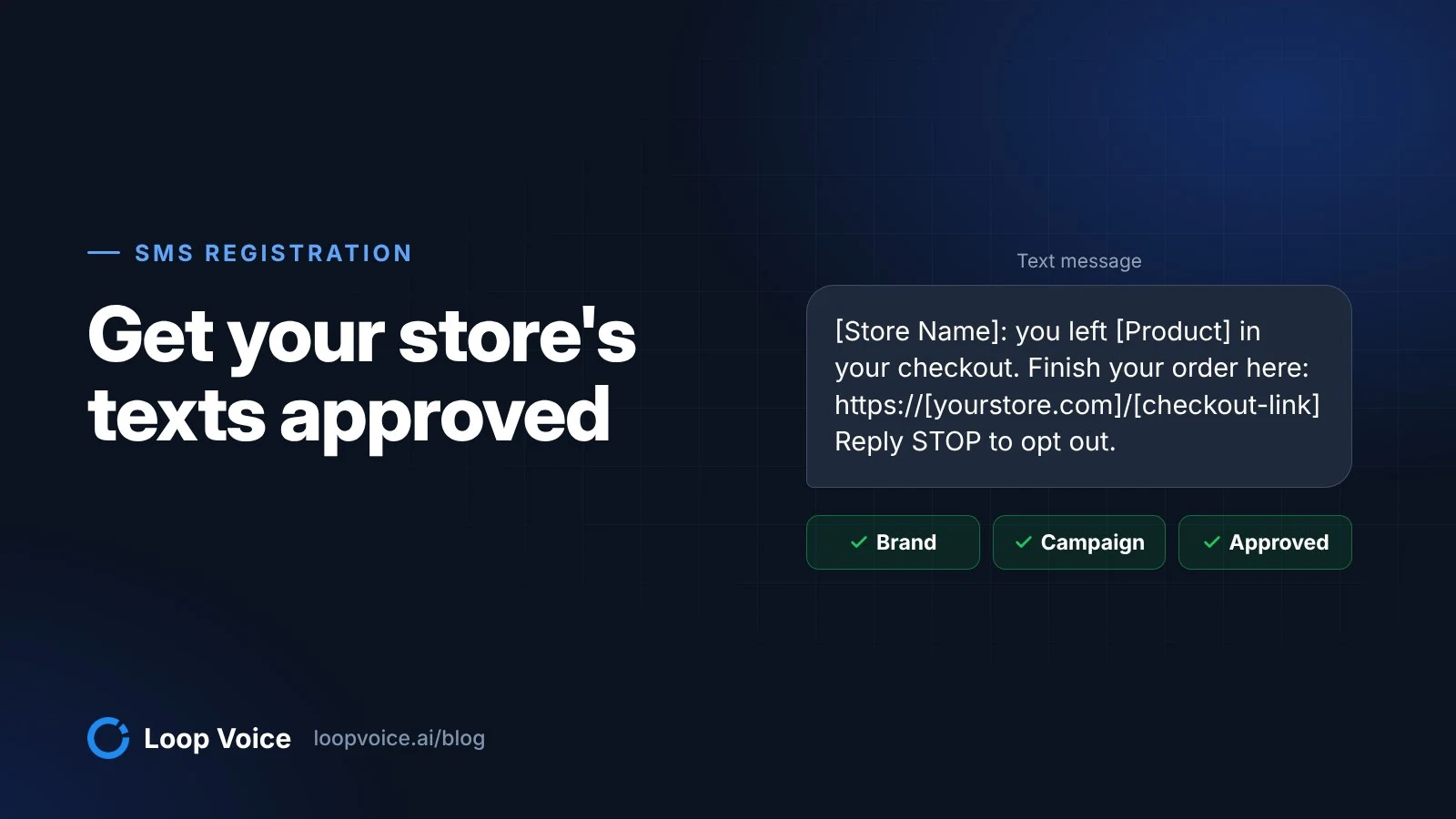
[Store]: Hi [first name], we tried calling about your [product]. Pick up where you left off: [checkout link] Reply STOP to opt out.
Example: after a conversation in which the shopper asked for the link and the agent offered a code.
[Store]: Here is the checkout we talked about, [first name]: [checkout link] Code [code] works at checkout. Reply STOP to opt out.
The rules behind those two lines:
- Store name first. The shopper may not have recognized the number that rang, and the name is what ties the text to the call.
- One link, to the checkout itself. Shopify's warning is blunt: "Anyone who opens the abandoned checkout link can continue that checkout," and a sent link can't be disabled or expired, so it goes only to the shopper who left it (Shopify Help Center). Skip public link shorteners: the CTIA Messaging Principles and Best Practices say a sender's shortener should use a web address dedicated to that sender.
- No code in the first text. Loop Voice's abandoned checkout template keeps the discount for the second call, and a code in the first text hands it to shoppers who might have finished without one.
- One segment. A standard text holds 160 characters; one emoji switches the encoding and cuts that to 70, and longer messages split into segments (Twilio). Example: with a 10-character store name, a four-letter first name, a three-word product and a 30-character link, the first template above comes to 146 characters. A longer link or product name pushes it into a second segment, so drop the product name if yours run long.
- A STOP line every time. CTIA's guidelines call for standardized STOP wording, and federal rules count replies of stop, quit, end, revoke, opt out, cancel or unsubscribe as revoking consent, to be honored within ten business days at most (47 CFR 64.1200(a)(10)). In Loop Voice, a STOP reply puts the number on the do-not-contact list before the next step runs.
After a conversation, the text confirms what the shopper agreed to. On a recorded call for a furniture store in the call library, the delivery price stopped the order, so the agent texted a 5% code and the checkout link, then closed with: "If you need anything later, just reply to that text or hop back on the checkout link." Under the benchmark's rule, an order after a call like that counts for the call, because the shopper picked up.
When to send it
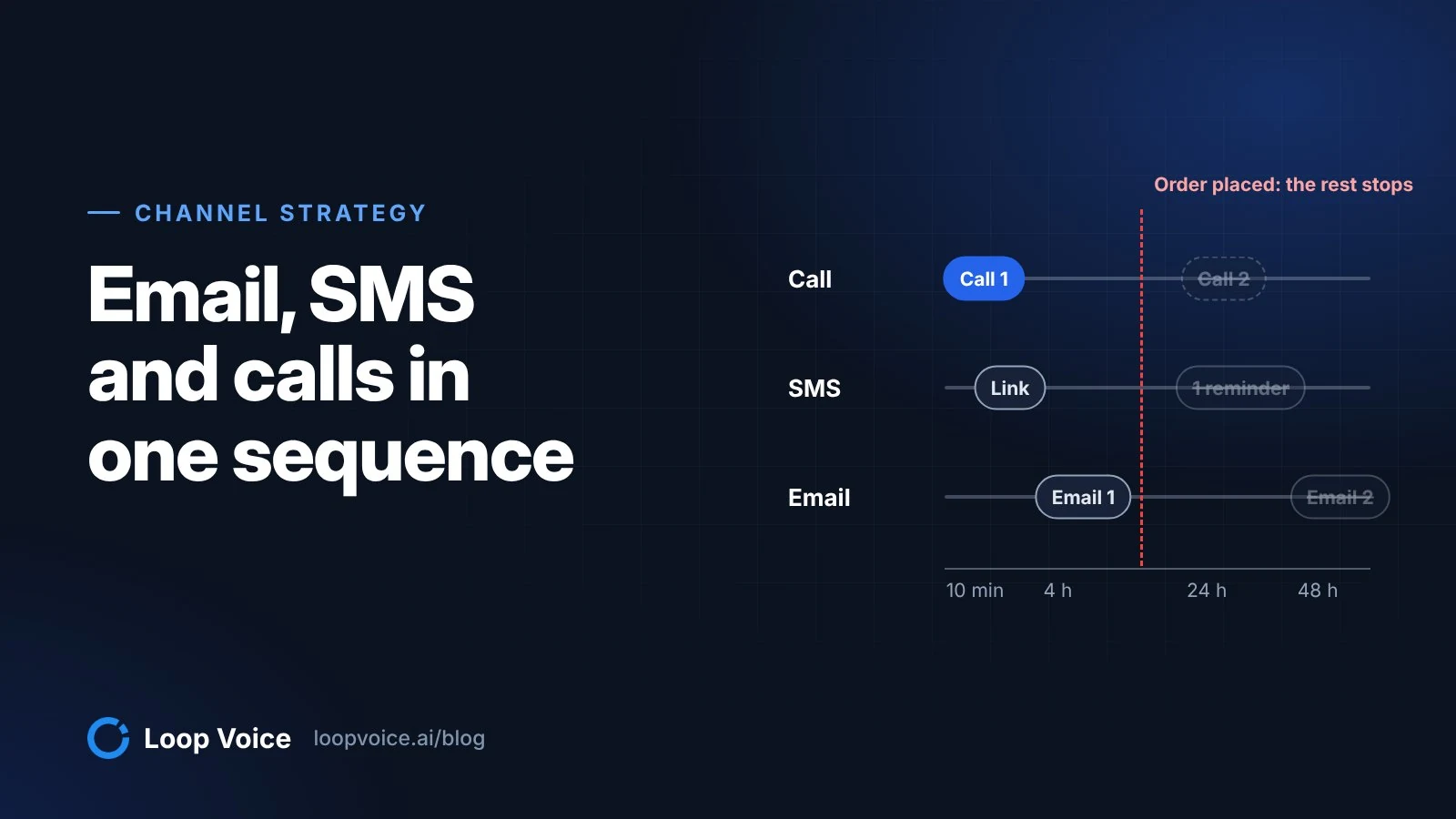
Send it within minutes of the missed call, inside calling hours. Loop Voice's abandoned checkout template is built that way: wait, call, text the checkout link, wait, call again with a discount, send a last note. The flow stops the moment the shopper orders, says stop or has a negative call.
- Right after the call, not hours later. The benchmark doesn't split text results by send time, but its speed-to-call figures point one way: shoppers first called 5 to 15 calling-hours minutes after abandoning ordered at 22.9% within 5 days, against 4.1% at 15 to 60 minutes. Those compare different shoppers and stores, not a controlled test; for hour-by-hour answer rates, see the post on the best time to call customers.
- Inside the shopper's hours. Klaviyo's quiet-hours guide puts the outer edge at 8 a.m. to 9 p.m. in the recipient's local time and warns that some states are stricter, such as Florida, which limits sending to 8 a.m. to 8 p.m. (Klaviyo Help Center). Loop Voice applies stricter calling hours in seven states to every call and text.
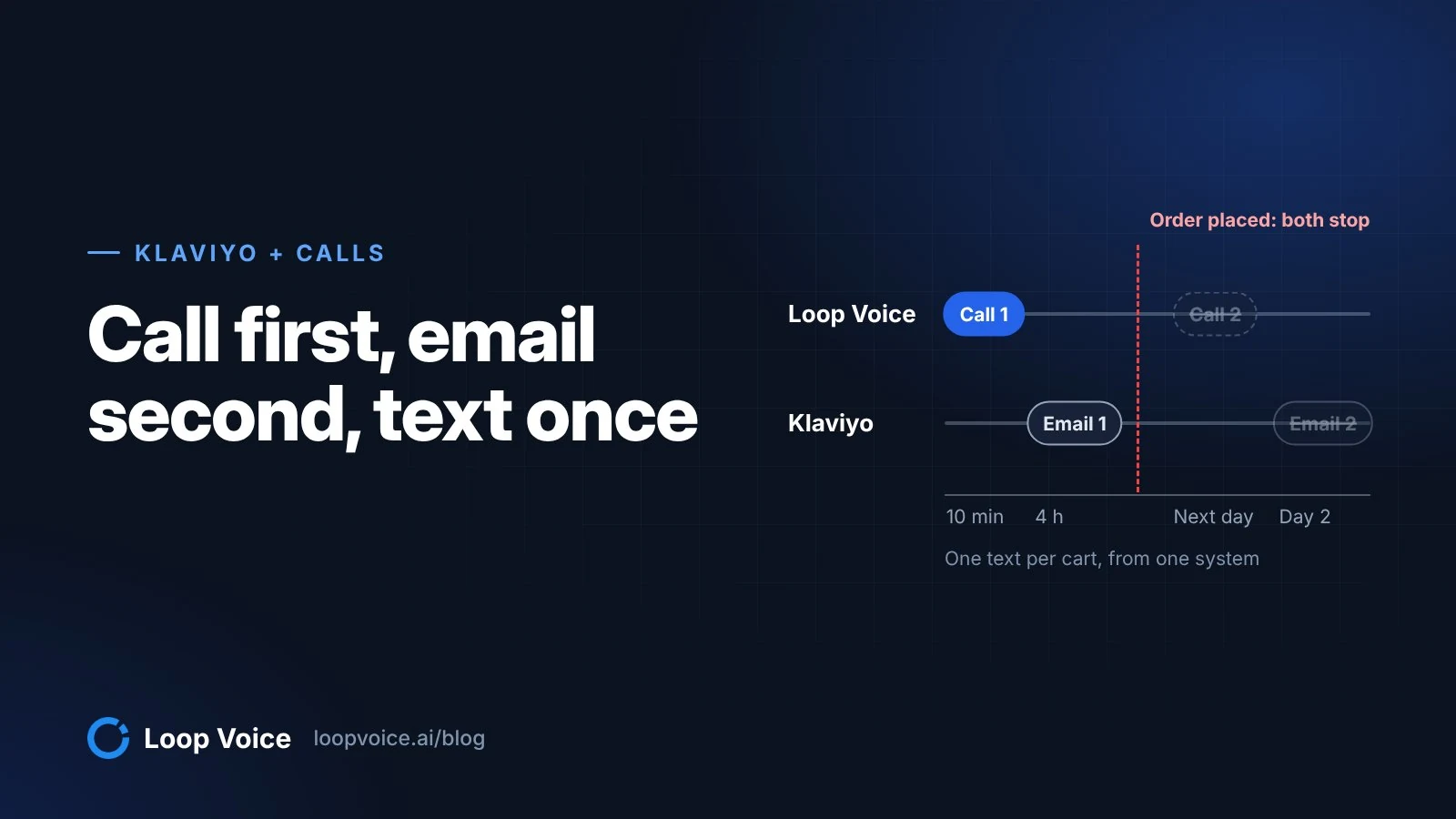
- One cart text, from one system. If Klaviyo also sends an abandoned cart text, the shopper gets two about one checkout. Pick an owner; our Klaviyo timing plan lays out both options.
- Never after an order. The flow stops when the shopper orders, so someone who checks out after the missed call hears nothing more.
Consent and registration come first
The text after a missed call is a marketing message, and it needs its own permission. Two details catch stores out:
- Shopify saves the SMS opt-in only when the checkout is submitted. Its help page says the customer "needs to submit the checkout" for their SMS marketing choice to be saved, so a shopper who ticks the box and then abandons may leave no consent behind (Shopify Help Center). The same page says to change the default checkbox text, which mentions news and offers, if you send abandoned cart reminders.
- Call consent and text consent are separate. AI-voiced marketing calls need prior express written consent, and your wording should name texts as well as calls. Our guide to calling and texting consent has an example checkbox; confirm yours with counsel.
Then register the number. Twilio says anyone sending SMS from a 10-digit long code to US phones must register for A2P 10DLC (Twilio), and it has blocked unregistered 10DLC messages to US numbers since September 1, 2023, with error 30034 (Twilio changelog). Our A2P 10DLC registration guide walks through brands, campaigns and fees.
Inside Loop Voice, 10DLC SMS registration arrived in June 2026, and SMS compliance is built into every template. If you text from a number you imported from Twilio, check which registered campaign covers it before you set the SMS step to Live.
Set it up and read the results
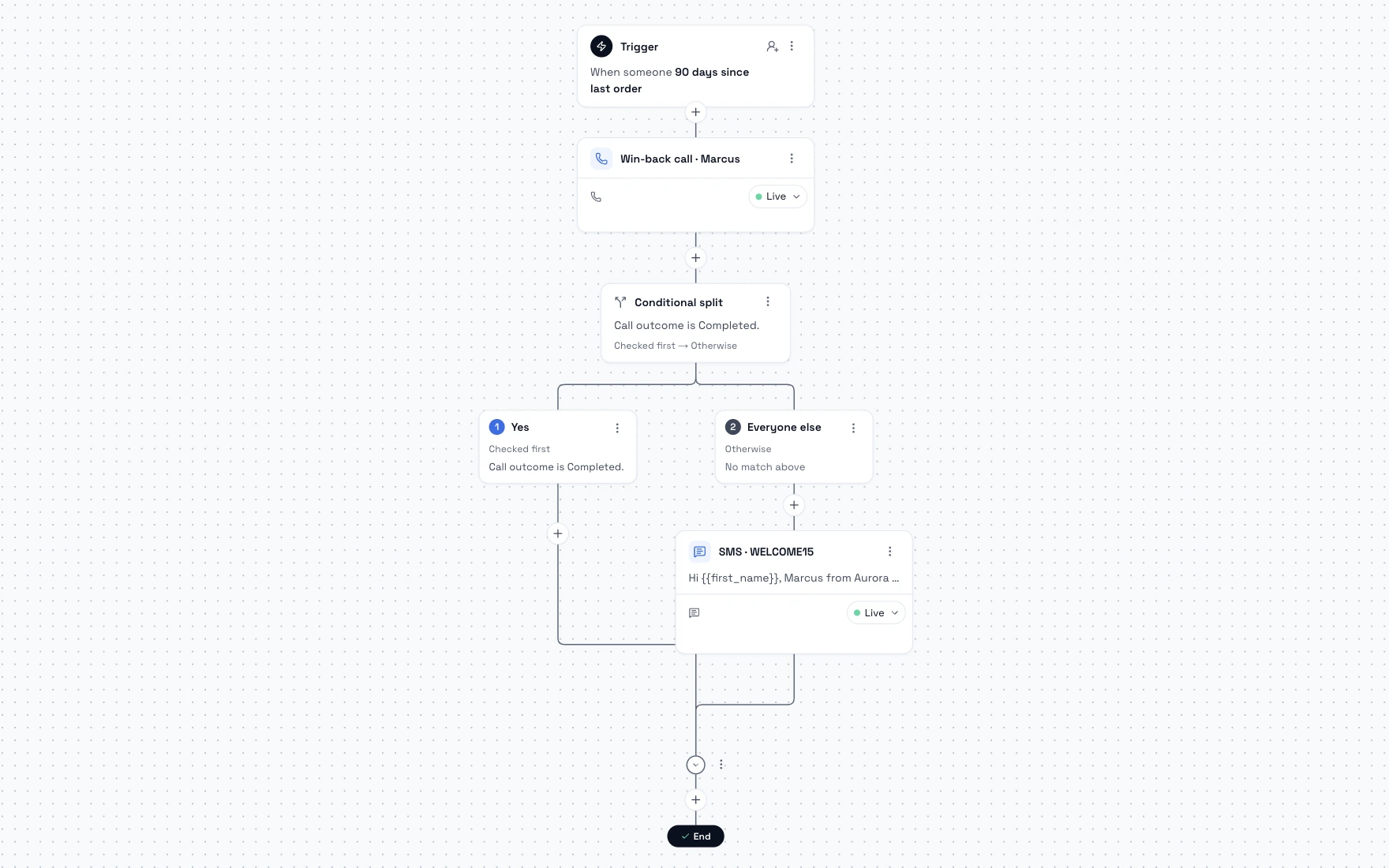
The text is a step in the flow, not a separate tool, and each step can be set to Draft, Manual or Live, so you can stage a new text inside a running flow.
- Keep the SMS step right after the first call in the abandoned checkout flow, or add one to any flow you already run.
- Write it with the merge fields for name, product and checkout link, and keep the STOP footer.
- To text only shoppers whose call wasn't completed, put a split on the call's outcome in front of the SMS step, as in the flow below.
- Read the SMS log each week. It shows each message's content and the revenue it produced, with a Converted-only view, and it tracks clicks on text links.
Two cautions when you set your numbers beside the benchmark's. The report counts texts as sent, because delivery receipts weren't recorded yet, and its click rate counts human clicks, with link previews and bots removed. For abandoned-checkout texts, it lists the click rate as not tracked in September.
Klaviyo's 2026 abandoned cart benchmarks report puts the average cart text click rate at 10.3% across more than 110,000 Klaviyo customers, but it doesn't define the click rate, so read that number beside the benchmark's 5.3%, not against it.
Links in Loop Voice texts carry utm_source=loop-voice, so the visits show up in your analytics, and with Triple Whale connected, Loop Voice's calls and texts appear there as their own channel.
Frequently asked questions
Should the first text after a missed call include a discount code?
Usually not. Loop Voice's abandoned checkout template keeps the discount for the second call, so the first text only sends the shopper back to the checkout. If you add a code, use one of the Shopify codes the agent is allowed to offer, so the call and the text never disagree.
If a shopper answers the call and then orders through the texted link, which gets the credit?
The call, in Loop Voice's benchmark. A sale within 5 days goes to its last touch, an answered call wins over any text, and a text takes the credit only when no call was answered in that window. Other tools set their own attribution rules, so the same order can be credited differently in each dashboard.
How long should the text after a missed call be?
One segment: up to 160 characters in standard text, or 70 if the message includes an emoji, according to Twilio. That fits the store name, one line about the checkout, a short link and the STOP line.
Should shoppers who answered the call get a text too?
Often, yes. Loop Voice texts the checkout link during or after the call, so a shopper who talked to the agent can finish on their own phone. On a recorded call for a furniture store, the agent texted a 5% code and the checkout link before hanging up. To text only shoppers whose call wasn't completed, put a split on call outcome in front of the SMS step.
Sources
- Loop Voice Ecommerce Benchmark, September 2026 (Loop Voice, 2026)
- Missed Call Text Back: How Auto-Texting Every Missed Call Recovers Lost Deals (Aloware, 2026)
- Recovering abandoned checkouts (Shopify Help Center, 2026)
- Messaging Principles and Best Practices (CTIA, 2023)
- How long can a message be? (Twilio, 2026)
- 47 CFR 64.1200, Delivery restrictions (Cornell Law School Legal Information Institute, 2026)
- Understanding text message quiet hours in flows (Klaviyo Help Center, 2026)
- Collecting customer contact information (Shopify Help Center, 2026)
- Programmable Messaging and A2P 10DLC (Twilio, 2026)
- [U.S. A2P 10DLC] Twilio now supports a fully verified messaging ecosystem (Twilio Changelog, 2023)
- The abandoned cart benchmarks report: 2026 data to inform your strategy (Klaviyo, 2026)
- Features (Loop Voice, 2026)
- Changelog (Loop Voice, 2026)
Hear it before you decide
Listen to real recovery calls, or see Loop Voice call a test checkout on your own store.