


Best Time to Call Customers: Answer Rates by Hour and Weekday
An hour-by-weekday grid of answer rates from Loop Voice's September 2026 benchmark of store calls, how to use it for abandoned-checkout calls and campaigns, and what one month of data can't prove.

Key takeaways
- Thursday at 1 pm was September's best hour, with 13.6% of calls answered, but it rests on 290 calls, so read the pattern, not the cell.
- Weekday mornings were weakest: calls from 8 am to noon were answered 5.4% of the time, against 7.0% from 5 pm to 9 pm, in the shopper's local time.
- Call abandoned checkouts within 5 to 15 minutes whatever the hour; save the hour for retries and campaigns, and end calling at 8 pm local time.
The short answer
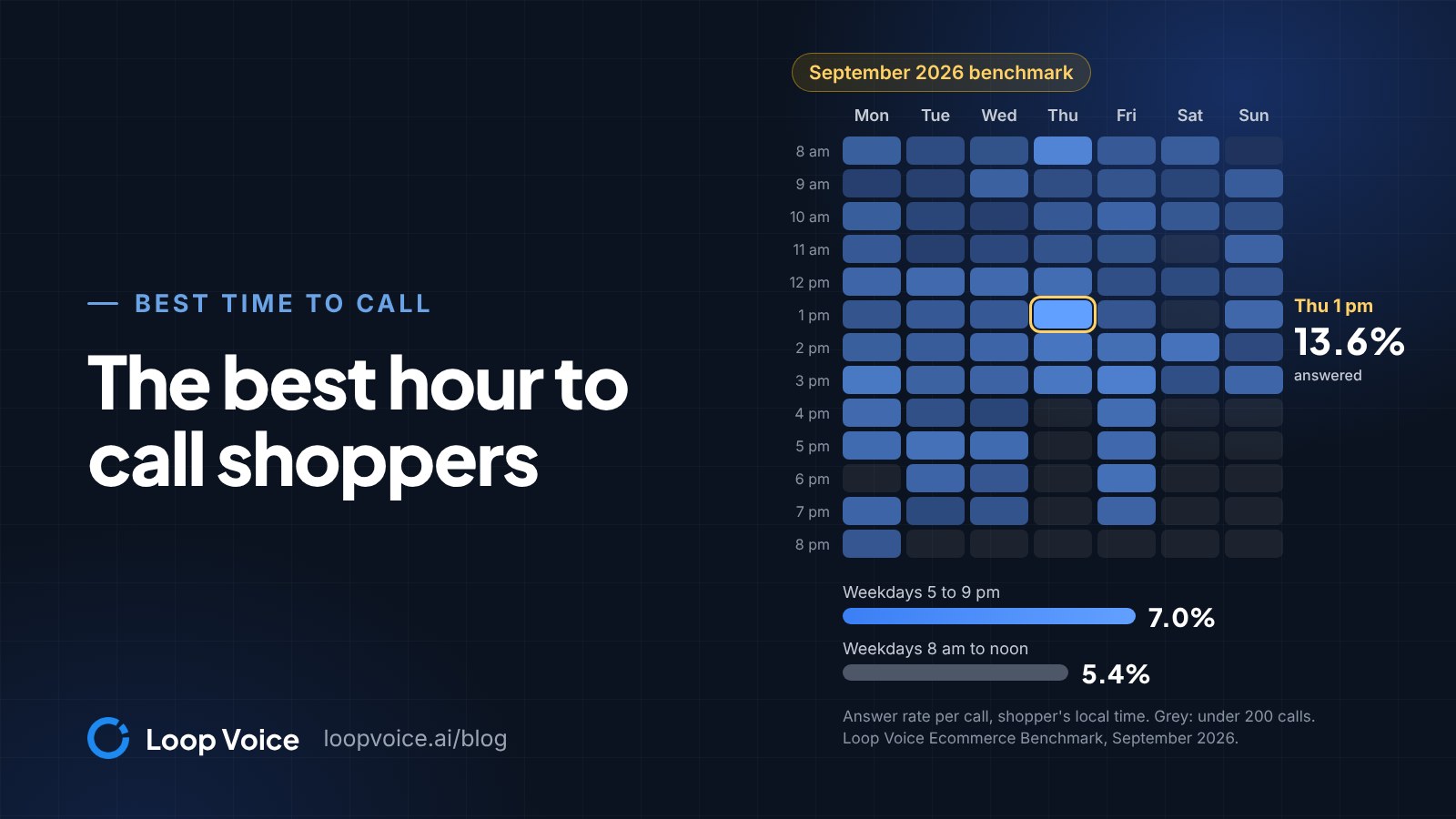
The best time to call online shoppers in Loop Voice's September 2026 benchmark was Thursday at 1 pm, when 13.6% of calls were answered, about twice the 6.6% rate across all calls. On weekdays, calls placed between 5 pm and 9 pm were answered more often than calls between 8 am and noon (7.0% against 5.4%), with every hour counted in the shopper's local time.
The figures come from the Loop Voice Ecommerce Benchmark, September 2026: 61,389 calls from 7 online stores to 18,361 shoppers who had started a checkout or placed an order, so none of them were cold calls. Loop Voice placed the calls and publishes the report, and the data is free to quote under CC BY 4.0.
Answer rates by hour and weekday
Each cell is the share of calls a person answered in that hour of the shopper's local day, so 1 pm means calls placed from 1:00 to 1:59 pm. Voicemail and call screening count as unanswered, and blank cells had fewer than 200 calls, which the benchmark greys out.
| Hour | Mon | Tue | Wed | Thu | Fri | Sat | Sun |
|---|---|---|---|---|---|---|---|
| 8 am | 6.6 | 4.6 | 5.2 | 10.6 | 6.1 | 6.4 | 1.9 |
| 9 am | 3.2 | 3.3 | 6.8 | 4.8 | 5.4 | 3.9 | 6.3 |
| 10 am | 6.5 | 3.9 | 3.2 | 6.0 | 7.2 | 5.8 | 4.9 |
| 11 am | 5.9 | 3.2 | 4.1 | 5.3 | 5.2 | 7.1 | |
| 12 pm | 7.3 | 7.8 | 7.8 | 8.1 | 4.9 | 4.5 | 5.6 |
| 1 pm | 5.4 | 5.9 | 6.0 | 13.6 | 5.7 | 7.5 | |
| 2 pm | 6.6 | 6.3 | 7.2 | 9.0 | 8.3 | 8.7 | 4.3 |
| 3 pm | 9.4 | 6.9 | 7.1 | 9.2 | 10.1 | 4.9 | 7.3 |
| 4 pm | 7.8 | 5.0 | 3.9 | 8.1 | |||
| 5 pm | 7.9 | 8.6 | 7.9 | 7.7 | |||
| 6 pm | 7.2 | 5.7 | 8.4 | ||||
| 7 pm | 7.2 | 4.4 | 5.3 | 7.1 | |||
| 8 pm | 5.7 |
Percent of calls answered. Source: Loop Voice Ecommerce Benchmark, September 2026, data file, which adds a 95% interval for each published cell.
- Thursday held the two best hours: 1 pm (13.6%) and 8 am (10.6%). The 8 am cell rests on 1,536 calls (95% CI 9.2 to 12.2) and the 1 pm cell on 290 calls (95% CI 10.1 to 18.0), so 8 am is the steadier number.
- Weekday mornings were the weak spot. Of the 15 weekday cells from 9 am to noon, 13 fell below the 6.6% average.
- Mid-afternoon was steady. Nine of the ten weekday cells at 2 pm and 3 pm were at or above the average, led by Friday at 3 pm (10.1% on 1,084 calls).
- Sunday at 8 am was the low point at 1.9% of 369 calls, and weekend and Thursday hours from 4 pm on had too few calls to publish.
The evening edge has a catch. The 8 pm hour has one published cell (Monday, 5.7%), so the weekday figure for 5 pm to 9 pm comes mostly from calls placed before 8 pm.
What the grid doesn't prove
Read the grid as a direction, not a schedule. Like the benchmark's other timing figures, these are comparisons across shoppers and stores, not a controlled test:
- Calls weren't assigned to hours at random. Nine in ten of September's calls (55,725 of 61,389, per the data file) were abandoned-checkout calls, timed by when each shopper left checkout rather than by the hour, so a cell mostly reflects when those shoppers were shopping, plus the retries that followed.
- Every attempt counts. The rate divides answered calls by all calls placed, so an hour heavy with second calls can look worse than an hour of first calls.
- Answered is not ordered. The benchmark publishes no order rates by hour. To learn what calls add, run a holdout test.
- It's one month from seven stores. September 2026 had four Thursdays, and Monday's cells include Labor Day on September 7 (OPM). No store makes up more than 15% of a figure, but a quiet week can still move a cell built on 290 calls.
Abandoned checkouts: call fast, then use the hour for the retry
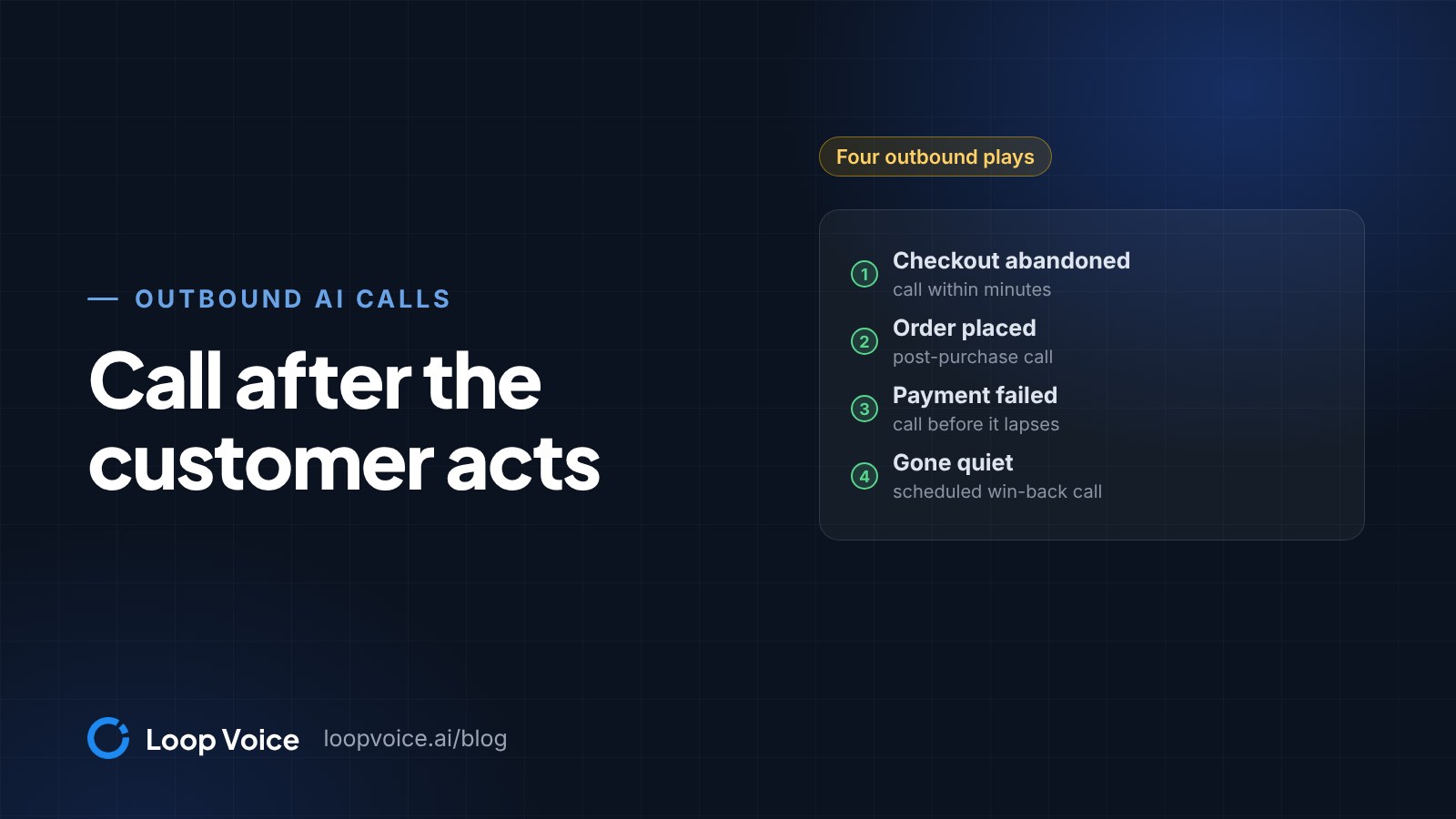
For an abandoned checkout, the shopper picks the hour by leaving. What you control is the wait, and the benchmark's speed-to-call figures favor calling within minutes over holding the call for a better hour.
The wait counts calling-hours minutes only (8 am to 9 pm in the shopper's time zone), so a checkout abandoned at 11 pm and called at 8:04 am counts as 4 minutes. In September, 72% of checkouts were abandoned during calling hours and got a first call a median 31 minutes later.
| Wait before the first call (calling-hours minutes) | Shoppers | Picked up | Ordered within 5 days |
|---|---|---|---|
| 5 to 15 minutes | 4,486 | 20.5% | 22.9% |
| 15 to 60 minutes | 1,322 | 9.3% | 4.1% |
| 1 to 4 hours | 793 | 15.2% | 4.7% |
| Abandoned after hours, called the next day | 3,973 | 15.0% | 6.5% |
Source: Loop Voice Ecommerce Benchmark, September 2026. Picked up is the share of shoppers, not of calls, and the under-5-minute band (165 shoppers) was too small to publish. These bands also compare different shoppers and stores, so take the direction, not the exact gap.
- Don't hold a checkout for a better hour. A checkout abandoned at 10 am on a Tuesday, one of the grid's weakest cells, should still get its first call within 5 to 15 minutes. The delay before that call is a setting in Loop Voice's abandoned checkout template, and Insights shows the time from abandon to first dial, so you can check that first calls land in that band.
- Let the hour shape the second call. The template calls, texts the checkout link, waits, then calls again with a discount. If first calls land in the morning, a wait of a few hours moves the retry into the stronger afternoon cells, and the text after the missed call covers the gap.
- Don't write off late-night checkouts. Called the next day, they ordered at 6.5%, more than daytime checkouts that waited 1 to 4 hours (4.7%). A shopper who orders overnight drops out of the flow before the morning call.
Campaigns: the one place you choose the hour
A campaign calls a list you choose, once, on the schedule you set, so this is where the grid earns its keep. Loop Voice outbound campaigns (in beta) take a campaign time zone, a daily calling window and a pace in calls per minute, and the window applies in each customer's local time.
Example: 1,800 customers at 5 calls a minute need 360 minutes of dialing, so a weekday window from 2 pm to 8 pm can finish the list in one day.
- Start after lunch. Weekday cells from 9 am to noon were the week's weakest block.
- Stop at 8 pm. The evening edge came mostly from calls before 8 pm, and Florida's limit for sales calls is 8 pm.
- Skip Sunday at 8 am. It was the lowest published cell, at 1.9% of 369 calls.
September's calls were mostly abandoned-checkout calls, and customers who haven't ordered in months may keep other hours. Test before you commit: set up two campaigns for comparable segments with different windows and compare their answer rates, since every call attributes back to the campaign that made it.
Example: at a 6.6% answer rate, 100 calls give a 95% interval of roughly 3.2% to 13.2%, too wide to rank two windows, while 1,000 calls narrow it to about 5.2% to 8.3%. Give each window at least 200 calls, the benchmark's own floor, and more when the two rates sit close together.
Calling hours come before answer rates
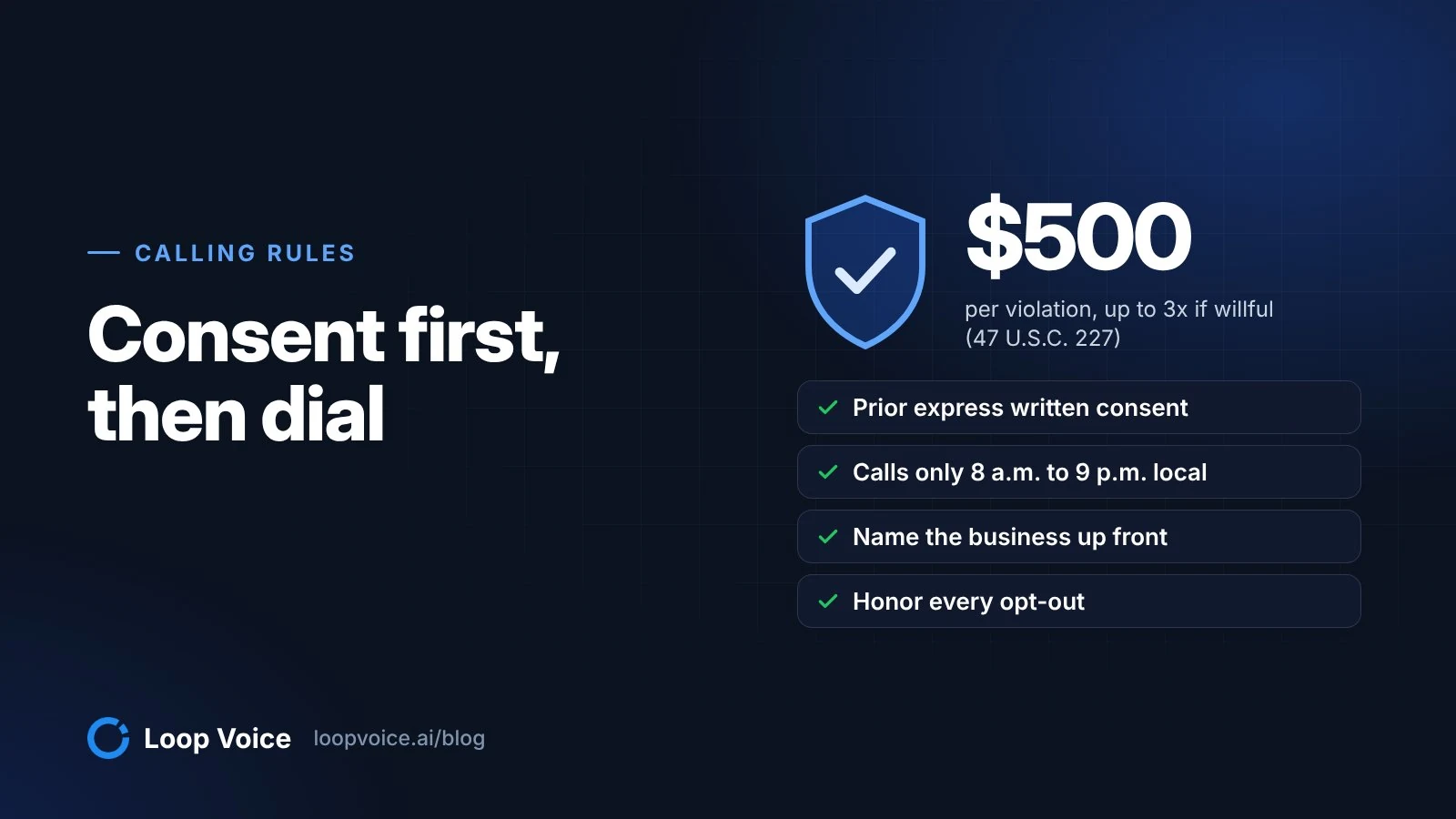
The legal window sets the edges of everything above. The federal rule bars telephone solicitations to a residential subscriber before 8 a.m. or after 9 p.m., local time at the called party's location (47 CFR 64.1200(c)(1)). Florida stops commercial telephone solicitation calls at 8 p.m. in the called person's time zone and allows no more than three from any number to a person in 24 hours on the same subject (Florida Statutes 501.616(6)), and other states set their own limits.
Loop Voice applies quiet hours in each customer's own time zone. Before any hour matters, AI-voiced marketing calls need the shopper's prior express written consent, and opt-outs have to be honored. Our guide to the rules for AI calls covers both; confirm the details for your states with counsel.
How other studies compare
Most published studies of the best time to call come from calling-software companies and phone-banking tools, and they measure cold or political calls. The benchmark's calls went to shoppers who had just started a checkout or ordered, so the populations differ as much as the methods.
| Study | Calls | Who was called | What counts | Best | Worst |
|---|---|---|---|---|---|
| Loop Voice benchmark (Sep 2026) | 61,389 | Shoppers after a checkout or order | A person picked up | Thursday 1 pm (13.6%); weekday afternoons and evenings | Sunday 8 am (1.9%); weekday mornings |
| MightyCall (2025) | 187,684 weekday calls | Its 20 busiest customers' calls; recipients not stated | Connected and lasted 30+ seconds | Monday (24%); 8 to 11 am | Wednesday 10 am (17.0%); after 2 pm |
| CallHub (2020 data) | 2,200,000+ | US and Canada phone banking, election year | Answer rate | 6 to 7 pm (23.38%); Friday | 8 to 9 am (17.64%); Tuesday |
| WAVV (2026) | 85.3 million dials | Cold outreach and aged lists, many industries | Answer and conversation rates | Monday 1 to 3 pm; 11 am to 4 pm | 6 to 9 am; Sunday |
Two of the three agree with the benchmark that mornings are a weak time to call: CallHub's lowest hour was 8 to 9 am, and WAVV calls 6 to 9 am the worst block of the business day. MightyCall found the opposite, with 8 to 11 am strongest, but it counts a call as successful only if it connected and lasted 30 seconds, and it doesn't say whom its customers were calling.
Compare the shape of the day, not the percentages. Each study defines an answer its own way, and WAVV warns that its hours aren't each recipient's local time.
Find your own best hour
Seven stores' shoppers are not yours. Loop Voice's Insights shows your answer rate against the prior window, who answered (a person, voicemail, an unreachable number or a call screener), pickup by attempt and the time from abandon to first dial, and call records export to CSV.
- Export a month of calls and count answered and total calls by hour and weekday, in each shopper's local time.
- Group hours into blocks, such as weekday mornings, afternoons and evenings, so each block passes 200 calls sooner.
- Move your campaign window or retry wait only when one block beats another by more than the noise in the example above, then check again the next month.
New benchmark issues appear on the benchmarks page, and the answer rates by state show how much a shopper's location moves the same numbers.
Frequently asked questions
What is the best day of the week to call online shoppers?
Thursday held the two best hours in Loop Voice's September 2026 benchmark: 1 pm, with 13.6% of calls answered, and 8 am, with 10.6%. Friday at 3 pm (10.1%) was close behind. A month of data from seven stores can't crown one day, so treat Thursday as a good bet, not a rule.
Should a store call customers on weekends?
Only where your consent and state rules allow it, and expect thin data. In the benchmark, weekend calls from 4 pm on were too few to publish, and Sunday at 8 am was the lowest published hour at 1.9%. Saturday at 2 pm (8.7%) and Sunday at 1 pm (7.5%) did better.
Are these hours in the store's time zone or the customer's?
The customer's. The benchmark reports every hour in the shopper's local time. Loop Voice applies quiet hours in each customer's own time zone and can run calling windows the same way, in which case a 2 pm window means 2 pm in Denver for a Denver shopper and 2 pm in Boston for a Boston one.
How many calls do I need before I trust my own best hour?
At least 200 per hour or block, the floor the benchmark uses before it publishes a cell, and more if two blocks sit close together. At a 6.6% answer rate, 200 calls still leave a 95% interval of about 3.9% to 10.9%, and 1,000 calls narrow it to about 5.2% to 8.3%.
Sources
- Loop Voice Ecommerce Benchmark, September 2026 (Loop Voice, 2026)
- Federal Holidays (U.S. Office of Personnel Management, 2026)
- 47 CFR 64.1200, Delivery restrictions (Cornell Law School Legal Information Institute, 2026)
- 501.616 Unlawful acts and practices, 2026 Florida Statutes (The Florida Senate, 2026)
- When to Cold Call in 2025: The Best Days & Times Based on Real Data (MightyCall, 2026)
- Best Time for Phonebanking? We Studied 2 Million Calls for the Answer (CallHub, 2026)
- What is the Best Time to Call? We Analyzed 85 Million Dials to Find Out (WAVV, 2026)
Hear it before you decide
Listen to real recovery calls, or see Loop Voice call a test checkout on your own store.