
Outbound AI Calls for Ecommerce: Plays, Timing, Rules and Cost
Which outbound AI calls pay for an online store, when to place them, the rules that keep them legal, what they cost and how to tell if they add orders.

Key takeaways
- Call abandoned checkouts 5 to 15 minutes after they stall: in Loop Voice's 7-store benchmark, those first called 5 to 15 minutes after abandoning had a 22.9% five-day order rate, against 4.1% at 15 to 60 minutes.
- Only 15.9% of shoppers called picked up at least once, so pair every call with a text that carries the link.
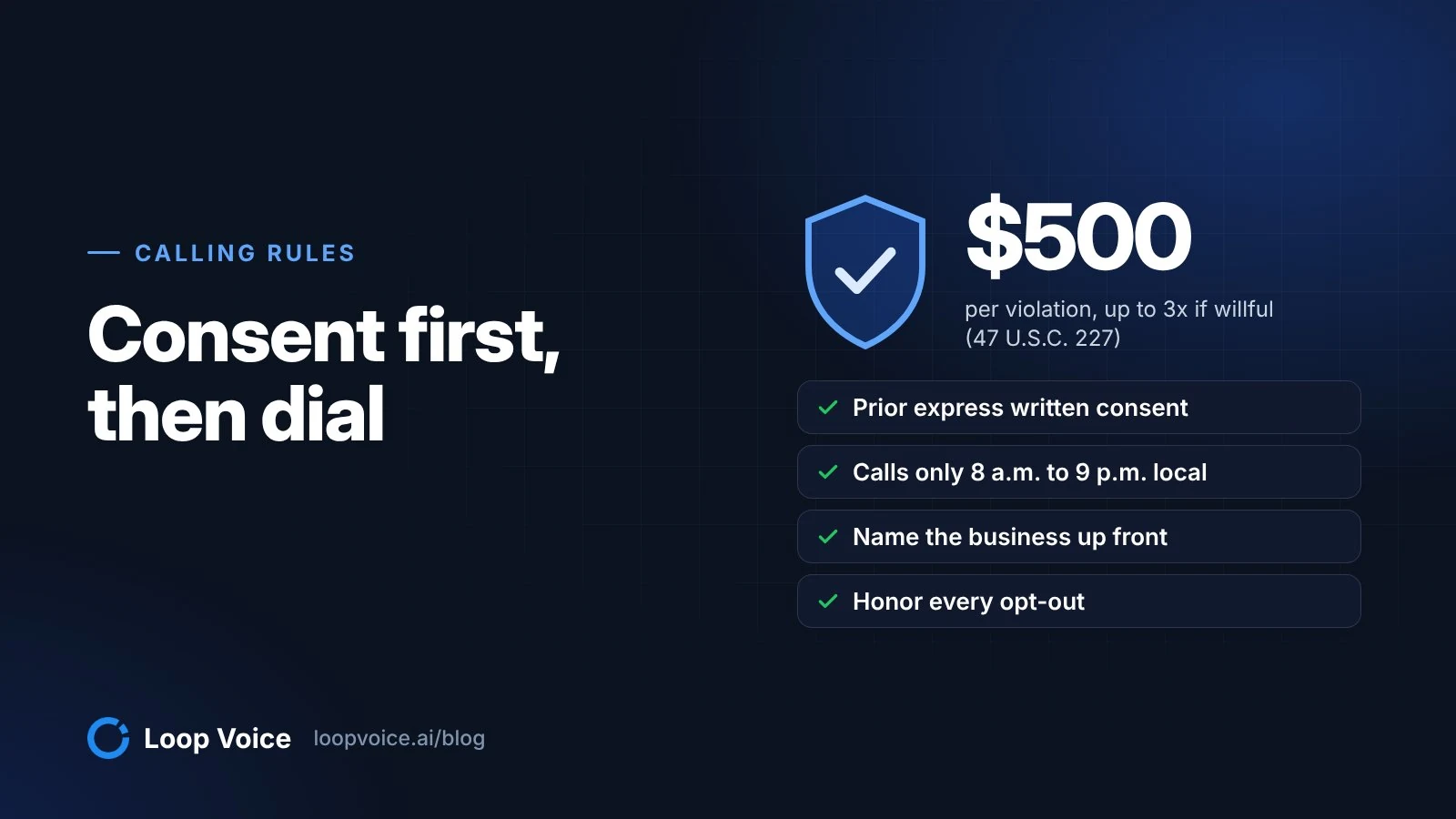
- AI-generated voices count as artificial under the TCPA, so AI sales calls need prior express written consent and belong between 8 a.m. and 9 p.m. local time (8 p.m. in Florida and Maryland).
- Loop Voice uses about 1.5 credits per answered conversation, about $0.95 to $1.49 each on monthly plans, and nothing when nobody answers.
- Judge the calls with a holdout; the benchmark's +5.7 point lift for abandoned checkouts (95% CI 4.4 to 6.9) is an estimate, not a randomized test.
Start with abandoned checkouts, then test the rest
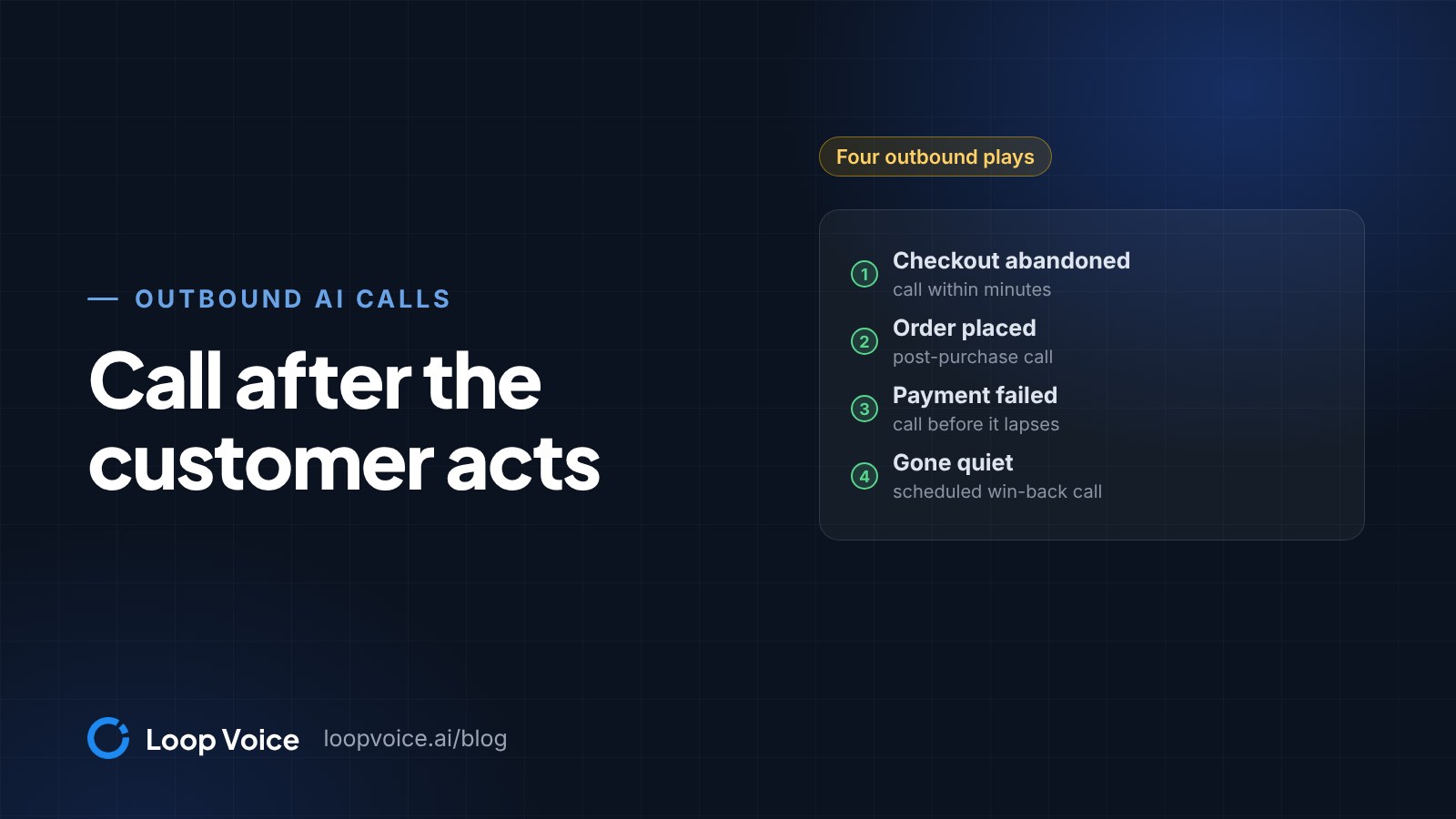
Abandoned-checkout calls are the outbound AI calls with a clear estimated lift so far; calls after a delivery, a failed payment or a lapse in reordering are worth testing, not assuming. Call abandoned checkouts 5 to 15 minutes after they stall, schedule the rest inside legal calling hours, call only people whose written consent covers AI calls (the calling rules), and judge the program by the orders it adds over a holdout group.
The timing comes from Loop Voice's September 2026 benchmark of 18,361 shoppers across 7 stores: checkouts first called 5 to 15 minutes after abandoning had a 22.9% five-day order rate, against 4.1% when the first call came 15 to 60 minutes later. In the same benchmark, post-purchase upsell calls showed no clear lift (+0.3 points, 95% CI -0.6 to 1.3), and failed-payment and win-back flows were not live yet. Loop Voice publishes this page and is one of several tools that place these calls; the benchmark is its own, and an estimate rather than a controlled test.
Seven outbound plays, with triggers and timing
Loop Voice flows start from events such as abandoned checkout, order fulfilled, second order (VIP) or a custom event, and campaigns (in beta) call a Shopify or Klaviyo segment, abandoned checkouts or inactive customers inside a daily calling window and pace you set.
| Play | Trigger | When to call | Goal of the call | Loop Voice page |
|---|---|---|---|---|
| Abandoned checkout | Abandoned checkout | 5 to 15 minutes after; after-hours checkouts the next day | Fix what stopped the order, text the checkout link | Abandoned cart |
| Post-purchase check-in and upsell | Order fulfilled, then a wait | Once the order has arrived | Confirm it arrived right, fix what didn't, offer the next order | Post-purchase upsell |
| Failed payment | Custom flow; failed-payment events aren't connected from store platforms yet, so ask how to start it | Soon after the decline, in calling hours | Get payment retried through a texted link | Failed payments |
| Win-back | Campaign to inactive customers | Once past your usual reorder gap | One good reason to order again | Customer win-back |
| VIP or subscriber check-in | Second order (VIP), or a campaign to a subscriber segment | After the second order | Thank them, catch problems before they cancel | Campaigns |
| Post-purchase survey | Custom flow | After they have used the product | Why they bought, what went wrong | Post-purchase survey |
| Restock or promotion | Custom flow, or a campaign | When the item is back or the offer starts | Tell people who asked, text the link | Campaigns |
Only the checkout timing has benchmark data behind it; treat the other timings as starting points to test. Loop Voice's example checkout flow waits ten minutes, calls, texts the checkout link, waits, calls again with a discount and sends a last note, and flows stop the moment the customer orders, says stop, or after a negative call.
A failed payment can also turn up inside a checkout flow: in one real call, an automotive parts store's order had been canceled after a declined payment, so the agent texted a link to reorder and stayed on until it confirmed.
Viewed product, added to cart and added to list can start flows too; keep those calls to customers who already gave call consent, and prove them against a holdout first.
Timing: what the benchmark shows
In the benchmark's abandoned-checkout flow, 14,036 shoppers were called and 16.5% picked up at least once. The table keeps orders within 5 days apart from answers, which are a different measure.
| First call | Ordered within 5 days | Answered |
|---|---|---|
| 5 to 15 minutes after abandoning, in calling hours | 22.9% | 20.5% |
| 15 to 60 minutes after, in calling hours | 4.1% | 9.3% |
| 1 to 4 hours after, in calling hours | 4.7% | 15.2% |
| Next day, for checkouts abandoned after calling hours | 6.5% | 15.0% |
Three rules follow:
- Call 5 to 15 minutes after the abandon. Let the flow place the first call automatically, not a person working a list.
- Don't write off after-hours checkouts. Called the next day, they ordered at 6.5%, better than in-hours checkouts first called 15 minutes to 4 hours later.
- Retry in the early evening. On weekdays, calls placed 5 to 9 p.m. were answered 7.0% of the time against 5.4% for 8 a.m. to noon, counted per call.
What the numbers don't prove
The benchmark covers 7 stores, and the timing groups were not randomly assigned. In the 5 to 15 minute group more shoppers ordered (22.9%) than answered (20.5%), so some of those orders came without a conversation, and fast calls may reach shoppers who were only briefly interrupted. Use the table to decide when to call and your own holdout to learn what the calls add.
What a good outbound call sounds like
Among 824 answered benchmark calls with a recorded reason for not buying, 33.4% of shoppers were browsing, 25.6% named discount or price, 11.7% a site or checkout error and 5.5% a product question. Baymard's survey of US online shoppers points the same way: 42% had abandoned a cart because they were just browsing, and setting those aside, 17% named website errors or crashes. A good call finds out which case it is with its first question and handles only that one.
| What the shopper said | Share of those 824 calls | What the agent should do |
|---|---|---|
| Just browsing | 33.4% | Accept it, text the link and end the call |
| Discount or price | 25.6% | Offer the one code you allow, and text it |
| Site or checkout error | 11.7% | Stay on the line and walk them through it |
| Product question | 5.5% | Answer from your pages; hand off what it can't |
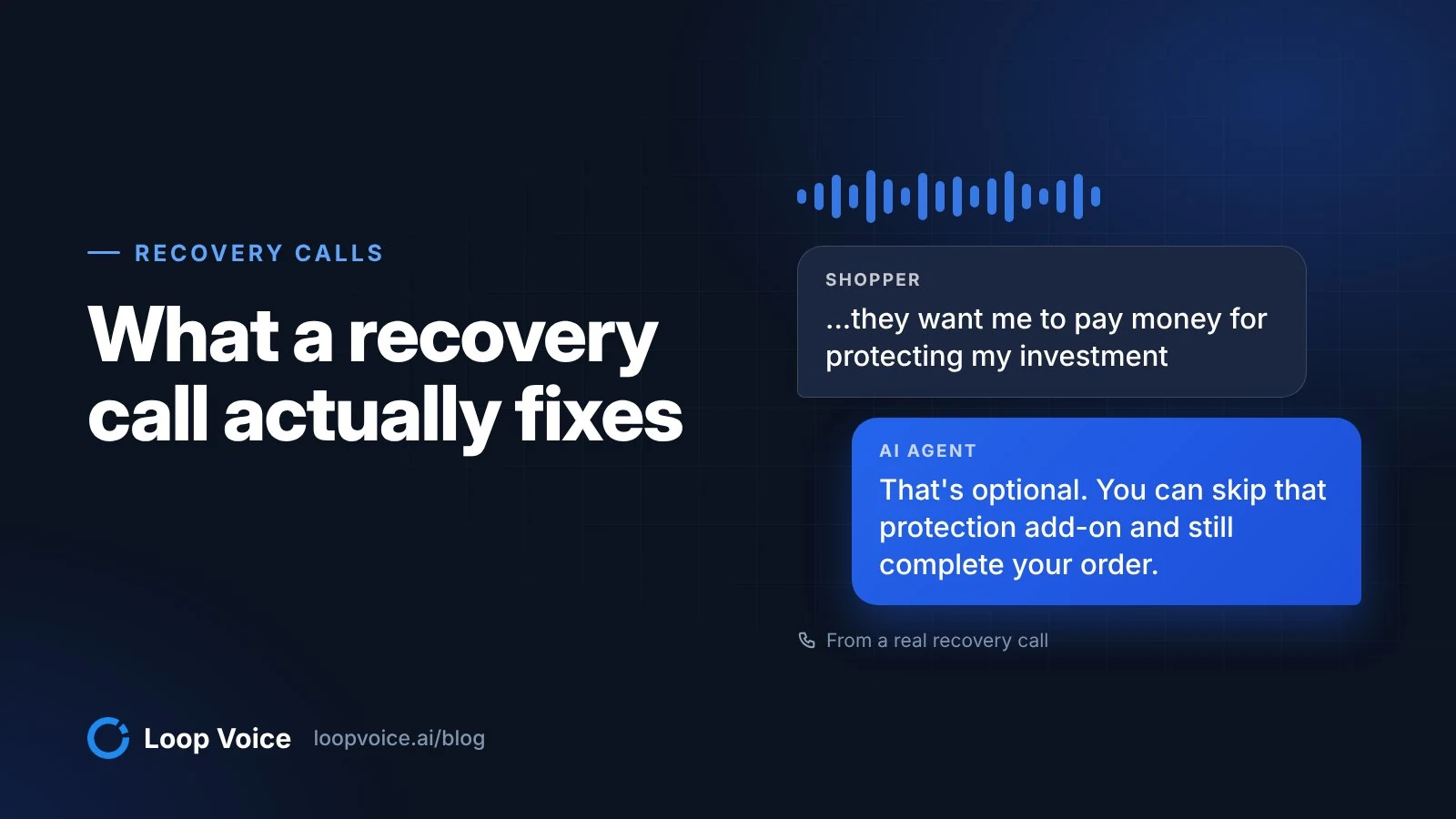
Jay's Modern Hearing order is the site-error case: the agent stayed on the line while he got the site working on another computer and rebuilt the order, until an add-on offer appeared at the last step.
Got it. If you're seeing six-month backup or other options, those are just optional add-ons.
If you don't want them, selecting no thanks is totally fine. After you hit no thanks, does it bring you back to a page with complete purchase again, or is it showing something else?
Okay. Now it says your order is confirmed.
Perfect. That means it went through.
The agent called the add-ons optional, didn't pitch them, and stayed through each snag until the confirmation appeared.
The second call is post-purchase. A check-in for a dog-chew brand found a packing mix-up; the agent opened a support ticket for the right chews, and only then brought up the next order.
Anything else you want to make sure is blueberry only on your next order?
Um, yes, that's the one she likes the best.
Got it, blueberry only. If you want, on your next order, you can use our 10% off code loop 10. L as in Lima, O as in Oscar, O as in Oscar, P as in Papa, 1, 0.
Can you repeat the code back to me just so I know it's clear?
Loop 10.
Perfect, loop 10. I'll let support know it's a blueberry only replacement to the same address and you're all set.
Fix first, offer second: the 10% code came after the problem was handled, and the agent had Leon read it back.
The same habits run through Loop Voice's public call library:
- Says what it is. A furniture shopper asked, "are you a human or are you AI?" The agent: "I'm an AI assistant. Yep. Totally happy to help either way, though."
- Sends the link. The same call closed with "I just texted you the code ... and I included that checkout link again too."
- Lets the shopper go. A gardening shopper answered "I'm all set." when the agent offered to stay on the line while he checked out, and the agent thanked him and said goodbye.
The rules that keep outbound AI calls legal and tolerable
In February 2024 the FCC ruled that calls made with AI-generated voices are "artificial" under the Telephone Consumer Protection Act, so AI calls carry the consent, identification and opt-out duties of prerecorded robocalls (FCC declaratory ruling 24-17). The practical version is below, not legal advice; our TCPA compliance guide for voice calls goes deeper on consent.
| Rule | What to do | Source | In Loop Voice |
|---|---|---|---|
| Consent for sales calls | Prior express written consent that clearly authorizes artificial-voice calls to that number, never a condition of buying | 47 CFR 64.1200(a)(2), (a)(3), (f)(9) | Express written consent enforced at the merchant level |
| Name the business | The name the business is registered under, at the start; during or after the call, a phone number other than the one that placed it, which on sales calls also takes do-not-call requests in business hours | 64.1200(b)(1), (b)(2) | The opening and close of your script |
| Offer the opt-out | On sales calls, opt-out instructions within two seconds of the name; record the request and end the call | 64.1200(b)(3) | "Don't call me" goes on the do-not-contact list before the next step; the instructions go in your script's opening |
| Honor revocations | Any reasonable request, including a "stop" text, within ten business days; honor do-not-call requests for five years | 64.1200(a)(10), (d)(6) | STOP texts, on-call requests and carrier blocks, honored by every flow, campaign and text |
| Calling hours | Keep sales calls between 8 a.m. and 9 p.m. in the customer's local time, the window the rule sets for telephone solicitations | 64.1200(c)(1) | Calling windows in each customer's own time zone |
| Florida | 8 a.m. to 8 p.m.; at most three calls in 24 hours on the same subject | Florida Statutes 501.616(6) | Calling window, plus a frequency cap on each agent |
| Maryland | 8 a.m. to 8 p.m.; at most three calls in 24 hours on the same subject | Maryland Commercial Law 14-4502(c) | Calling window, plus a frequency cap on each agent |
A past order is not written consent, so win-back and VIP campaigns should call only customers whose consent covers AI calls. Shopify's checkout opt-ins (Settings > Checkout > Marketing opt-in) cover email and SMS, and Shopify's help page on them doesn't mention calls, so add your own unchecked consent line naming AI-voice calls wherever you collect the phone number.
The FTC's guidance for sellers says the National Do Not Call Registry doesn't block calls to consumers who signed a written agreement, including their number, to get your calls; sellers who have to use the registry must sync with it at least every 31 days.
The 8 p.m. cutoff in Florida and Maryland falls inside the 5 to 9 p.m. window that answered better than mornings. If you call Florida or Maryland numbers, end the window at 8 p.m. local time, or end it there for everyone. A weekly cap of three or fewer keeps one agent within the 24-hour limit; caps are set per agent, so if several agents can call the same customer, count their caps together.
Never let the agent claim to be human; Loop Voice's guardrails include clear identity as an AI when asked.
What outbound AI calls cost
Loop Voice uses credits only when someone answers: an answered conversation uses about 1.5 credits on average, unanswered calls use none, and answered calls that don't convert still use credits. On monthly billing that is about $0.95 to $1.49 per answered conversation, depending on the plan (Loop Voice pricing).
| Plan | Monthly price | Credits | About this many answered conversations | Per answered conversation |
|---|---|---|---|---|
| Starter | $119 | 120 | 80 | about $1.49 |
| Growth | $399 | 500 | 330 | about $1.20 |
| Scale | from $975 | 1,500 | 1,000 | about $0.98 at 1,500 credits |
| Enterprise | $3,790 | 6,000 | 4,000 | about $0.95 |
Yearly billing lowers each price, and extra conversations are billed at the plan's per-extra-credit rate.
Example: a store has 600 abandoned checkouts a month with a phone number and call consent, a $90 average order and a 40% gross margin. At the benchmark's 16.5% pickup rate for abandoned checkouts, about 100 of those shoppers answer at least once, about 150 credits (more if some answer both calls), which Growth covers and Starter doesn't.
At about 100 conversations, Growth costs about $4 per answered conversation, not $1.20, because the low figures assume the credits get used. Counting the plan price only, covering the $399 takes about 11 extra orders a month at $36 of margin each, a lift of about 1.8 points on 600 checkouts. For abandoned checkouts, the benchmark's estimated lift was +5.7 points (95% CI 4.4 to 6.9, calls and texts together, from 5 of its 7 stores, as the abandoned cart page reports): this store clears the bar even at the low end, but the estimate is not a randomized test, so its own holdout decides.
How to tell if the calls add orders
Loop Voice ties revenue to the Shopify order number, with an attribution window you set per workspace, and reports it per flow, campaign, channel and cart value band. That figure counts every order that followed a call or text inside the window, including orders that would have happened anyway, so it overstates what the calls add.
The benchmark's call and text conversion rates also count orders that followed a touch, not orders the touch caused. Across both live use cases, AI calls and texts added an estimated +2.8 points of 5-day conversion (95% CI 1.9 to 3.7) for the shoppers they reached, measured against enrolled shoppers the flows never reached in the same 6 stores, so even that is not a randomized holdout.
Loop Voice's four published customer stories report attributed revenue, the same kind of figure: Modern Hearing (hearing aids) $300,000+ with 11% of calls becoming a sale, Warrior Will Power (health and wellness) $200,000+ from 1,184 calls at 7.1%, CityMan USA (streetwear) $45,000+ at 5%, and CastleFlexx (mobility and recovery) $30,000+ at 8%.
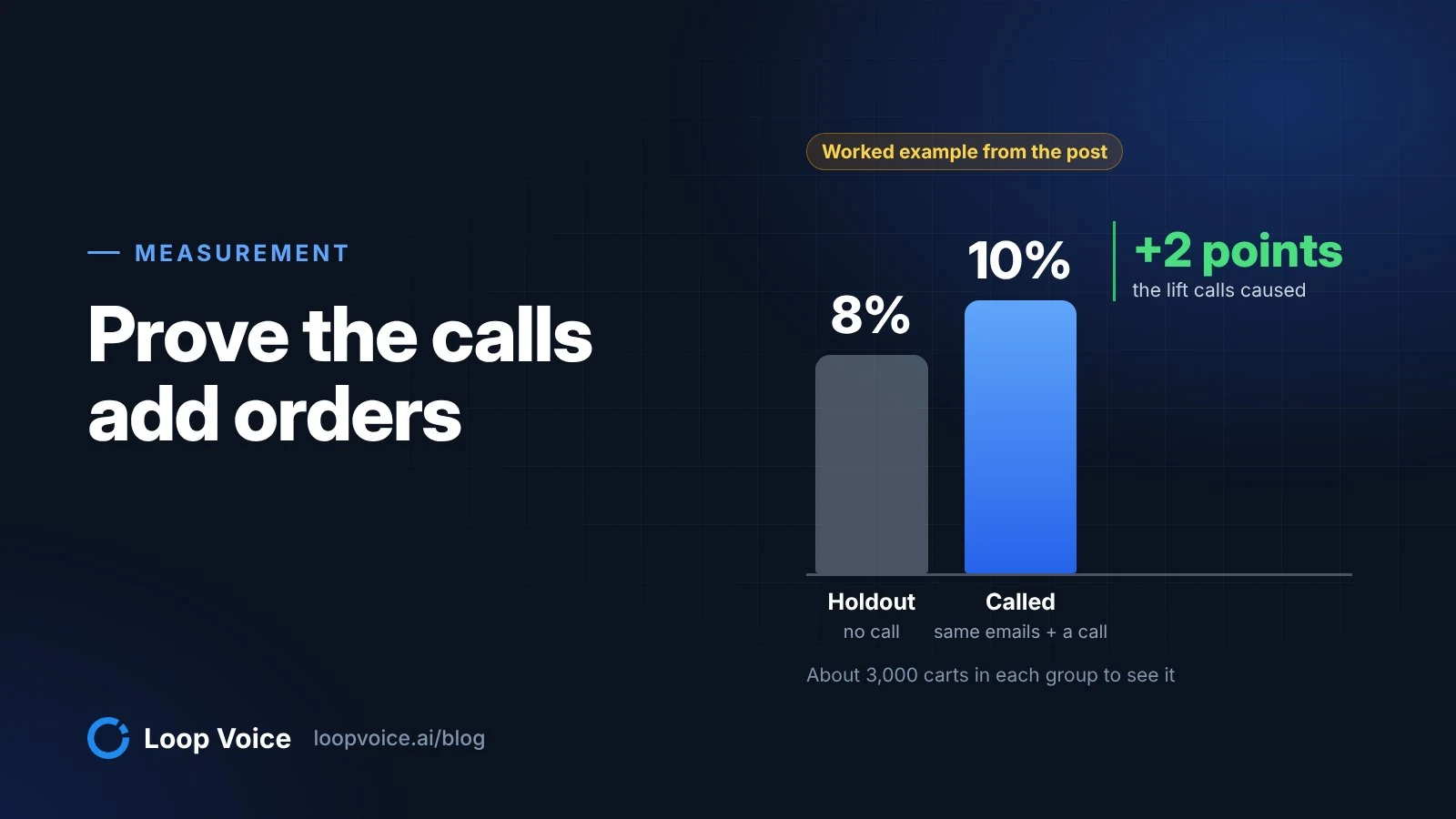
To find your own incremental number, hold out a random share of eligible checkouts, change nothing else, and compare order rates over your attribution window; how to run a holdout test on cart recovery calls covers the setup. Loop Voice's A/B split between two agents on the same flow tells you which agent sells better, not whether calling adds orders.
Read these every week:
| Metric | What to look for |
|---|---|
| Time from abandon to first dial | 5 to 15 minutes in calling hours |
| Pickup by attempt and by caller ID | Whether the second attempt and local numbers earn their place |
| Who answered (human, voicemail, call screener, unreachable) | Many call screeners: check your caller ID name registration |
| Call success score and QA notes | This week's top objection, and whether the script handled it |
| New do-not-contact entries by source | A jump after a script change means roll it back |
| Orders against the holdout | Incremental orders, and credits per incremental order |
When outbound AI calls are not worth it
Loop Voice's pricing page says the calls work best with a $50+ average order, 100+ abandoned carts a month and US customers, with a minimum viable volume of roughly 50 to 100 abandoned carts a month; below 50, focus on traffic first. Count yours in Shopify admin under Orders > Abandoned checkouts; Shopify lists a checkout there once it sits incomplete for more than ten minutes after the shopper gives an email, and deletes ones older than three months.
Skip or pause outbound calls when:
- You have fewer than 50 abandoned checkouts a month. Too few calls to learn from, and too few orders to carry the plan.
- Orders are small. Example: at a $30 average order and a 40% margin, each order earns $12, so Starter's $119 needs about 10 extra orders a month, a 10-point lift on 100 checkouts, above even the top of the benchmark's abandoned-checkout range (+5.7 points, 95% CI 4.4 to 6.9).
- No consent covers AI calls. Fix consent capture first, and use email, plus texts where shoppers opted in, in the meantime.
- Most customers are outside the US. The pricing page's fit names US customers.
- Calls keep finding the same checkout bug. Fixing the checkout is cheaper than calling around it.
Frequently asked questions
Should an AI agent leave a voicemail when nobody answers?
A voicemail in an AI voice is still an artificial voice message, so the FCC's rules apply: name the business at the start, give a callback number, and on sales calls leave a toll-free number that lets the person opt out. Keep it short, and if your consent language doesn't cover AI-voice calls, it doesn't cover the voicemail either.
How many call attempts should one abandoned checkout get?
Two is a sensible default, and it matches Loop Voice's example flow: a call about ten minutes after the abandon, a text with the checkout link, then a second call with a discount and a last note. Florida and Maryland allow at most three sales calls in 24 hours on the same subject; caps are set per agent, so if other plays use other agents, count their caps together.
What should an AI sales call say in its first ten seconds?
The store's name and how to stop the calls, then the reason and a permission question. For example: "Hi, this is the AI assistant for [your registered business name]; say stop anytime and we won't call again. I'm calling about the checkout you started: is now an okay time?" That puts the business name first and the opt-out instructions right after it, as the FCC's rules for sales calls ask; give a callback number before the call ends.
Sources
- Implications of Artificial Intelligence Technologies on Protecting Consumers from Unwanted Robocalls and Robotexts (Declaratory Ruling, FCC 24-17) (Federal Communications Commission, 2024)
- 47 CFR 64.1200, Delivery restrictions (eCFR, National Archives, 2026)
- Q&A for Telemarketers & Sellers About DNC Provisions in TSR (Federal Trade Commission, 2026)
- 501.616 Unlawful acts and practices, 2026 Florida Statutes (The Florida Senate, 2026)
- 50 Cart Abandonment Rate Statistics 2026 (Baymard Institute, 2025)
- Collecting customer contact information (Shopify Help Center, 2026)
- Recovering abandoned checkouts (Shopify Help Center, 2026)
- Maryland Code, Commercial Law 14-4502 (Maryland General Assembly, 2026)
Hear it before you decide
Listen to real recovery calls, or see Loop Voice call a test checkout on your own store.