


AI Voice Agent KPIs: 11 Metrics for Store Calls, With Formulas
Eleven KPIs that show whether AI calls to shoppers work, with formulas, September 2026 benchmark values and how to measure each one in a pilot.

Key takeaways
- Judge reach and conversion per shopper; per-call rates are for tuning timing and retries.
- Attributed results compare flows and agents under one rule; only a comparison group shows whether calling adds orders.
- Keep calling where cost per incremental order is below the contribution an order leaves.
Which KPIs matter for AI calls to shoppers
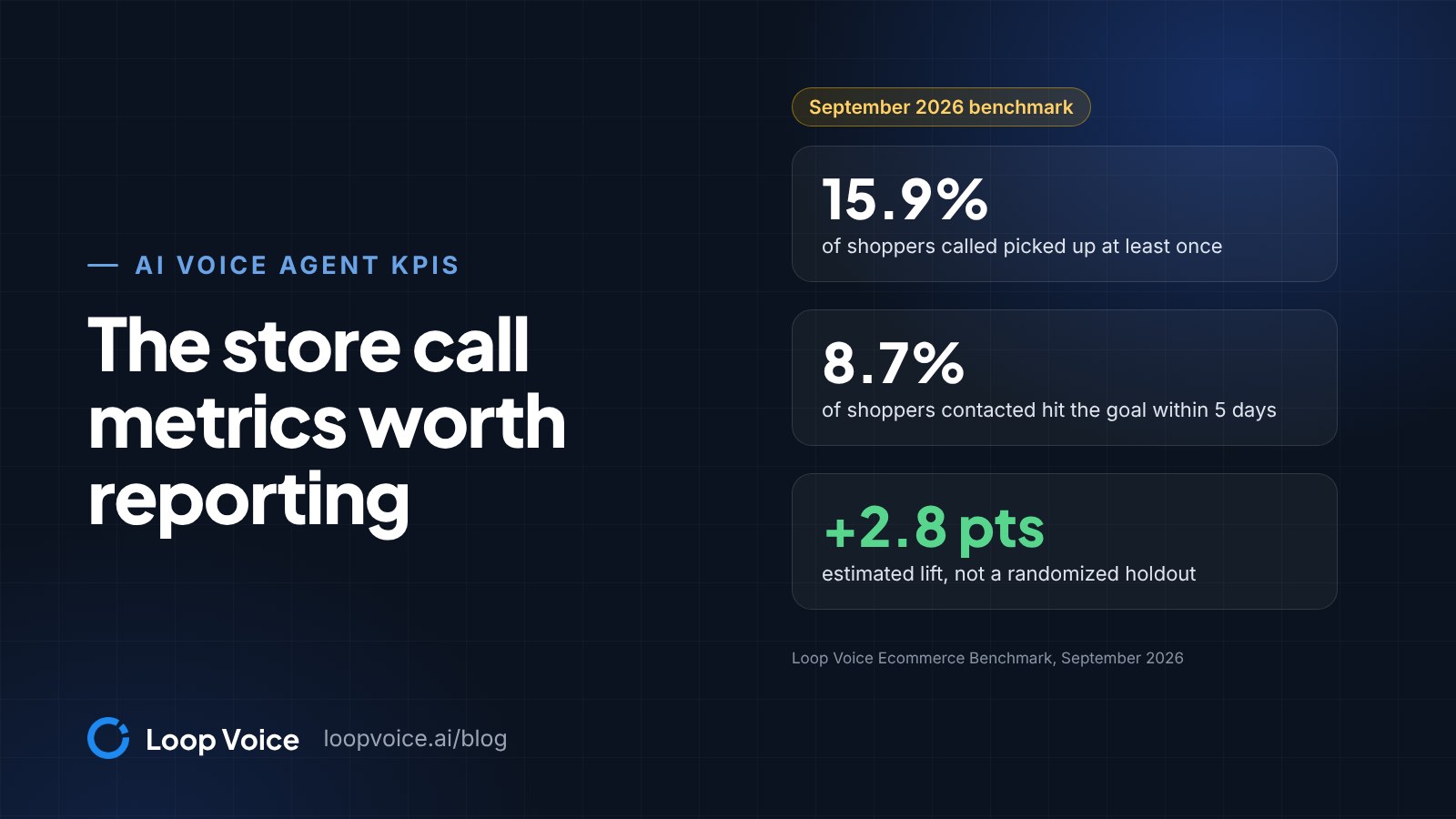
The AI voice agent KPIs worth tracking on store calls are answer rate per shopper, time to first call, contacted conversion, lift over shoppers you didn't reach, the text metrics around each call, opt-outs and cost per answered conversation. In Loop Voice's September 2026 benchmark, 15.9% of 18,361 shoppers called picked up at least once, and AI calls and texts added an estimated +2.8 points of 5-day conversion against enrolled shoppers the flows never reached in the same stores; an estimate, not a randomized holdout.
Vendor KPI lists borrow from other jobs: CloudTalk's is built for contact centers, Retell's measures conversion per connected call, and Thoughtly's tracks leads and pipeline. Store calls ask whether calling a shopper added an order, so denominators and windows matter most.
Values below come from the Loop Voice Ecommerce Benchmark for September 2026 unless marked: 7 online stores, 61,389 calls and 8,459 shoppers texted.
The eleven metrics at a glance
| Metric | Formula | September 2026 value |
|---|---|---|
| 1. Answer rate per shopper | Shoppers who picked up ÷ shoppers called | 15.9%; abandoned checkout 16.5% |
| 2. Answer rate per call | Calls a person answered ÷ calls placed | 6.6%; best hour 13.6% |
| 3. Time to first call | Calling-hours minutes to first dial | 5 to 15 minutes: 22.9% ordered; 15 to 60: 4.1% |
| 4. Contacted conversion | Goal reached in 5 days ÷ shoppers contacted | 8.7%; abandoned checkout 13.7% |
| 5. Lift | Contacted conversion minus a comparison group's | +2.8 points, an estimate |
| 6. Credited touch | Attributed conversions credited to texts or calls ÷ all | Texts 78.6%, calls 21.4% |
| 7. Text click rate | Shoppers who opened the link ÷ shoppers sent one | 5.3% |
| 8. Text conversion | Converted with a text as credited touch ÷ shoppers texted | 8.1% |
| 9. Opt-out rate | Opt-outs ÷ shoppers who answered (calls) or were texted (texts) | Set your own ceiling |
| 10. Cost per answered conversation | Spend ÷ answered conversations | About $0.95 to $1.49 (Loop Voice pricing) |
| 11. Resolved share, inbound | Resolved without handoff ÷ inbound calls answered | Not in the benchmark |
Reach metrics
Reach metrics say whether shoppers can answer at all, not whether they buy.
1. Answer rate per shopper
Formula: shoppers who picked up at least once ÷ shoppers called, over a set period. Count a pickup only when a person answered; the benchmark counts neither voicemail nor call screening.
September 2026: 15.9% (95% CI 15.4 to 16.4, n 18,361). For shoppers called after abandoning checkout, 16.5% of 14,036.
In a pilot: Loop Voice's Insights split who answered into human, voicemail, unreachable and call screener. Listen to a sample marked human, because machine detection makes mistakes: Twilio's documentation says its detection "will not always return the right answer" and can take a very short voicemail greeting for a person.
2. Answer rate per call
Formula: calls answered by a person ÷ calls placed. Retell's connection rate and Thoughtly's contact rate are this one: Retell divides calls connected to a person by calls dialed, and Thoughtly counts the share of outbound calls that connect.
September 2026: 6.6% of the 61,389 calls placed were answered by a person, per the report's data download; it runs below the per-shopper rate because those calls went to 18,361 shoppers, many of them more than once. By hour, Thursday at 1 pm was best, with 13.6% of calls answered, and weekday calls between 5 pm and 9 pm were answered 7.0% of the time against 5.4% between 8 am and noon.
In a pilot: use it, with pickup by attempt in Insights, to tune when and how often you call, and report reach per shopper. Our post on the best time to call customers breaks the hours down.
3. Time to first call
Formula: median minutes from abandoned checkout to first dial, counting only calling-hours minutes. The benchmark's clock runs from 8 am to 9 pm in the shopper's time zone, or a state's tighter window, so a checkout abandoned at 11 pm and called at 8:04 am counts as 4 minutes.
September 2026: shoppers who abandoned during calling hours and got a first call 5 to 15 minutes later ordered at 22.9% within 5 days; a first call 15 to 60 minutes later went with a 4.1% order rate. These are comparisons across shoppers and stores, not a controlled test, so read them as a direction.
In a pilot: report the median and the share of checkouts called within 15 calling-hours minutes; in Loop Voice, the wait before the first call is a delay you set in the flow. Whether a call is allowed at all depends on consent and calling hours, covered in our guide to calling rules.
Outcome metrics
Outcome metrics need a goal and a window; the benchmark uses an order or an accepted add-on within 5 days.
4. Contacted conversion
Formula: shoppers contacted who hit the goal within the window ÷ shoppers contacted. Count everyone contacted, including shoppers who never picked up.
September 2026: 8.7% of shoppers contacted hit the goal within 5 days of first contact, through any channel (95% CI 8.3 to 9.1). For abandoned checkout, 13.7% of the 14,036 shoppers called ordered within 5 days.
In a pilot: treat it as a description; the report labels it "not the lift". Loop Voice also splits out call conversion; the benchmark divides it by shoppers who picked up, a much smaller group, so show it beside the answer rate.
5. Lift over shoppers you didn't reach
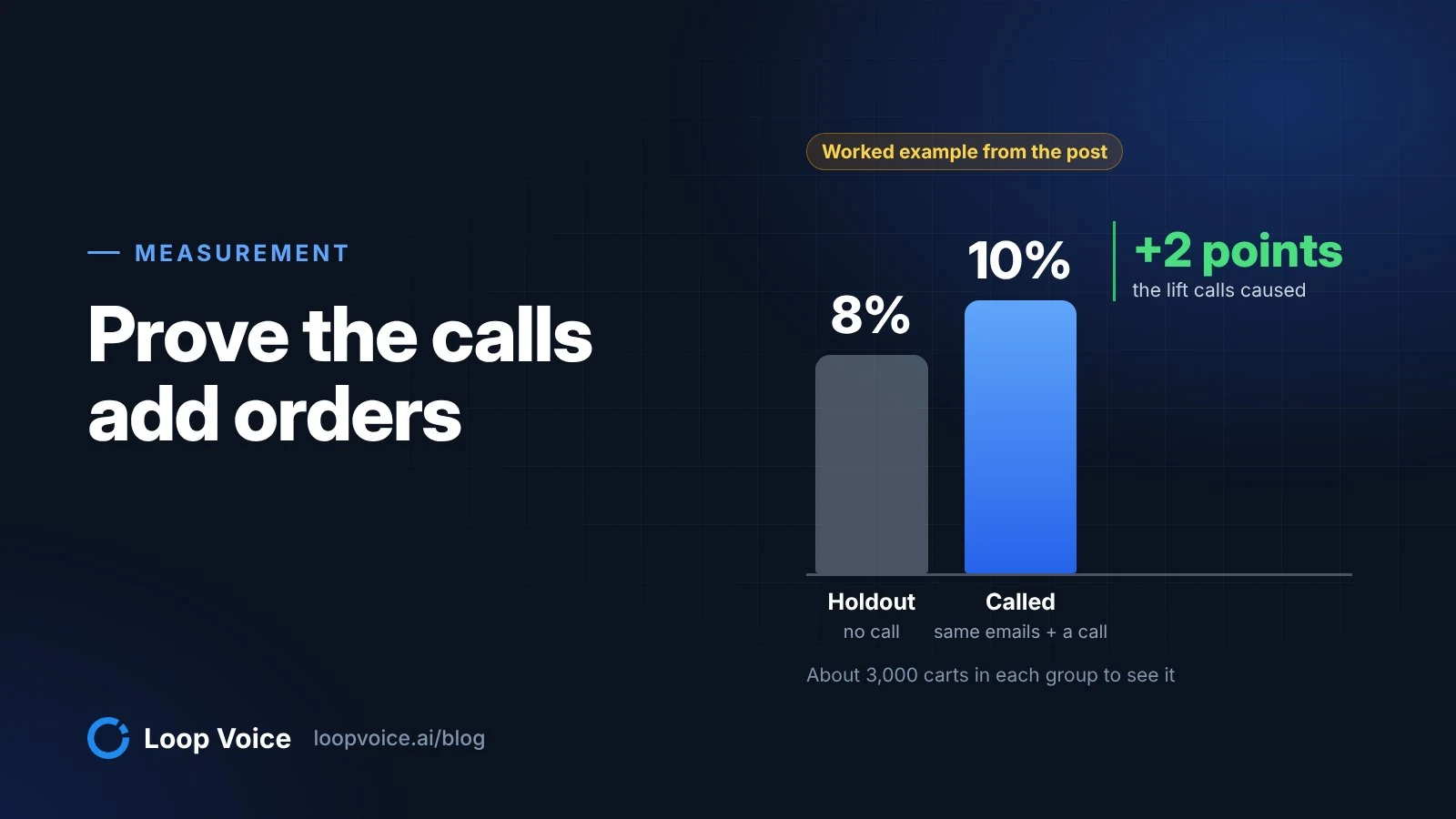
Formula: conversion of contacted shoppers minus conversion of comparable shoppers who entered the flow but weren't contacted, over the same window. In a randomized holdout, chance picks who isn't contacted; without one, the comparison group is whoever the flow missed.
September 2026: AI calls and texts added an estimated +2.8 points of 5-day conversion (95% CI 1.9 to 3.7) over enrolled shoppers the flows never reached in the same stores, who converted at 6.2%; an estimate, not a randomized holdout. The report estimates lift store by store in 6 of the 7 stores, counting only shoppers who hadn't bought by the store's median first-call time, so 8.7 minus 6.2 won't give you 2.8. For abandoned checkout the estimate was +5.7 points (95% interval 4.4 to 6.9), from 5 of the 7 stores, so results on your store will differ.
In a pilot: run a randomized holdout. Our holdout guide covers the split, the sample you need and how long to run it.
6. Credited touch, calls versus texts
Formula: attributed conversions credited to texts ÷ all attributed conversions, and the same for calls. The rule decides the split: the benchmark credits each sale within 5 days to its last touch, where an answered call wins and otherwise a text, sent or clicked, wins.
September 2026: texts were the credited touch on 78.6% of 660 attributed conversions and answered calls on 21.4%.
In a pilot: don't read it as texts doing the work. Most shoppers never pick up, so a text is their last touch, and a last-touch rule can't say whether the missed call made the text work. Only a comparison against shoppers you didn't contact shows what the whole sequence added. Our missed call text back post covers what to write.
7. Text click rate
Formula: shoppers who opened a texted link ÷ shoppers who got a text with a link.
September 2026: 5.3% (95% CI 4.8 to 5.8, n 8,459).
In a pilot: Loop Voice tracks link clicks in the SMS log, and its links carry utm_source=loop-voice for your analytics. The benchmark doesn't measure text delivery yet, so this rate can't tell a text that never arrived from one that was ignored.
8. Text conversion
Formula: shoppers texted who converted with a text as the credited touch and no answered call ÷ shoppers texted, within the window.
September 2026: 8.1% within 5 days (95% CI 7.5 to 8.7, n 8,459).
In a pilot: compare it with your Klaviyo SMS numbers only when the rules match. Klaviyo's default windows for new accounts are 5 days for email opens and clicks and for SMS clicks, and 12 hours for SMS deliveries, credited to the last touch.
Guardrail metrics
Guardrails don't prove calls work. They tell you when to stop.
9. Opt-out rate
Formula: shoppers who asked not to be contacted again ÷ shoppers who answered, for calls; STOP replies ÷ shoppers texted, for texts. Report it by flow and agent version.
Value: set your own ceiling before launch and check it weekly.
In a pilot: every opt-out in Loop Voice lands on the do-not-contact list before the next step runs, with its source recorded: STOP by text, "don't call me" on the call, or a carrier block. Loop Voice's A/B tests also stop variants that raise opt-outs.
10. Cost per answered conversation, and per extra order
Formula: calling spend ÷ answered conversations. Once you have a holdout, also spend ÷ incremental orders.
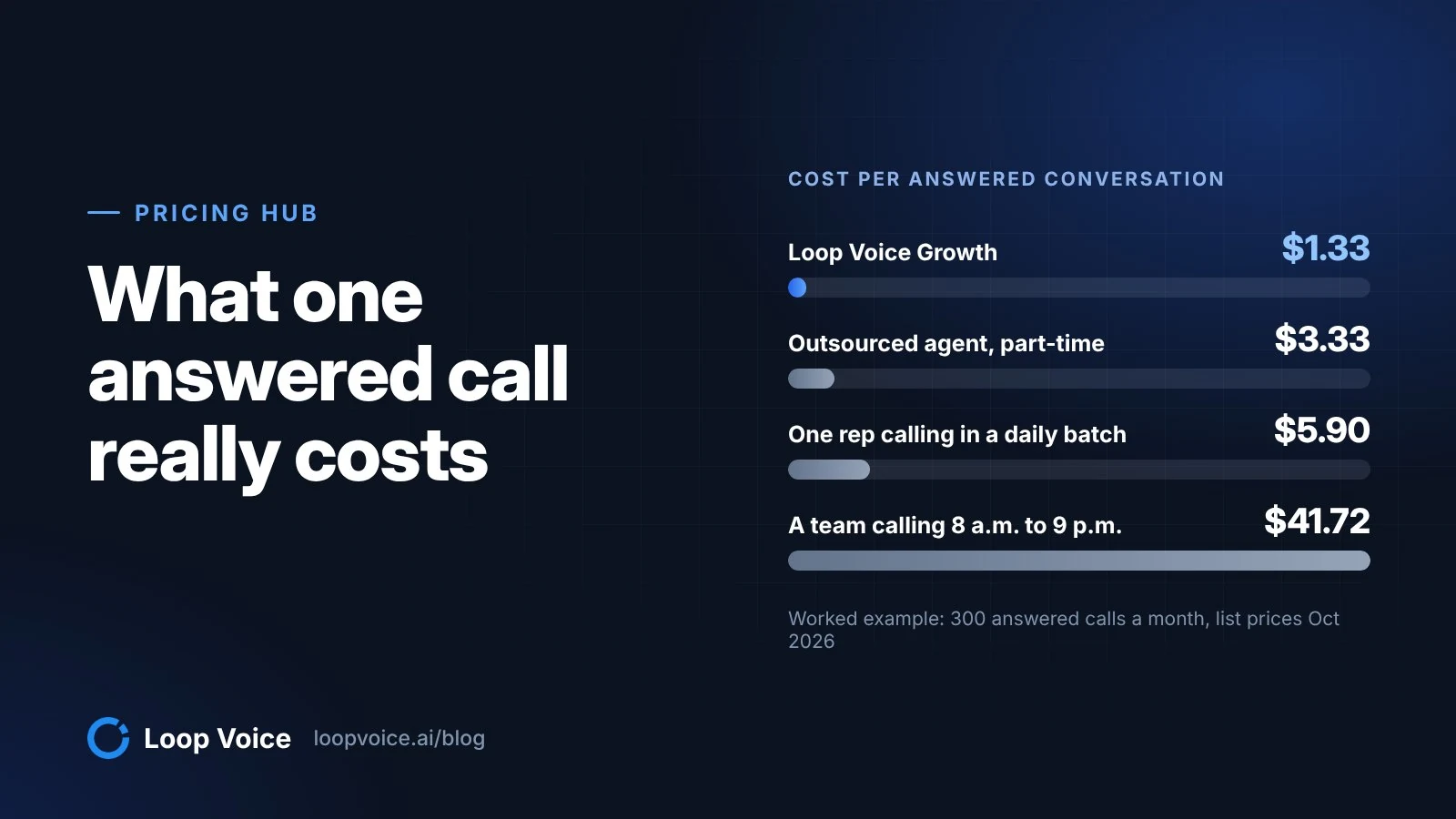
Published value: on Loop Voice's monthly plans, an answered conversation costs about $0.95 to $1.49 (cost calculator). An answered conversation uses about 1.5 credits and calls nobody answers use none, so cost follows pickups, not dials.
In a pilot: cost per answered conversation is what reach costs. Cost per incremental order, set against the contribution an order leaves after product, shipping and fees, says whether to keep calling.
Example: a month of calling costs $1,000 and the holdout shows 40 extra orders, so each extra order cost $25. If an order leaves $40 of contribution, calling paid for itself; at $20, it didn't.
11. Resolved share on inbound calls
Formula: inbound calls the agent resolved without a handoff ÷ inbound calls it answered. CloudTalk calls the same idea containment, "the share of calls the AI handles end-to-end without involving a human."
Value: the benchmark covers outbound flows, so there's no published inbound figure.
In a pilot: Loop Voice gives every inbound call a topic and an outcome, and the Support tab in Insights shows resolved share, topics and unanswered questions. Handoffs that cluster on one topic usually point to a missing knowledge-base entry or an unclear policy. Complex refunds, legal and medical questions should reach a person, and built-in rules in Loop Voice stop or escalate those calls (see the inbound support line).
Attributed and incremental, in plain words
Attributed means an order followed a call or text inside a time window, so the call or text gets the credit. Incremental means the order wouldn't have happened without it. The first is a bookkeeping rule; the second needs a group of shoppers you didn't contact.
Each tool keeps its own books: Loop Voice ties revenue to the Shopify order number inside the attribution window you set, and Klaviyo credits the last eligible touch inside its own windows. One order can count in both, so don't add them up.
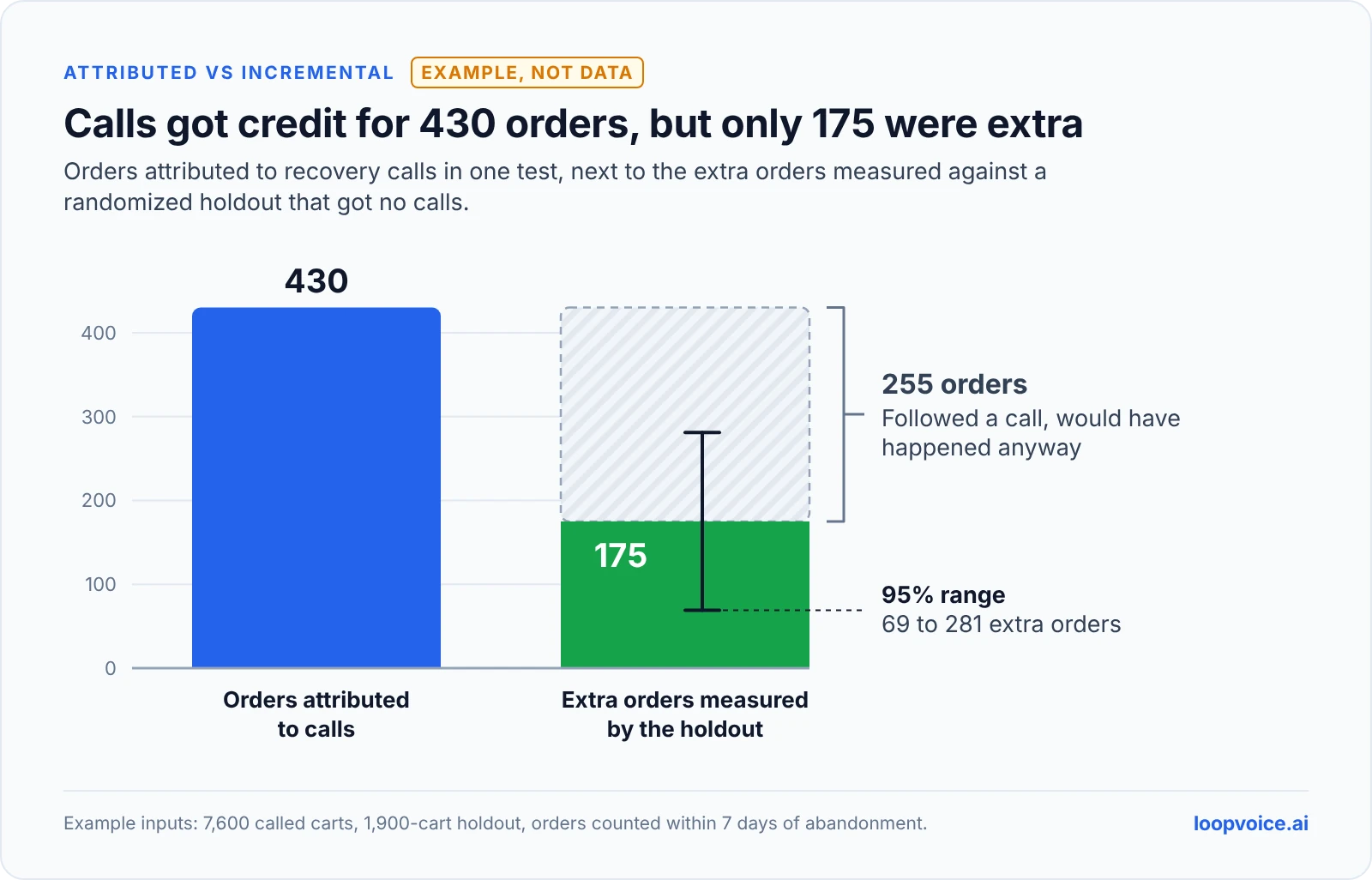
Attributed numbers are still right for comparing flows, agents and weeks under one rule. They can't tell you whether to keep calling; lift against a comparison group can. The September benchmark used shoppers the flows never reached because no store ran a randomized holdout yet.
How to measure them in a 30-day pilot
- Write the definitions down. The goal per use case, the window (5 days in the benchmark, 7 in our holdout guide; pick one) and whether each rate divides by shoppers or calls.
- Split before the first call. Hold out a random share of eligible shoppers, by shopper rather than by checkout, and keep every email and text from your other tools the same for both groups.
- Week 1: check reach. Answer rate per shopper, time to first call, and 20 calls heard end to end. Fix timing, the opening line and knowledge-base gaps before judging outcomes.
- Weeks 2 to 4: watch the guardrails. Opt-outs, cost per answered conversation and handoffs weekly; conversion only once the groups are big enough. The benchmark won't publish a rate built on fewer than 200 calls or shoppers, and neither should you.
- Readout. Contacted conversion for both groups, the lift with its 95% interval, cost per incremental order against contribution, and the credited-touch split as context.
Small samples swing more than they look. Example: 24 orders from 200 shoppers is 12%, and the 95% Wilson interval, the method the benchmark uses, runs from about 8.2% to 17.2%. NIST's statistics handbook explains why that interval beats the textbook formula, whose lower limit can fall below zero.
Metrics to drop or demote
- Average handle time as a target. It's a contact-center cost measure; CloudTalk counts "silences, retries, and confirmations" in it. On a sales call, long can be good: Melvin's Modern Hearing call in our call library ran 14:40, and he completed checkout while the agent stayed on the line. Track length to catch loops and dead air.
- Containment on outbound calls. An outbound call that hands a ready buyer to your team hasn't failed. Keep resolved share for inbound lines.
- Attributed revenue as the headline. Report it next to lift; on its own it includes orders that would have come anyway.
- Blended quality scores. Retell suggests a 1 to 10 voice quality score built from several inputs. Loop Voice's call success score, 0 to 100 per human conversation, is good for finding weak calls to read, not for reporting upward.
Frequently asked questions
What answer rate should an AI voice agent reach on store calls?
There's no universal target; it depends on who you call and when. In Loop Voice's September 2026 benchmark, 15.9% of shoppers called picked up at least once, and so did 16.5% of shoppers called after abandoning checkout. Per call it was 6.6% in the report's data download, because shoppers get several attempts, so compare like with like.
Why don't my Loop Voice and Klaviyo revenue numbers add up?
Each tool credits orders by its own rule and window, so one order can appear in both reports. Use lift from a holdout to see what calls added.
How long should an AI calling pilot run before I judge it?
Until both groups reach the size you planned, and no less than two full weeks, the floor our holdout guide sets. Judge conversion and lift only at the end.
Sources
- Loop Voice Ecommerce Benchmark, September 2026 (Loop Voice, 2026)
- Key Metrics & KPIs for AI Voice Agent in Contact Centers (CloudTalk, 2026)
- The 8 KPIs Every AI Outbound Calling Strategy Should Track (Retell AI, 2026)
- How to Measure AI Voice Agent Performance: A Complete Framework for Revenue Teams (Thoughtly, 2026)
- Answering Machine Detection (Twilio, 2026)
- Understanding message conversion tracking (Klaviyo Help Center, 2026)
- Loop Voice Ecommerce Benchmark, September 2026: data download (JSON) (Loop Voice, 2026)
- Confidence intervals (section 7.2.4.1) (NIST/SEMATECH e-Handbook of Statistical Methods, 2026)
- AI Voice Agent Cost Calculator for Ecommerce (Loop Voice, 2026)
Hear it before you decide
Listen to real recovery calls, or see Loop Voice call a test checkout on your own store.