


Selling to Older Shoppers Online: Why the Phone Still Closes
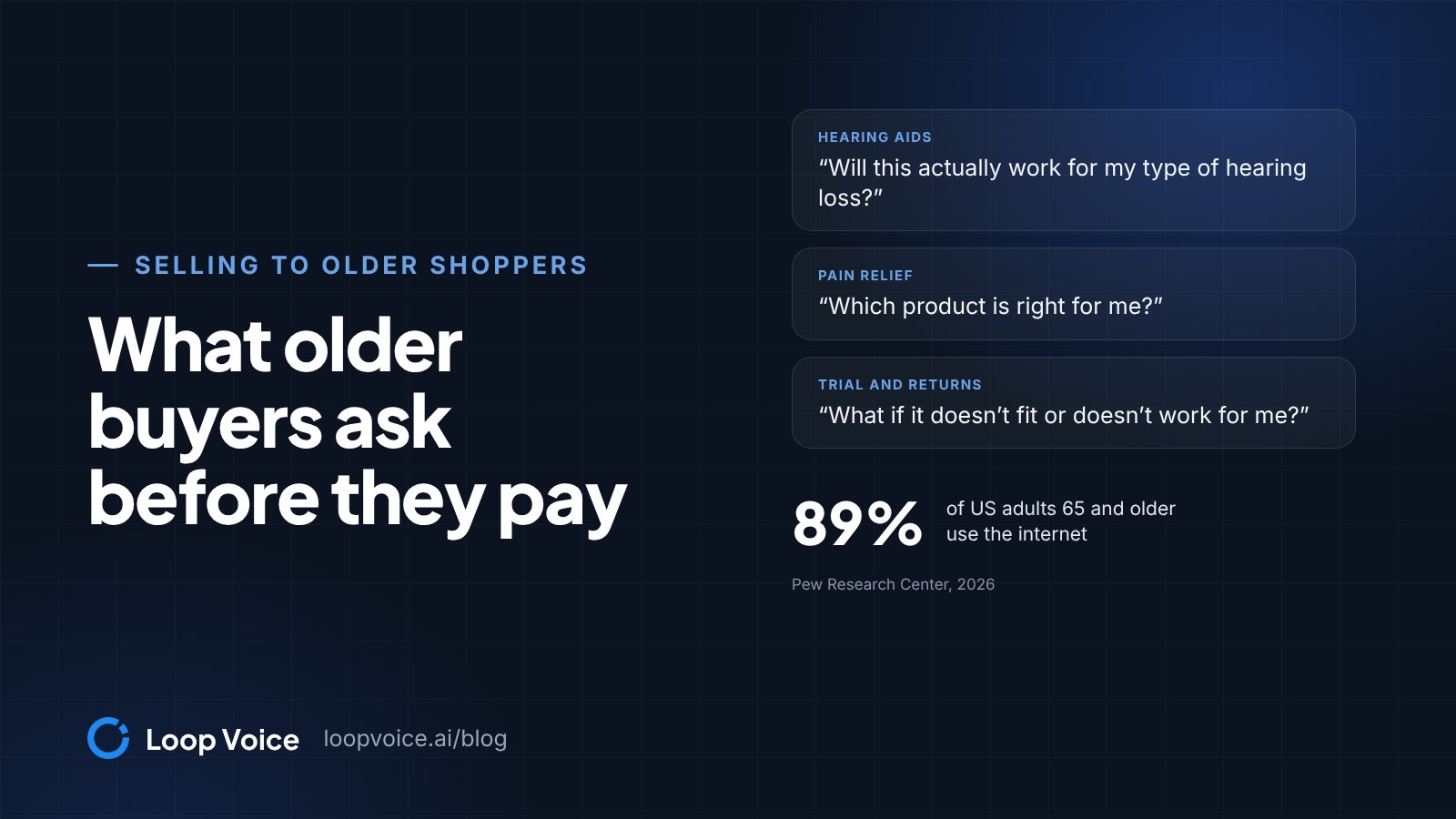
Most older adults are online: 89% of US adults 65 and older use the internet, Pew found in 2026. At a hearing aid brand and a mobility and recovery brand, what stopped the sale was a question the product page left open. Their calls show which questions, and why the phone still closes.

Key takeaways
- Older adults are online: in Pew Research Center's 2026 survey, 89% of US adults 65 and older use the internet and 79% own a smartphone.
- Modern Hearing's buyers wanted to know if it would work for their kind of hearing loss, how it compared with a clinic and what happened if it didn't fit; CastleFlexx's asked which product suited their condition and how soon they'd see results.
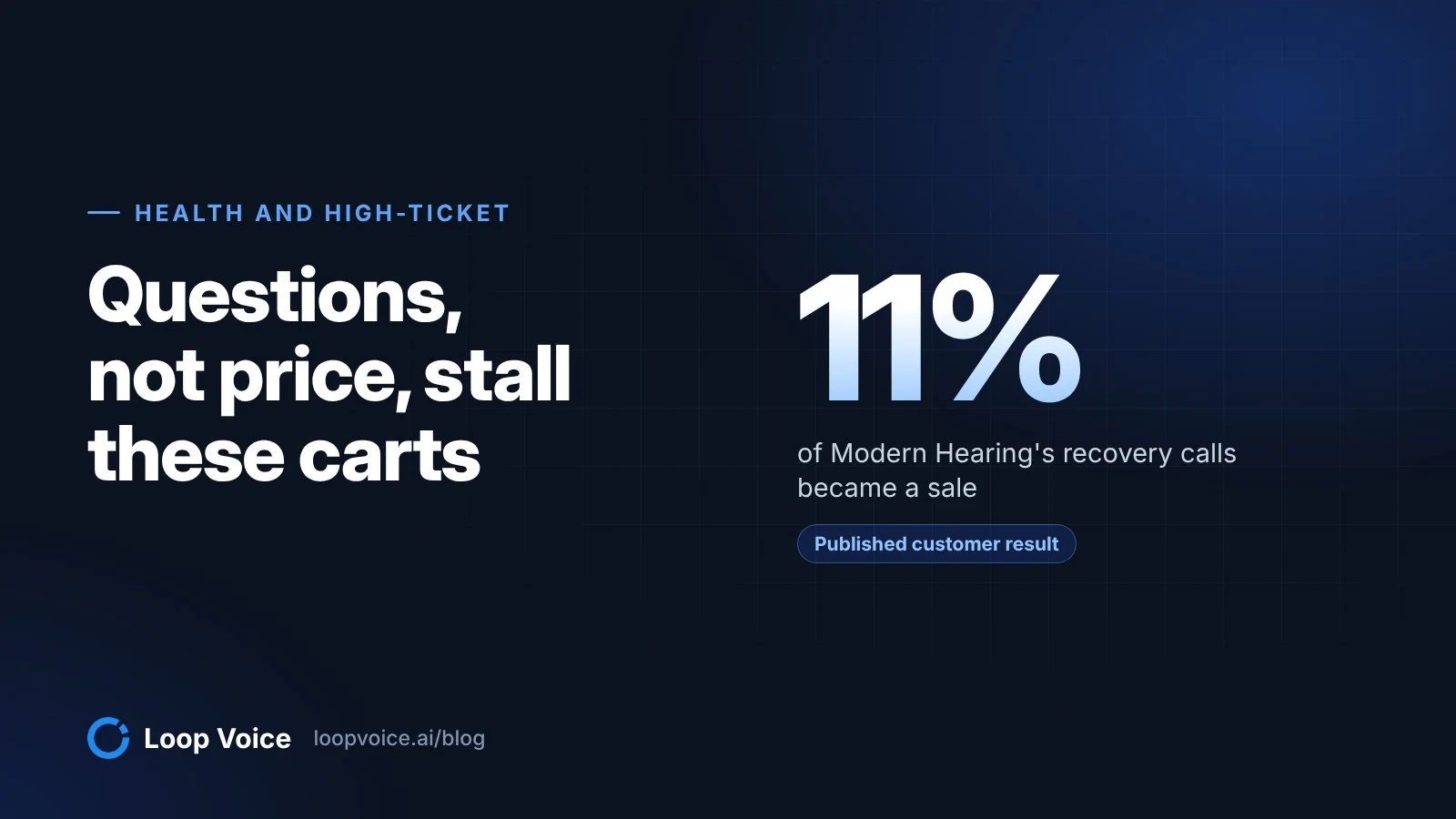
- At Modern Hearing, 11% of 8,000+ Loop Voice calls led to a sale, for $300,000+ in attributed revenue.
- Put the answers on the page, pick up when buyers call, open every outbound call with your store's name and the fact that it's an AI, and call only shoppers who agreed to be contacted.
Older shoppers are online; open questions stop the sale
Selling to older shoppers online works when your store answers the specific question each buyer brings, and for health devices a phone call often answers it better than a product page. Getting them online isn't the hard part: in Pew Research Center's 2026 survey, 89% of US adults 65 and older use the internet (Pew on internet use) and 79% own a smartphone (Pew on mobile phones).
AARP Research's latest survey of adults 50 and older shows them embracing video chat, online shopping and digital gaming, with texting now their leading way to communicate (AARP 2026 Tech Trends). The same survey names what holds them back. Three in five adults 50-plus say technology is not designed with their age in mind, and the top barrier to adopting new tech is data privacy, followed by understanding the true value of a purchase.
For a store, that means showing what the product does in this buyer's situation and making it easy to ask about it. The two stores below sell in categories where need rises with age; neither publishes its customers' ages.
Hearing aids: will it work for my hearing?
Hearing loss climbs steeply with age. The National Institute on Deafness and Other Communication Disorders puts disabling hearing loss at 22% of adults 65 to 74 and 55% of adults 75 and older, and fewer than 1 in 3 adults 70 and older who could benefit from hearing aids has ever used them (NIDCD hearing statistics).
Modern Hearing's story says most of its visitors had been living with hearing loss for years, and many were let down before, by cheap amplifiers that whistled and by clinics that upsold them. After 8,000+ Loop Voice calls, three objections stood out:
- Will this actually work for my type of hearing loss? The story calls it the most common objection in the category. Tinnitus, certain voice pitches and noise in restaurants each needed a specific answer; general claims of crystal-clear sound didn't settle it.
- Why trust this over a clinic? Many callers measured the device against their own past clinic visits, not against other hearing aid sites.
- What if it doesn't fit or doesn't work for me? The agent's answer covered the 45-day at-home trial, the warranty and the support team. Nearly every buyer who ordered after a call credited the trial with putting them at ease, though on the product page it hadn't sunk in for most of them.
Those calls are credited with $300,000+ in attributed revenue, and 11% of them led to a sale. Attributed means the order followed a call, which isn't proof the call caused it. Modern Hearing now addresses all three objections on the product page and in its ad copy. The setup for this category is in AI voice agents for hearing aid brands.
Pain relief: which product, and how soon?
Chronic pain rises with age too. CDC's National Center for Health Statistics found that 36.0% of adults 65 and older had chronic pain in 2023, against 12.3% of adults 18 to 29 (NCHS Data Brief 518).
CastleFlexx, a mobility and recovery brand, sells to people living with plantar fasciitis, tennis elbow, hip problems or back pain. Its story says customers have tried other things before and reach checkout "interested but cautious." It names three objections: "Will it actually work for my condition?", "Which product is right for me?" and "How long until I see results?"
The calls taught it two things. Buyers responded much more strongly to copy about their own pain point than to general mobility language, and the strongest trust signal was a testimonial about the buyer's own condition.
Across 2,789 calls, 8% led to a sale, and the story credits $30,000+ in attributed revenue. More on the category is on our page for pain relief device brands.
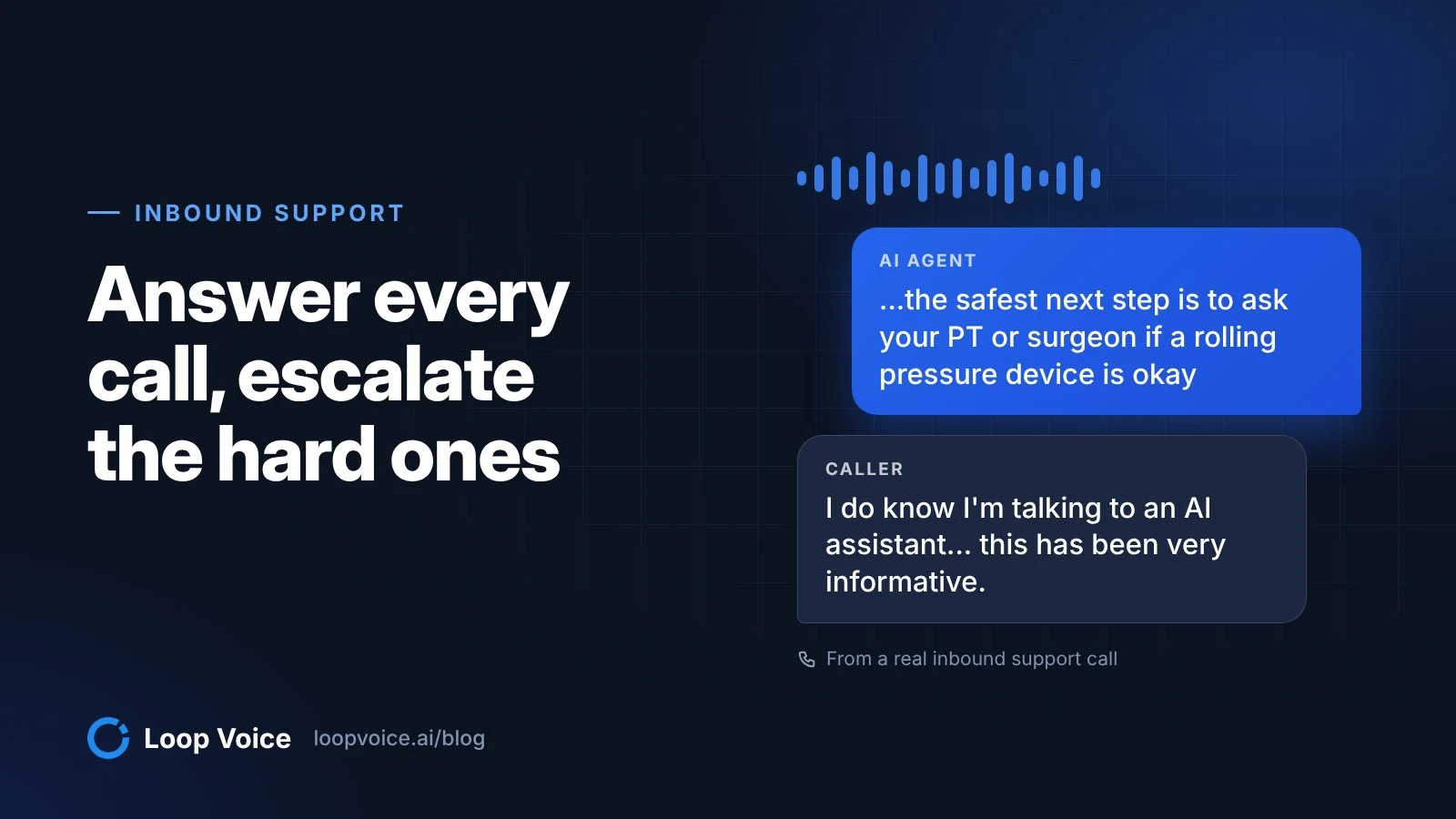
Some questions are about safety, and the right answer is a referral. One caller to a health device brand's support line was nine months past knee surgery and wanted to know whether the product was safe for him. The agent said the brand's safety guidance lists recent surgery as a don't-use case without medical sign-off, and told him to ask his physical therapist or surgeon whether a rolling pressure device was okay.
Why the phone still closes
Both stories say the cart wasn't lost over price. CastleFlexx calls it caution; Modern Hearing calls it history. A product page answers the average question, and a call answers this buyer's. As Modern Hearing's story puts it, customers asking about tinnitus need a tinnitus answer.
Those conversations take time. The five Modern Hearing calls in the call library ran from 11:41 to 20:50 in full, and each one ended with an order. Hodge's call shows why: the agent gives one step, then waits while he does it on his own screen.
Perfect. Go ahead and enter the card number, expiration, and security code, then tap place order. Just let me know what the screen says after you submit, whether it confirms the order or shows an error.
Okay.
No rush. What does it say now?
Confirmation order. You paid for your order. You order confirmation.
Awesome. You're all set.
The agent never takes card details. The shopper pays on your site, and the agent can send the checkout link by text, during the call or after it, which suits adults 50 and older now that texting is their leading way to communicate.
Fix the page and the checkout first
Calls find the gaps, and the page should close them. These changes follow from what both stores heard:
- Put the trial next to the price. Say how long it lasts and how a return works, in plain words, where the buyer decides. Most of Modern Hearing's buyers only took the trial in on the phone.
- Answer by condition. Give each common condition its own answer on the page, and collect reviews by condition, as CastleFlexx now does.
- Make it easy to read and tap. The W3C notes that contrast sensitivity, near focus and fine motor control change with age for many people, and that sites accessible to people with disabilities are more accessible to older users as well (W3C on older web users). Check text size, contrast and button size on the product page. In Shopify's checkout and accounts editor, the Typography section sets the checkout's fonts and the color sections set backgrounds, buttons and error text (Shopify's checkout style settings).
- Make add-ons clearly optional. On two recorded Modern Hearing calls, a protection add-on and a six-month backup offer held up the order until the agent explained they were optional. Our checkout troubleshooting guide covers this and other checkout snags.
- Show a phone number where the question comes up, next to the trial terms and on the order confirmation.
Answer the phone, and say who is calling
A phone number only helps if someone picks up, and a call you place only helps if the shopper trusts it. Four things decide both.
Phone hours
An inbound Loop Voice agent takes the call on the first ring, day or night, and handles order status, returns and product questions using your knowledge base. During the support hours you set, it can transfer the caller to your team and brief them first; if nobody answers within the ring time, or it's after hours, it opens a ticket. If your team covers the daytime, forward the store line to the agent's number for evenings and weekends only. A customer who calls back within 7 days reaches an agent that has the earlier conversation.
Pace and voice
Check that the guardrails for not interrupting and for handling silence are on, set the speaking speed, and test before you go live. In the simulator you can write a one-off customer, for example a buyer whose last hearing aids whistled and who wants the return steps read back before paying; nothing is dialed or charged. The same W3C page lists difficulty hearing higher-pitched sounds among the age-related changes many older people have, so choose the voice on a real phone line, not on laptop speakers: the test console has the agent call your own number.
Say it's an AI, and sound like the store
Caution about unexpected calls is well earned. In the FTC's latest report on older consumers, business impersonation was the scam adults 60 and older most often reported losing money to when it started with a phone call (FTC, Protecting Older Consumers 2024-2025). AARP found that trust, privacy and data security are the top concerns for about half of older adults who hesitate over new tech, especially AI tools.
So write the opening to sound like your store: the agent names the store, says it's an AI assistant and says what the call is about. Loop Voice agents never claim to be human, and with the AI identity guardrail on they say they're an AI whenever a caller asks. The caller nine months past knee surgery knew he was talking to an AI, and said so:
Uh, that's okay. I already found it. I'm here on the web now perusing through, and that's, uh, really what caught my attention. But, Alex, I do thank you for your time today. You've been gracious and kind, and, uh, I do know I'm talking to an AI assistant. But just for those people in the background and for the quality assurance people who are listening, uh, this has been very informative. And, uh, I'll do that. I'll take your recommendation. I will speak to my PTs. I'll speak to my doctor, the surgeon, and find out what it is they recommend, and I'm gonna tell them about [the store]. And then I'm gonna show them the website and see what they tell. But as far as for, you know, the information Huntout was on today, uh, it was a home run. You landed. You did a great job. Thank you.
You're very welcome
Consent and calling hours
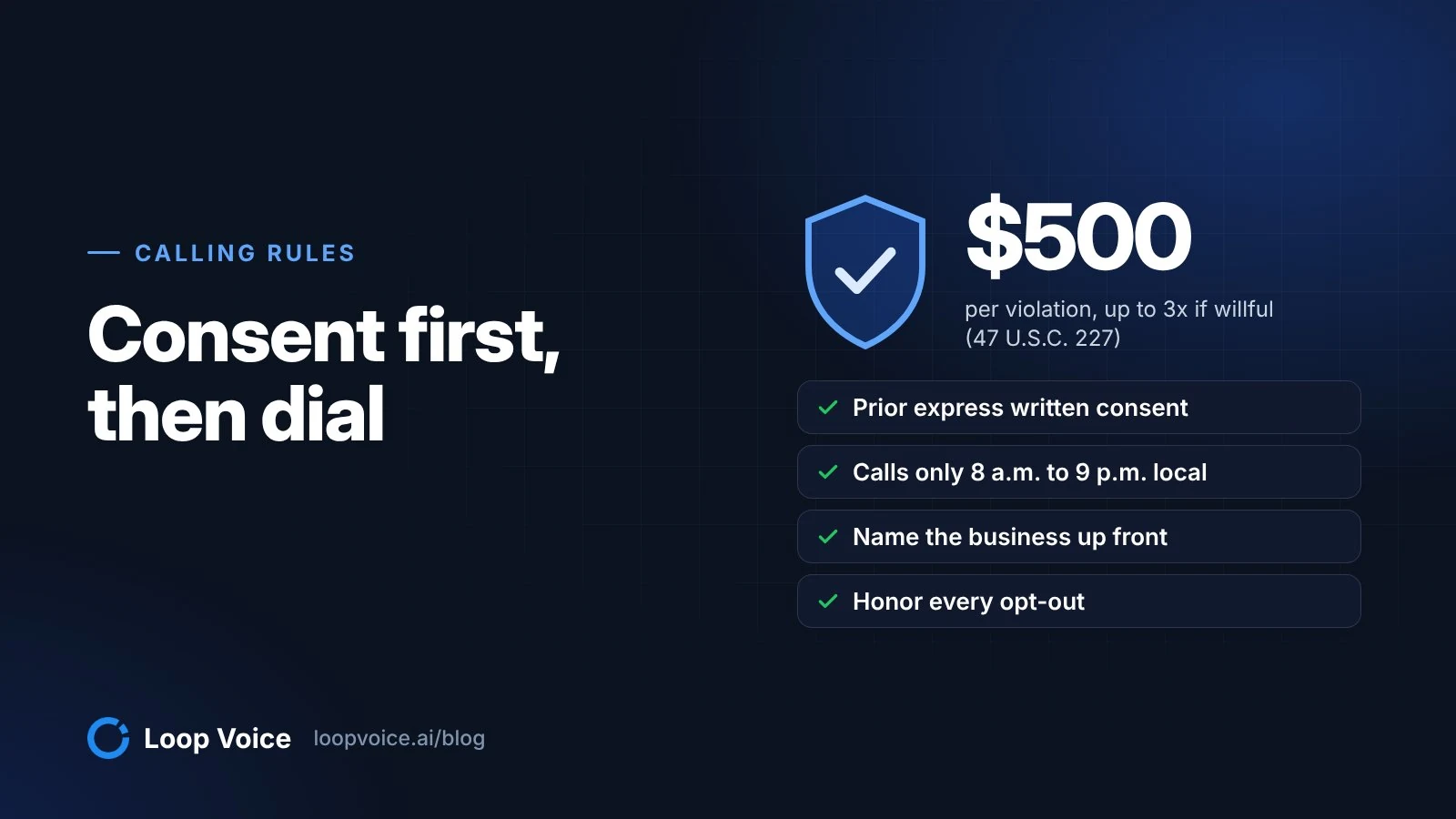
The FCC has confirmed that the TCPA's limits on calls using an "artificial or prerecorded voice" cover AI-generated voices, so those calls need the called party's prior express consent (FCC declaratory ruling). Marketing calls that use such a voice need prior express written consent under the FCC's rules (47 CFR 64.1200). Loop Voice's outbound calls go only to shoppers who agreed to be contacted, only during the calling hours you set, counted in each shopper's own time zone, and opt-outs are honored right away. Collecting and proving consent stays with you. Our guide to calling rules walks through each requirement; confirm how they apply to your store with counsel.
What not to do
- Don't guess ages. Your checkout doesn't record a shopper's age, and a flow built on a guess will misjudge people in both directions. Build flows around the product and its questions.
- Don't open with a discount when the doubt is about fit. Price wasn't the blocker in either story. Loop Voice's default abandoned checkout flow saves its code for the second call, and you can drop it and let the trial terms do the work.
- Don't let the agent play doctor. Load your labeling, safety pages and trial terms into the knowledge base, and keep the built-in rule that stops or escalates calls on medical or legal questions. What to keep off a health call is covered in cart recovery calls for health products.
Frequently asked questions
Do older shoppers prefer to buy over the phone?
The surveys cited here don't measure that preference. They do show most are online: Pew counts 89% of US adults 65 and older as internet users, and AARP finds adults 50 and older embracing online shopping. The phone earns its place before the purchase, while a question about fit, safety or returns is still open. A Loop Voice agent answers it and can stay on the call while the shopper checks out on your site, without ever taking card details.
Should an AI agent say it's an AI at the start of the call?
Yes, especially for health products. Business impersonation tops the FTC's list of phone scams that cost adults 60 and older money, so make the opening unmistakable: the store's name, that the caller is an AI assistant and why it's calling. Loop Voice agents never claim to be human, and with the AI identity guardrail on they say they're an AI whenever asked.
How long do sales calls with hearing aid buyers last?
Long, in the recordings Loop Voice has published: the five Modern Hearing calls in its call library ran from 11:41 to 20:50 in full, and each ended with an order. Five calls picked for a library aren't an average, so judge your own calls by orders and answered questions, not by length.
What should a store fix first for older customers?
The answer that settles the most doubt, placed next to the price. For Modern Hearing that was the 45-day trial: almost every buyer who ordered after a call named it, though most had not taken it in from the product page. Then check text size, contrast and button size, and make every add-on clearly optional.
Sources
- Americans' Use of Internet, Broadband in 2026 (Pew Research Center, 2026)
- Americans' Use of Mobile Devices in 2026 (Pew Research Center, 2026)
- 2026 Tech Trends and Adults 50-Plus (AARP Research, 2025)
- Quick Statistics About Hearing, Balance, & Dizziness (National Institute on Deafness and Other Communication Disorders, 2024)
- Chronic Pain and High-impact Chronic Pain in U.S. Adults, 2023 (CDC National Center for Health Statistics, 2024)
- Older Users and Web Accessibility: Meeting the Needs of Ageing Web Users (W3C Web Accessibility Initiative, 2025)
- Customizing the style of your checkout (Shopify Help Center, 2026)
- Protecting Older Consumers 2024-2025 (Federal Trade Commission, 2025)
- Implications of Artificial Intelligence Technologies on Protecting Consumers from Unwanted Robocalls and Robotexts (Federal Communications Commission, 2024)
- Modern Hearing customer story (Loop Voice, 2026)
- CastleFlexx customer story (Loop Voice, 2026)
- 47 CFR 64.1200, Delivery restrictions (Cornell Law School Legal Information Institute, 2026)
Hear it before you decide
Listen to real recovery calls, or see Loop Voice call a test checkout on your own store.