


Self-Hosted Voice AI Agents: 9 Open-Source and On-Prem Options Compared (2026)
Nine ways to run voice AI agents on your own servers, compared on license, telephony, models and setup. Dograh is the closest self-hosted match for Vapi or Retell.

Key takeaways
- For a Vapi or Retell style builder on your own servers, start with Dograh: a visual workflow builder, telephony connections and call testing, open source under BSD 2-Clause and running from one Docker command.
- If your engineers want a framework instead of a product, Pipecat (BSD 2-Clause) and LiveKit Agents (Apache 2.0) have the widest model and transport support; you build the dashboard and monitoring yourself, plus the dispatch with Pipecat.
- jambonz and AVA Core sit at the telephony layer, connecting SIP trunks or an Asterisk PBX to the AI. jambonz's code is MIT, but its official self-hosted build now needs a paid license.
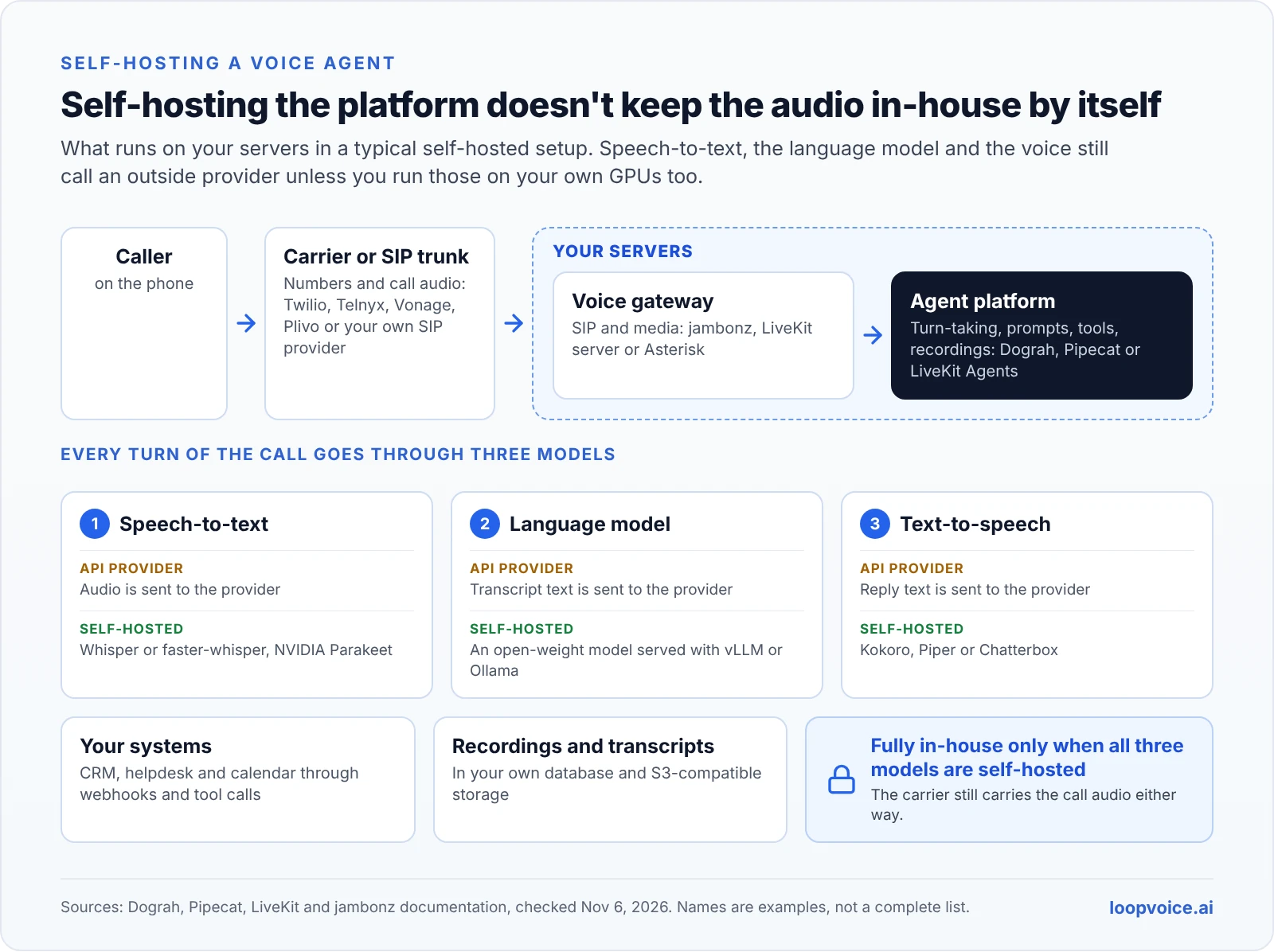
- Self-hosting the platform doesn't keep audio in-house by itself: unless speech-to-text, the language model and the voice also run on your hardware, every turn of the call goes to those providers.
- Loop Voice, the publisher, is hosted and not self-hostable, so it isn't ranked here; for an online store without someone to run servers, a hosted agent usually costs less in total.
The short answer
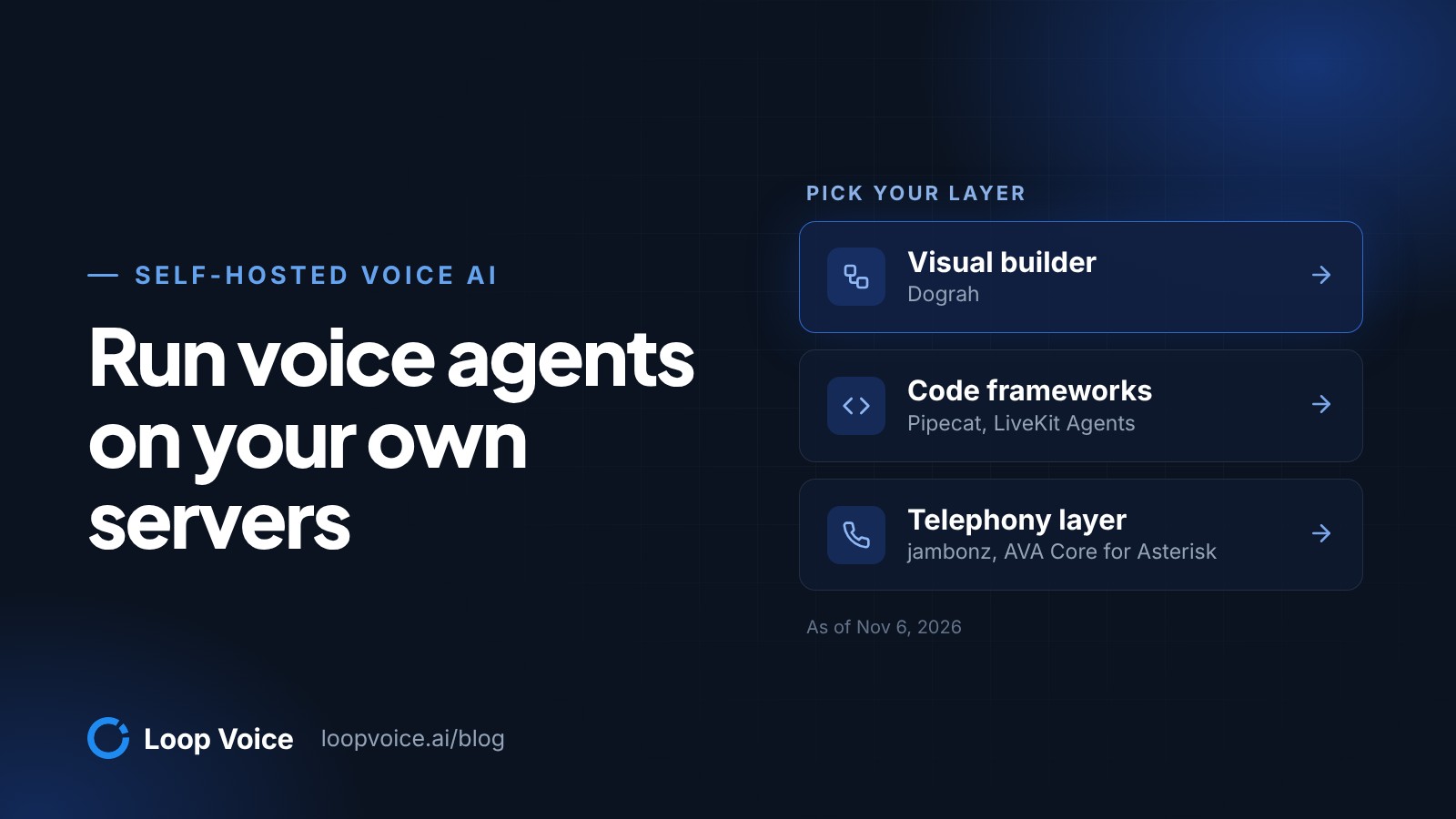
The open-source ways to run AI phone agents on your own servers in 2026 split into three layers. Dograh is the closest thing to a self-hosted Vapi or Retell: a visual builder, telephony connections and call testing in one Docker deployment. Pipecat, LiveKit Agents, Bolna and TEN are frameworks your engineers build on, and jambonz and AVA Core connect phone carriers or an Asterisk PBX to the AI.
Loop Voice publishes this guide. Loop Voice itself is a hosted product for online stores and can't be self-hosted, so it isn't one of the options; the last section says when hosted is the better choice. Licenses, features and prices come from each project's own repository, docs and pricing pages, checked on Nov 6, 2026.
 DograhOpen-source voice agent builder you can self-host
 PipecatOpen-source Python framework for voice agents
 LiveKit AgentsOpen-source agents framework and media server
 jambonzSelf-hostable telephony layer for voice AI
 BolnaOpen-source voice agent engine in Python
 AVA CoreOpen-source AI agent for Asterisk and FreePBX
 TEN FrameworkReal-time agent framework backed by Agora
 Kyutai UnmuteFully local speech loop from Kyutai
 Rasa ProLicensed agent platform you can run on-prem
Comparison table, as of November 2026
| Option | What you run | License | Builder | Telephony | Hosted option | Best for |
|---|---|---|---|---|---|---|
| Dograh | A full platform: builder, telephony, testing, recordings | BSD 2-Clause | Visual workflow builder | Twilio, Vonage, Telnyx, Plivo, Exotel and others; Asterisk ARI | Dograh Cloud: 1 cent a minute plus models | Teams that want a Vapi or Retell style builder on their own servers |
| Pipecat | A Python framework you build on | BSD 2-Clause | Code; a Flows editor to visualize | Twilio, Telnyx, Plivo, Exotel; Daily SIP and phone numbers | Pipecat Cloud from $0.01 an agent minute, plus models | Engineers who want the widest model choice |
| LiveKit Agents | A Python or Node.js framework, plus a WebRTC server and SIP service | Apache 2.0 | Code (Agent Builder is Cloud-only) | Any SIP trunk through LiveKit SIP | LiveKit Cloud: free tier, then from $50 a month | Teams that want a proven media layer at scale |
| jambonz | A telephony platform between SIP trunks and the AI | MIT code; paid license for the official self-hosted build | Portal and Agent Studio | Any SIP trunk, PBX or session border controller | jambonz.cloud from $5 to $8 per concurrent call a month | Telecom teams with their own carriers |
| Bolna | A Python orchestration engine | MIT | Code; the hosted dashboard is closed source | Twilio and Plivo | Hosted platform from $0.06 a minute | Lightweight agents on Twilio or Plivo |
| AVA Core | An AI agent next to Asterisk or FreePBX | MIT | Admin UI with a setup wizard | Asterisk or FreePBX through ARI | None (public demo only) | Businesses already on Asterisk |
| TEN Framework | A real-time agent framework backed by Agora | Apache 2.0 plus Agora's conditions | TMAN Designer, a local graph editor | Twilio SIP example; Agora RTC by default | Not stated | Real-time voice inside your own app |
| Kyutai Unmute | A fully local speech loop for the browser | MIT (code) | None | None | Demo only | Research and privacy-first prototypes |
| Rasa Pro | A licensed agent platform on Kubernetes | Proprietary | Rasa Studio | Twilio, jambonz, AudioCodes, Genesys | None stated; sold as licenses | Enterprises that need on-prem dialogue control |
"Hosted option" is the vendor's own managed version, useful for a pilot before you move it in-house. For these projects, the platform fee is the small part of the bill: model usage, phone minutes and the people who run it cost more, as the cost section below shows.
Why teams self-host, and what it doesn't fix
Teams self-host voice agents for four reasons: call data has to stay on infrastructure they control, per-minute platform fees add up at high volume, the agent needs changes a hosted product won't make, or it has to run somewhere a SaaS can't reach, such as a private network.
Self-hosting the platform covers less than it sounds. The platform runs the call, but every turn still passes through speech-to-text, a language model and text-to-speech. If those are API services, audio and transcripts leave your servers on every turn. Keeping everything in-house means running all three models on your own GPUs as well, which brings its own latency and quality work.
You also take over what a vendor would otherwise run: uptime, scaling for concurrent calls, security patches, backups, carrier setup and call quality reviews. If nobody on the team will own that after launch, a hosted platform is usually cheaper in total.
A visual builder you run yourself
If the people who change the agent's script and rules aren't all engineers, you need a product with a builder, not a library.
Dograh
Dograh calls itself "the open-source, self-hostable alternative to Vapi & Retell", and of the open-source options here it is the closest to a finished product rather than a kit. You get a visual workflow builder with agent nodes, global instructions, tools and end-call outcomes, a browser panel to test the agent by voice or text, a QA node that has a language model review every transcript after the call, knowledge bases, webhooks and campaigns. It is licensed under BSD 2-Clause, its voice pipeline is a Dograh-maintained fork of Pipecat, and release 1.51.0 shipped on Nov 4, 2026.
Setup. One script pulls two images plus Postgres, Redis and MinIO and starts them with Docker Compose; the deployment docs list 8 GB of RAM and 4 vCPUs as the minimum for a remote server. A Helm chart for Kubernetes exists but is marked alpha. The quickstart opens a public Cloudflare tunnel and leaves signup open, so close signup with ENABLE_SIGNUP=false once your accounts exist, and set ENABLE_TELEMETRY=false if anonymous usage data shouldn't leave your network.
Telephony and models. Dograh doesn't sell numbers or minutes. It connects to Twilio, Vonage, Telnyx, Plivo, Exotel, Vobiz and Cloudonix, to WhatsApp for inbound calls, and to your own Asterisk PBX or VICIdial through Asterisk ARI; call transfer to a person works on Twilio, Telnyx and Asterisk. For models you can pick from more than a dozen speech-to-text and voice providers, any OpenAI-compatible language model server such as Ollama or vLLM, and local speech models through Speaches. Dograh says local speech-to-text and text-to-speech are production-ready and swapping in a local language model is in beta.
One default to change: a fresh install uses Dograh's own managed models, which its docs describe as Dograh-managed inference billed through a Dograh Cloud account. Before the first real call, switch each layer to your own provider keys to keep calls off Dograh's cloud, or to local models if nothing may leave your servers.
Cost. The software is free. Dograh Cloud charges a platform fee of 1 cent a minute plus model usage, includes 10 concurrent calls and takes credits from $5, and an Enterprise plan adds on-premise or private-cloud deployment with SSO, audit logs and custom pricing. Coding assistants can edit agents through its MCP server, and Python and TypeScript SDKs cover the rest.
Pick Dograh if the people who will change the agent aren't all engineers, or if you want to be running test calls today and decide later how much of the stack to self-host. Our guide to voice AI agents for European languages and GDPR covers how to run it with EU-only data.
Frameworks for engineers
These are libraries, not products. You write the agent in code, run the worker processes, and build or buy the parts a business user would see: a dashboard, call logs, campaign tools and monitoring.
Pipecat
Pipecat is a Python framework for real-time voice and multimodal agents, licensed under BSD 2-Clause. Its model coverage is the widest here: the README lists 24 speech-to-text, 26 language model and 31 text-to-speech services, including local options such as faster-whisper, Kokoro and Piper. Pipecat Flows, for structured conversations, now ships inside the core package, with an optional visual editor to design and export flows.
For phone calls it has serializers for Twilio, Telnyx, Plivo and Exotel, plus Daily's SIP and phone numbers; the Asterisk and FreeSWITCH serializers are community-maintained, and Pipecat's docs note that the WebSocket route lacks call center features such as transfers. You run each bot as a Python process and handle dispatch yourself, or use Pipecat Cloud, which starts at $0.01 per active agent minute and has a Frankfurt region.
Ownership is changing. On Oct 29, 2026, Daily announced that Deepgram is acquiring it and that Pipecat will move to an independent foundation and stay open source and vendor neutral. Pick Pipecat if your team writes Python and wants full control of every model and transport.
LiveKit Agents
LiveKit Agents is a Python and Node.js framework for agents that join LiveKit's WebRTC rooms, and everything it needs is open source under Apache 2.0: the media server written in Go, a separate SIP service for phone calls, and the agent workers. LiveKit says OpenAI built ChatGPT's Advanced Voice on its cloud version.
Self-hosting it is real infrastructure work. The server runs as a single binary, in Docker or on Kubernetes with LiveKit's Helm chart, but not on serverless or private clusters; the SIP service needs port 5060 and the media range 10000 to 20000 open to the internet; and distributed setups need Redis. Some features stay in LiveKit Cloud: the browser Agent Builder, its inference gateway, phone numbers and the full turn-detection model, while a smaller turn detector runs locally for free.
Plugins cover the major model providers and local ones such as Ollama, Kokoro and NVIDIA Riva. LiveKit Cloud starts free with 1,000 agent minutes, then $50 a month with 5,000 minutes and $0.01 a minute after. Pick LiveKit if you expect high concurrency or also need video and web clients.
Bolna
Bolna is an MIT-licensed Python engine that wires speech-to-text, a language model and text-to-speech into phone calls, configured with JSON. The open-source part covers Twilio and Plivo, model access through LiteLLM and vLLM, and a self-hosted transcriber option; the no-code dashboard on its hosted platform is closed source. Its hosted product, focused on India, starts at $0.06 a minute with models included, plus telephony and a platform fee. It is a lighter starting point than Pipecat for a Twilio or Plivo agent, with less written about running it in production.
TEN Framework
TEN Framework, backed by Agora, builds real-time agents as a graph of extensions in Python, Node.js, Go or C++, with a local visual editor and its own voice activity and turn detection models. Read the license first: it is Apache 2.0 plus Agora's conditions, which bar hosting on end-user devices, competing with Agora, or letting third parties build or deploy on it. If you plan agency, platform or white-label use, ask Agora first. Telephony is an example-level Twilio SIP extension, and the default transport is Agora's own.
The telephony layer
If you already run phone infrastructure, the question is less which agent framework to use and more how calls get from your carrier or PBX to the AI and back.
jambonz
jambonz describes itself as "the bring your own everything telephony platform" for voice AI. It connects any SIP trunk, PBX or session border controller to speech providers, your own language model or speech-to-speech models, with multi-tenancy built in, and Agent Studio lets you build agents without writing a jambonz application. A single-server install on 4 vCPUs, 8 GB of RAM and 100 GB of disk handles 50 to 75 concurrent calls.
The license changed. The code on GitHub is MIT, but the official self-hosted distribution needs a paid license key: $7 per concurrent session a month, or $2,000 a month for unlimited sessions, with a one-month trial for up to 10 sessions. Its terms also make telemetry mandatory, and air-gapped sites need fixed-term offline licenses. Pick jambonz if you need carrier-grade SIP control in your own data center and are ready to pay for the license.
AVA Core for Asterisk
AVA Core, the Asterisk AI Voice Agent, is an MIT-licensed Docker Compose app that answers and places calls through an existing Asterisk or FreePBX server using its ARI interface, with an admin UI and a setup wizard. It can use realtime voice APIs or fully local models: faster-whisper, Vosk or Sherpa-ONNX for speech, language models through llama.cpp, and Kokoro or Piper for the voice. The project states 0.5 to 2 seconds per turn on an RTX 3060 or better and 5 to 15 seconds on CPU only, which is the clearest public number here on what local models cost in latency. It is maintained under a personal GitHub account with a contributor community, so check its pace of fixes before you rely on it.
Fully local, and enterprise on-prem
Two more options sit at the edges: a research stack that runs entirely on local GPUs, and an enterprise platform you can install on-prem without it being open source.
Kyutai Unmute
Kyutai Unmute wraps Kyutai's own speech-to-text and text-to-speech models around any text language model, all on your GPUs. It needs a CUDA GPU with at least 16 GB of memory, its speech-to-text covers English and French, and it has no telephony, builder or multi-tenancy. Use it to measure what a fully local speech loop feels like, not to answer customer calls.
Rasa Pro
Rasa Pro runs on your own Kubernetes cluster and adds voice through Twilio, jambonz, AudioCodes and Genesys channels, with Rasa Studio as the editing interface. It is proprietary and needs a license key: the free Developer Edition is capped at one use case and a set number of conversations a month, its telemetry can't be turned off, and voice needs a voice-enabled license. The older Apache 2.0 Rasa Open Source is in maintenance mode. It suits enterprises that want deterministic dialogue flows on-prem; Cognigy, another enterprise option, no longer offers on-premises installs to new customers.
Vocode, once a common pick, is left out: its last release was in August 2024, and its README asks for community maintainers.
The models: what runs on your own GPUs
Running the models yourself is what keeps audio in-house, and the licenses matter as much as the quality. As of Nov 6, 2026:
| Layer | Model or server | License | Note |
|---|---|---|---|
| Speech-to-text | Whisper and faster-whisper | MIT | Whisper is a batch model; faster-whisper is the usual base for streaming servers |
| Speech-to-text | NVIDIA Parakeet TDT 0.6B v3 | CC BY 4.0 | Commercial use allowed with attribution |
| Speech server | Speaches | MIT | OpenAI-compatible server for faster-whisper, Kokoro and Piper; Dograh's documented local route |
| Text-to-speech | Kokoro-82M | Apache 2.0 | Small and widely supported (Pipecat, LiveKit, Dograh through Speaches) |
| Text-to-speech | Chatterbox | MIT | From Resemble AI |
| Text-to-speech | Piper | GPL-3.0 for the maintained repository | Check the GPL terms before you ship it inside a product |
| Text-to-speech | XTTS-v2 | Coqui Public Model License | Non-commercial use only |
| Model server | vLLM | Apache 2.0 | OpenAI-compatible API for open-weight models |
| Model server | Ollama | MIT | Simple local runner with an OpenAI-compatible API |
| Language model | gpt-oss-120b and gpt-oss-20b | Apache 2.0 | Open-weight models from OpenAI |
| Language model | Llama 3.3 70B Instruct | Llama 3.3 Community License | Gated and not an OSI open-source license |
Expect to spend time on latency. Local models need GPUs sized for your busiest hour, and the gap between a GPU and CPU-only inference is the difference between a natural pause and a dead line. Test in every language you need: Kyutai's speech-to-text, for example, covers only English and French.
What self-hosting costs
The software is free; running it isn't. Plan for five lines in the budget:
- Servers for the platform. These are modest: Dograh's minimum for a remote server is 8 GB of RAM and 4 vCPUs, and one jambonz server handles 50 to 75 concurrent calls.
- GPUs, if you self-host the models. Dograh's on-prem page points to NVIDIA A100 or H100 class servers for local language models; Kyutai Unmute needs at least 16 GB of GPU memory.
- Model usage, if you don't. Speech-to-text, language model and voice providers bill per minute or per token, and at scale this is often the largest line.
- Phone minutes and numbers. Your carrier or SIP trunk bills these directly in every setup here.
- People. Someone has to patch, scale, monitor and listen to calls.
The platform layer itself is the cheap part. Even the managed versions charge about a cent a minute for it: Dograh Cloud's platform fee is 1 cent, Pipecat Cloud starts at $0.01 per active agent minute, and LiveKit Cloud charges $0.01 a minute beyond its included minutes. Self-hosting saves that cent; whether it saves more depends on the models and the people. Our cost comparison of AI agents and call centers shows how the per-conversation math works for a hosted agent.
How to choose
- Business users will edit the agent, or you want a builder today: Dograh.
- Python engineers who want every model and transport choice: Pipecat.
- High concurrency, video or web clients, and a team that can run WebRTC infrastructure: LiveKit Agents.
- Your own carriers, PBXs or multi-tenant telephony at scale: jambonz, under its paid license.
- An Asterisk or FreePBX box you want to put AI on: AVA Core, or Dograh through Asterisk ARI.
- No audio may leave the building: any of the above with local speech and language models, sized and tested for your languages.
- An online store that wants calls working this week: none of these. A hosted agent such as Loop Voice, or the developer platforms in our Loop Voice vs Vapi and Loop Voice vs Retell AI comparisons, gets you there faster.
Before you go live: a self-hosting checklist
Whichever project you pick, run through this before the first real caller hears it:
- Lock down access. Put the dashboard behind HTTPS on your own domain, close public signup once your accounts exist, and keep provider keys in a secrets manager rather than in a shared .env file.
- Decide on telemetry. Check what the project reports back by default and switch it off if your policy requires it. Dograh, for example, sends anonymous usage data unless ENABLE_TELEMETRY is set to false.
- Set retention. Decide how long recordings and transcripts are kept, where they are stored, and how a deletion request reaches every copy, including logs at your model providers.
- Load test at peak concurrency. Run as many simultaneous test calls as your busiest hour and measure the delay per turn, not just whether calls connect.
- Plan the handoff. Make sure calls can transfer to a person and that the person sees what was already said.
- Review real calls every week. Server dashboards won't show an agent that misunderstands people; listening to a sample of calls will.
- Follow the calling rules. The agent should say who is calling and that it is an AI, honor opt-outs on the spot, and call only people who agreed to it. Our guide to calling rules for AI voices covers the US rules.
When a hosted platform is the better pick
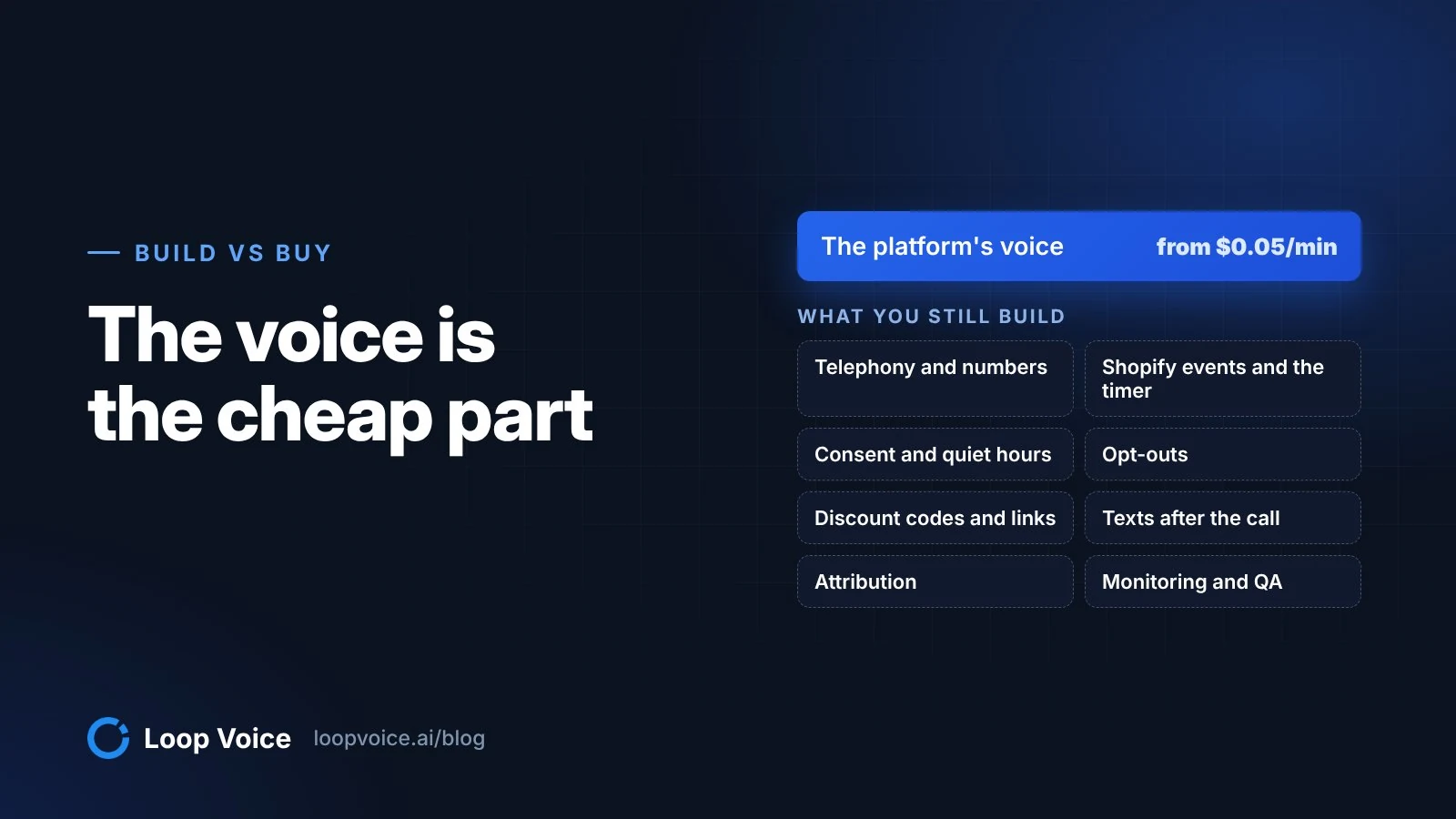
Self-hosting pays off when someone on your team will own the stack after launch, or when your data rules leave no other option. If neither is true, a hosted product usually costs less once engineering time is counted, and our build-or-buy breakdown shows where that time goes.
Online stores are the clearest case. A store that wants calls to shoppers who abandon checkout, or a support line answered at night, rarely needs the source code; it needs store events, texted checkout links, opt-out handling and revenue matched to orders. That is what Loop Voice is built for, as a hosted product on monthly plans whose credits are used only when a customer picks up, with no servers to run, and our 2026 roundup of AI voice agents for Shopify compares it with the other hosted options.
Frequently asked questions
Is Dograh free to self-host?
Yes. Dograh's code is open source under the BSD 2-Clause license, and its pricing page lists the self-hosted edition as the full platform with no limits. You still pay for your servers, your phone carrier and the speech and language models you use. A fresh install uses Dograh's own model stack, which is billed through a Dograh Cloud account, unless you switch to your own providers or local models.
Can a self-hosted voice agent run without any outside API?
Yes, if speech-to-text, the language model and text-to-speech all run on your own hardware, for example faster-whisper, an open-weight model served with vLLM or Ollama, and Kokoro for the voice. Calls still reach you through a phone carrier or SIP trunk. Expect to buy GPUs sized for your busiest hour and to spend time on latency and language quality.
What is the difference between Pipecat and LiveKit Agents?
Both are open-source frameworks for engineers. Pipecat is a Python library with the widest list of model integrations, and you run and dispatch the bot processes yourself. LiveKit Agents runs agents as participants in rooms on LiveKit's own open-source WebRTC media server, with a separate SIP service for phone calls, which suits high concurrency and mixed voice, video and web clients.
Can Loop Voice be self-hosted?
No. Loop Voice is a hosted AI voice agent for online stores, so there are no servers for you to run. Its security page lists its subprocessors with their regions, a data processing agreement is available on request, and recordings and transcripts are kept for 7 days by default.
Sources
- Dograh (Dograh, 2026)
- Dograh on GitHub (GitHub, 2026)
- Dograh deployment overview (Dograh Docs, 2026)
- Dograh pricing (Dograh, 2026)
- Dograh language model configuration (Dograh Docs, 2026)
- Dograh API keys and Dograh models (Dograh Docs, 2026)
- Pipecat deployment overview (Pipecat Docs, 2026)
- Pipecat on GitHub (GitHub, 2026)
- Pipecat Cloud pricing (Daily, 2026)
- Deepgram is acquiring Daily and establishing an independent Pipecat Foundation (Daily, 2026)
- Self-hosting LiveKit (LiveKit Docs, 2026)
- LiveKit pricing (LiveKit, 2026)
- jambonz overview (jambonz Docs, 2026)
- jambonz self-hosting licenses (jambonz, 2026)
- Bolna on GitHub (GitHub, 2026)
- TEN Framework on GitHub (GitHub, 2026)
- AVA AI Voice Agent for Asterisk on GitHub (GitHub, 2026)
- Unmute on GitHub (Kyutai, 2026)
- Rasa documentation (Rasa, 2026)
- vocode on PyPI (PyPI, 2026)
- XTTS-v2 model card (Hugging Face, 2026)
- Piper (maintained repository) (GitHub, 2026)
Hear it before you decide
Listen to real recovery calls, or see Loop Voice call a test checkout on your own store.