
Black Friday Customer Service: How to Handle the Phone Surge
Plan for about double your normal contact volume, with where-is-my-order questions taking the biggest share. Load the holiday answers first, let an AI agent take the routine calls, and staff the exceptions.

What to expect, and who should answer what
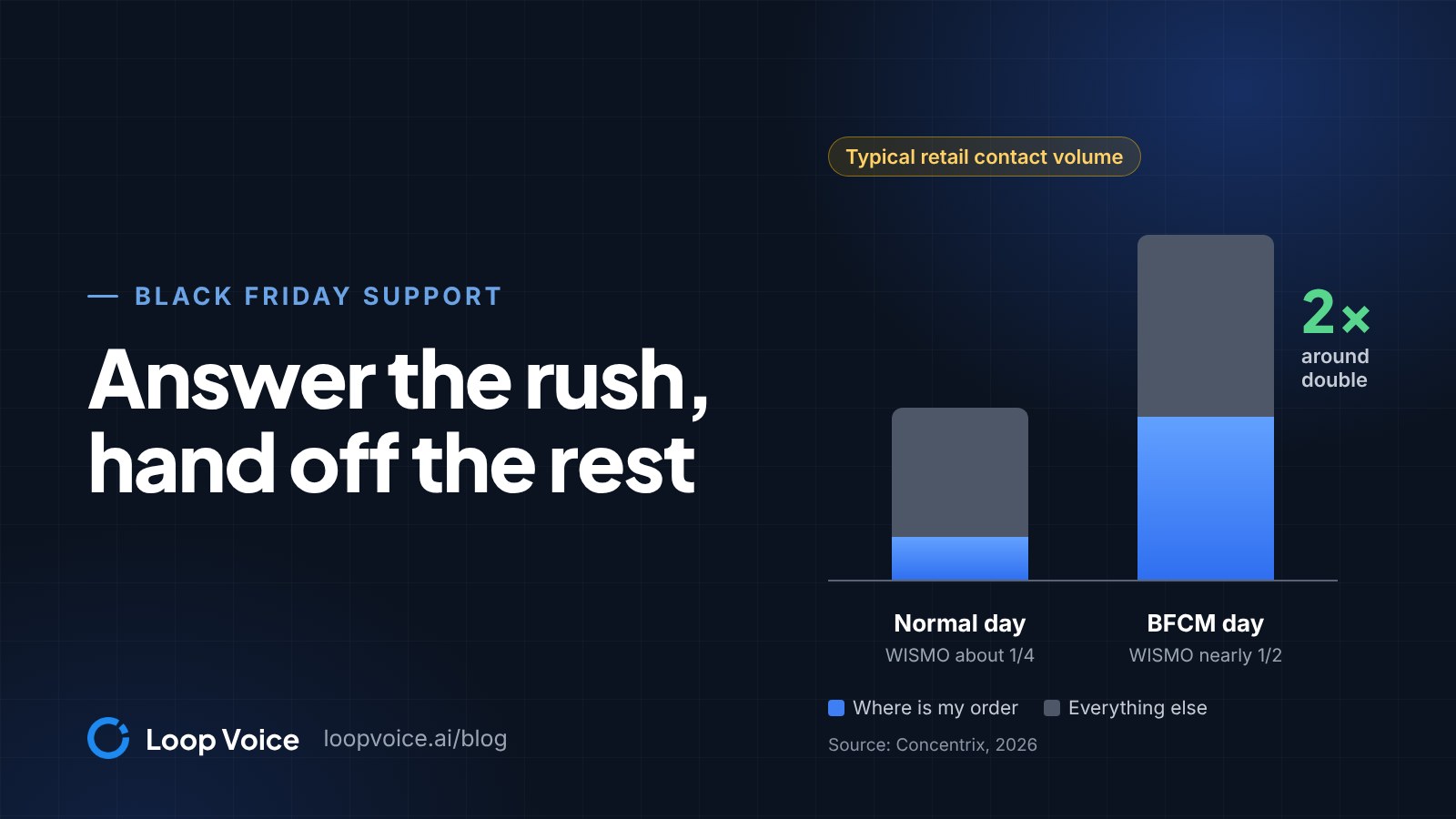
Plan for about double your normal customer service volume over Black Friday and Cyber Monday, with where-is-my-order questions making up a much bigger share than usual. Concentrix, which runs contact centers for retailers, says BFCM contact volumes typically rise to around double normal levels, peaks of three to five times are not unusual, and where-is-my-order contacts can climb from roughly a quarter of volume to nearly half (Concentrix).
Shoppers also ask more before they buy. Gorgias measured pre-purchase questions running about 51% heavier per day during BFCM 2025 than in September and October, with brand policy questions up about 73% (Gorgias). Many arrive when nobody is at a desk: at the median brand Gorgias studied, 53% of pre-purchase questions and about 51% of support questions came in outside weekdays 9 a.m. to 6 p.m., one in five on a weekend (Gorgias). Those figures cover chat, email and contact forms, not phone calls.
Split the calls before the week starts:
| Calls | Who answers | What it needs |
|---|---|---|
| Where is my order | AI agent | Order status from your store data |
| Will it arrive by December 25 | AI agent | Your shipping cutoffs in the knowledge base |
| Sale terms, exclusions, codes | AI agent | A sale terms page, re-crawled |
| Returns and exchanges inside policy | AI agent | Your holiday return policy |
| Sizing and product questions | AI agent | Your catalog and product pages |
| Damaged, wrong or missing items | Your team, as a ticket | The order and the recording |
| Refunds outside policy, price differences | Your team, as a ticket | The AI summary and the order |
| "Can I talk to a person?" | Your team, as a ticket | The summary, so nobody starts over |
Load the holiday answers before November 20
The agent answers from its knowledge base: your site pages, policies and FAQ, crawled, your catalog, synced, and any PDF, DOC or text file you upload (features). Many BFCM calls are about rules that only exist for the season, so write them down first:
- Sale terms. Start and end times with the time zone, what is excluded, whether codes stack, and the free-shipping threshold.
- Shipping cutoffs. The last order date for delivery before December 25 for each method you offer. USPS recommends sending by December 17 for Ground Advantage, December 18 for Priority Mail and December 19 for Priority Mail Express in the lower 48 states (USPS). UPS publishes its year-end schedule by service (UPS holiday schedule).
- Holiday returns. If you extend the return window for gifts, the exact dates, and how gift returns and exchanges work.
- Order changes. How long a customer has to change an address or cancel after ordering, and what happens after the order ships.
- Price changes. What you do when someone bought days before the sale price started.
Then check it. The knowledge base scores how ready it is to answer and lists answer gaps: real questions from live calls that found nothing, over 7, 30 or 90 days. Use the retrieval test with the questions your team heard last November, such as "Will this arrive by Christmas if I order today?", and fix any page that returns the wrong passage.
Decide when the agent picks up
Loop Voice's inbound agent picks up calls 24/7, with the same objectives, guardrails and knowledge base as your outbound agents (customer support use case). A shopper your recovery agent called this week reaches the same agent when they call back. Pick the coverage by how your phones are staffed today:
- Your team covers the phones in the day: forward your store line to the agent's number in the evenings, overnight and at weekends, when more than half of chat and email questions arrived at the median brand Gorgias studied.
- Nobody owns the phone today: let the agent answer every call for the week, inside the scope in the table above.
- Your team answers, but queues build at peak: most phone systems can forward calls that ring out; point that rule at the agent's number.
AI agents already carry part of the load. During Cyber Week 2025, customer service conversations handled by AI agents on Salesforce rose 55% week over week, and agent actions such as updating delivery addresses and starting returns rose 70% (Salesforce).
Write the handoff rules for the busiest week
Handoffs are where a busy week goes wrong. When the agent cannot resolve something, a ticket is created with the AI summary, the order and the recording attached, in Loop Voice and also in Gorgias, Zendesk, Redo or by SMS. Built-in rules stop or escalate on negative sentiment, a do-not-contact request, complex refunds, and legal or medical questions. Add the BFCM ones on top:
- The caller asks for a person. Hand off at once, and have the agent say when your team will reply, in hours, not "soon".
- Damaged, wrong or missing items. Capture what arrived and what was expected, then hand off with the order.
- Address changes or cancellations after the order ships. Hand off; a person checks whether the parcel can still be stopped.
- Refunds outside policy and price-difference requests. The agent neither approves nor refuses; a person decides.
- A delivery that missed a promised date. Hand off with the order, so the person can offer the remedy you allow.
Then staff the ticket queue, not the phone. Example: a store that takes 150 calls on a normal day plans for 300 a day over the weekend. If the agent resolves 7 in 10 and hands off the rest, the team works 90 tickets a day, each with the summary, the order and the recording already attached.
Our support setup guide has the full escalation list and the helpdesk routing for the rest of the year.
Test it with last year's hardest calls
Run the simulator before the week. It plays six personas against the agent, including an angry customer, a rushed customer and someone suspicious of AI, up to ten conversations per run, and nothing is dialed or charged. Write BFCM scenarios from your own ticket history:
| Scenario | Pass if the agent |
|---|---|
| "Where is my order?" placed on Black Friday, not shipped yet | Gives the status from the order without guessing a date |
| "Will it arrive by Christmas if I order today?" | Quotes your cutoff for that shipping method, not a general promise |
| "My Black Friday code won't work" | Checks the sale terms, and hands off with the details if the code should work |
| "I bought it last week. Can I get the sale price?" | Follows your price-change policy, or hands off without promising |
| "Can I return a gift?" | Explains the holiday return window and the steps |
| "Are you a robot?" | Says plainly that it is an AI assistant, with the guardrail for clear identity as an AI on |
Then call the line yourself from a phone your store has never seen, and make one call that ends in a handoff to check the ticket arrives with the summary, the order and the recording.
Pre-purchase calls are the ones to protect
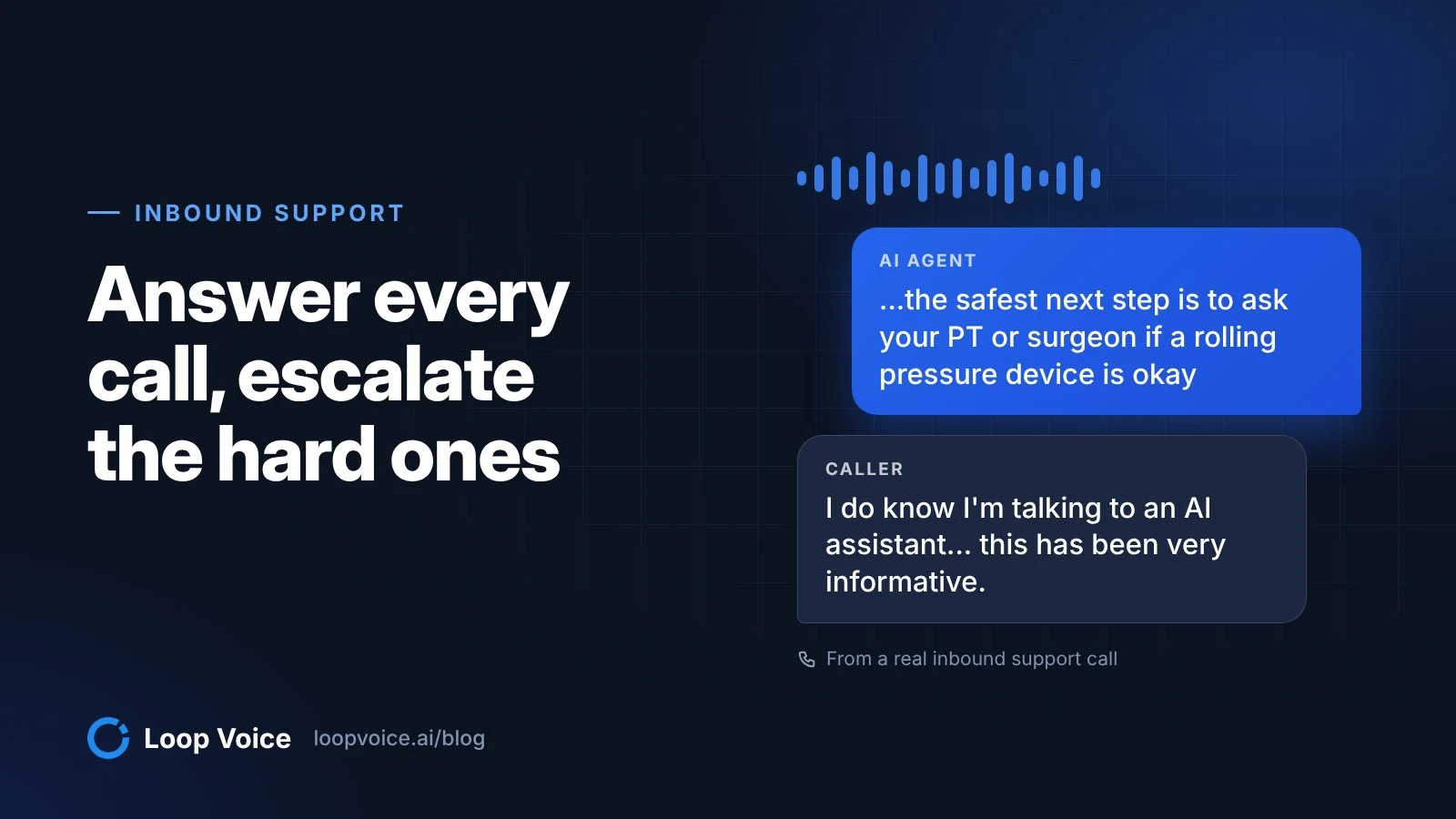
A sale week brings questions from people who have not bought yet, and those calls are revenue. This one came in to a health device brand from a caller asking whether a product was safe for him after knee surgery:
I hear you. If you haven't been cleared yet, I don't want to steer you into using strong pressure around a postsurgical knee on your own. At nine months out, the safest next step is to ask your PT or surgeon if a rolling pressure device is okay for your calf and behind the knee. And if so, what intensity to start at and what areas to avoid? Our safety guidance specifically calls out recent surgery as a don't use category without medical sign off. And I can't override that on a call. If they do clear you, core is usually the better starting point for rehab style use since it tops out lower at eighteen pounds. And you can always keep it light. Max is mainly for people who already know they want very strong pressure. Do you want me to tell you exactly where on [the store's website] the safety pages so you can show it to your PT?
Uh, that's okay. I already found it. I'm here on the web now perusing through, and that's, uh, really what caught my attention. But, Alex, I do thank you for your time today. You've been gracious and kind, and, uh, I do know I'm talking to an AI assistant. But just for those people in the background and for the quality assurance people who are listening, uh, this has been very informative. And, uh, I'll do that. I'll take your recommendation. I will speak to my PTs. I'll speak to my doctor, the surgeon, and find out what it is they recommend, and I'm gonna tell them about [the store]. And then I'm gonna show them the website and see what they tell. But as far as for, you know, the information Huntout was on today, uh, it was a home run. You landed. You did a great job. Thank you.
The agent quoted the store's safety guidance, pointed him to his physical therapist or surgeon, and did not push a sale. He said he knew he was talking to an AI assistant and still called the conversation "very informative." Put your safety pages and product limits in the knowledge base before the week, and the agent can hold the same line at 11 p.m. on Black Friday. More real calls are in the call library.
What it costs next to seasonal staff
Loop Voice costs about $0.95 to $1.49 per answered conversation on monthly plans, depending on the plan (pricing). A US customer service rep costs about $31.36 an hour with benefits; our cost comparison works through the math.
Seasonal hires still make sense for what the agent hands off: damaged items, refunds and the calls that need judgment. To compare AI phone agents for the routine calls, see the best AI phone agents for Shopify customer service.
After Cyber Monday: the next two waves
The surge does not end on Cyber Monday. Concentrix describes a second wave of delivery and tracking questions in the run-up to Christmas, and a third in January, driven by returns and post-Christmas sales.
Update the agent twice more: around December 15 with the last shipping dates and what you can still promise, and after December 25 with gift returns. Each week, read the answer gaps and the handoff reasons; a cluster of the same reason usually means a missing page or policy.
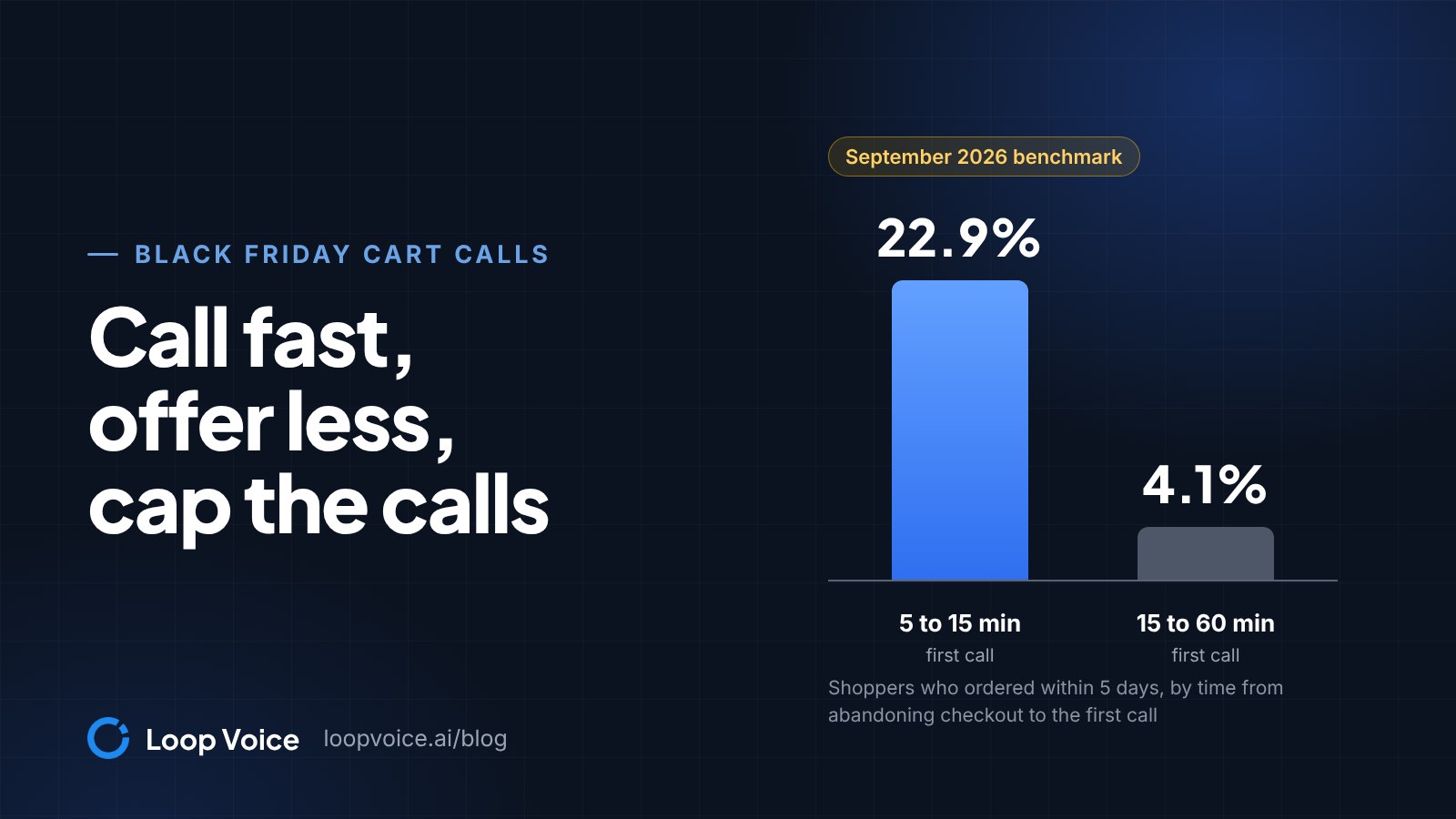
If you also call shoppers who abandon checkout during the sale, the Black Friday cart calls plan covers timing, offers, caps and credits for the week.
Frequently asked questions
How much does customer service volume rise on Black Friday?
Concentrix, which runs contact centers for retailers, says BFCM contact volumes typically rise to around double normal levels, with peaks of three to five times not unusual. Where-is-my-order contacts can climb from roughly a quarter of volume to nearly half.
Can an AI phone agent answer where-is-my-order calls during Black Friday?
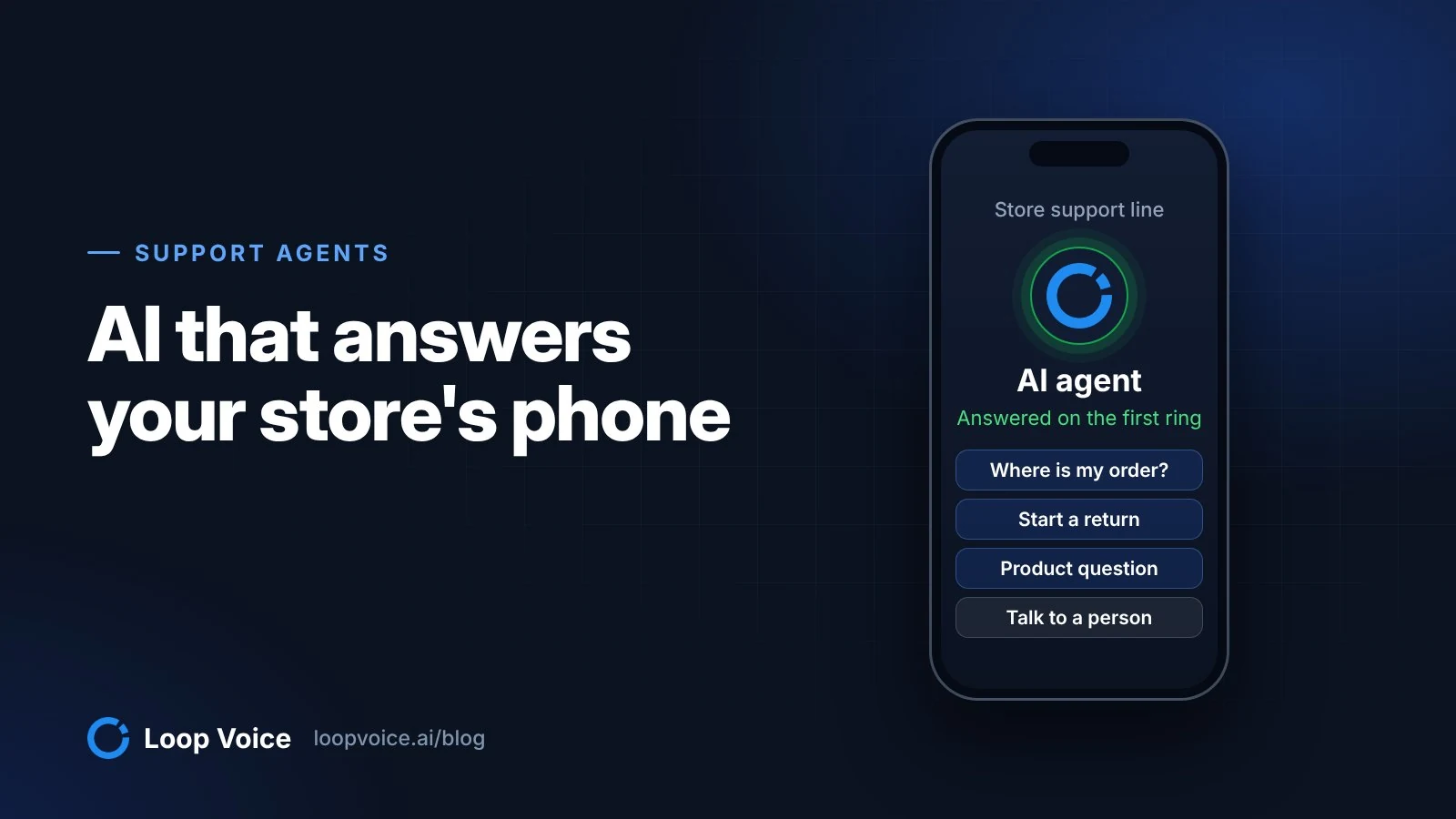
Yes. Loop Voice's inbound agent handles order status, returns and exchanges, sizing, shipping and subscription changes from your store data and knowledge base. Calls it cannot resolve become a ticket with the AI summary, the order and the recording attached.
Should an AI agent answer every call during BFCM or only after hours?
It depends on who covers your phones today. If your team answers in the day, forward the store line to the agent in the evenings, overnight and at weekends. If nobody owns the phone, let the agent answer every call for the week, with a narrow scope.
What should a store add to its knowledge base before Black Friday?
The sale terms, the last order dates for delivery before December 25 by shipping method, the holiday return window, how long customers have to change or cancel an order, and what you do about price differences. Then run the retrieval test with real questions from last year.
What happens when a Black Friday caller asks for a person?
The agent hands off at once: a ticket opens with the AI summary, the order and the recording attached, in Loop Voice and in Gorgias, Zendesk or Redo if you use them. Have the agent tell the caller when your team will reply, in hours.
When do holiday shipping questions peak?
After Cyber Monday, in the run-up to Christmas. USPS recommends sending by December 17 for Ground Advantage and December 18 for Priority Mail for delivery before December 25 in the lower 48 states, so load those dates before the questions arrive.
Sources
- What really happens to contact volumes during Black Friday? (Concentrix, 2026)
- BFCM's fastest-growing question is also its best-converting one (Gorgias, 2026)
- Your team is sleeping on 53% of shopper questions (Gorgias, 2026)
- Salesforce Data: AI and Agents Propel Cyber Week to Record $336.6B in Global Spend (Salesforce, 2025)
- Postal Service Recommends 2026 Holiday Mailing and Shipping Dates (USPS, 2026)
- UPS holiday schedule (UPS, 2026)
Hear it before you decide
Listen to real recovery calls, or see Loop Voice call a test checkout on your own store.